China issues white paper on democratic reform, achievements in Tibet









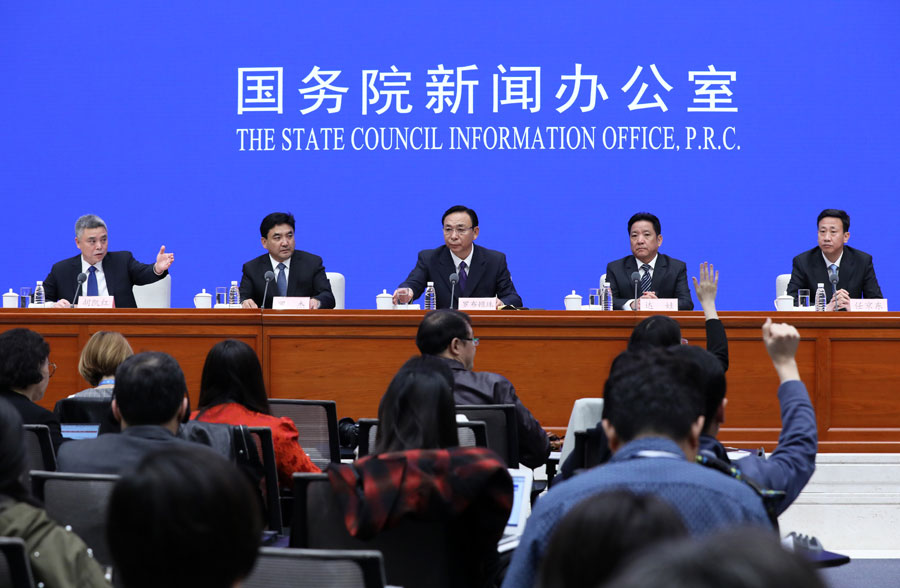
BEIJING -- China's State Council Information Office on Wednesday issued a white paper on democratic reform and the leap of development in Tibet over the past six decades.
The white paper, titled "Democratic Reform in Tibet -- Sixty Years On," lauded the democratic reform as "the greatest and most profound social transformation in the history of Tibet."
"By abolishing serfdom, a grim and backward feudal system, Tibet was able to establish a new social system that liberated the people and made them the masters of the nation and society, thus ensuring their rights in all matters," the document said.
The year 2019 marks the 60th anniversary of the campaign of democratic reform in Tibet.
These 60 years have changed Tibet completely, turning the region into a beautiful home to the local people, seeing their solidarity and enterprising spirit and a great leap of social progress, it said.
The leap of Tibet's development fully demonstrates that its democratic reform conformed to the historical trend of the times and the fundamental aspirations of all ethnic groups in Tibet, and met the people's real demand for social progress.
Since democratic reform, the people of all ethnic groups in Tibet have become the masters of the country. It has been deeply rooted in the people's minds that they must remain committed to the leadership of the Communist Party of China (CPC), the socialist road, and the system of regional ethnic autonomy, the document stressed.
"For many years, however, the old Tibetan forces represented by the Dalai Lama have attempted to deny the achievements of democratic reform and development in Tibet, for the sake of their political interests and out of a hankering for the dark and backward days of feudal serfdom," the document said. "They disregard facts, and attempt to reverse the tide of history in opposition to the interests of human civilization."
Under the guidance of Xi Jinping Thought on Socialism with Chinese Characteristics for a New Era, the people of all ethnic groups in Tibet are working together with the whole country to create a better life and achieve the great rejuvenation of the Chinese nation, it noted.
"With steady progress being made towards socialism with Chinese characteristics for a new era, Tibet is bound to have an even brighter future," the document said.
Besides a preamble and a conclusion, the white paper consisted of ten sections, "Feudal Serfdom: A Dark History," "Irresistible Historical Trend," "Abolishing Feudal Serfdom," "The People Have Become Masters of Their Own Affairs," "Liberating and Developing the Productive Forces," "Promoting a Range of Undertakings," "Enhancing Ecological Progress," "Protecting the Freedom of Religious Belief," "Strengthening Ethnic Equality and Unity," and "Development of Tibet in the New Era."
MASTERS OF THEIR OWN
Through democratic reform, feudal serfdom under theocracy in Tibet was abolished completely, with about 1 million serfs liberated.
From Sept. 1 to 9, 1965, the First Session of the First People's Congress of Tibet was held. At this session, Tibet Autonomous Region was established, and the People's Committee of the autonomous region came into being by election.
The people in Tibet can, in accordance with the law, directly elect deputies to the people's congresses at county (district) and township (town) levels, and these elected deputies will then elect deputies to the people's congresses at the autonomous regional and national levels.
Currently, there are 35,963 deputies to the people's congresses at all levels in Tibet. Among them, deputies from the Tibetan and other minority ethnic groups account for 92.18 percent.






- National Games vibe is everywhere in Guangzhou
- Forum unites global experts to enhance city image communication
- Miao New Year celebrations get underway in Guizhou's Leishan county
- Mainland spokesman reiterates stand on Taiwan
- Fujian county's rural development becomes a big draw for Taiwan investors
- Nobel laureate in chemistry: Give young scientists more independence