US exclusion of academics 'shortsighted'









Visiting scholars say officials treated them in 'unfriendly and offensive' way
Following a recent report saying that the United States canceled Chinese scholars' visas or placed them under administrative review by the FBI, experts warned that Washington's ramping up measures to treat China as a rival could significantly harm normal bilateral exchanges and damage the country's open and inclusive national image.
According to a New York Times report on Sunday, the US intelligence and security service has mounted a "counterintelligence operation" aimed at barring Chinese academics from visiting the US if they are "suspected of having links to Chinese intelligence agencies".
The report said the number of affected Chinese scholars in the social sciences and among heads of academic institutes and experts "who help explain government policies" reached 30 in 2018, citing Chinese scholars and their US counterparts.
Wang Wen, executive dean of the Chongyang Institute for Financial Studies, a think tank at Renmin University of China, said his 10-year B1/B2 visa was canceled via an email in February.
The cancellation came after he attended a symposium in January at the Carter Center in Atlanta, Georgia, marking the 40th anniversary of China-US diplomatic ties. After he returned to China, he received an email from the US embassy, informing him his visa was canceled without saying why. It did say he could apply for a new visa.
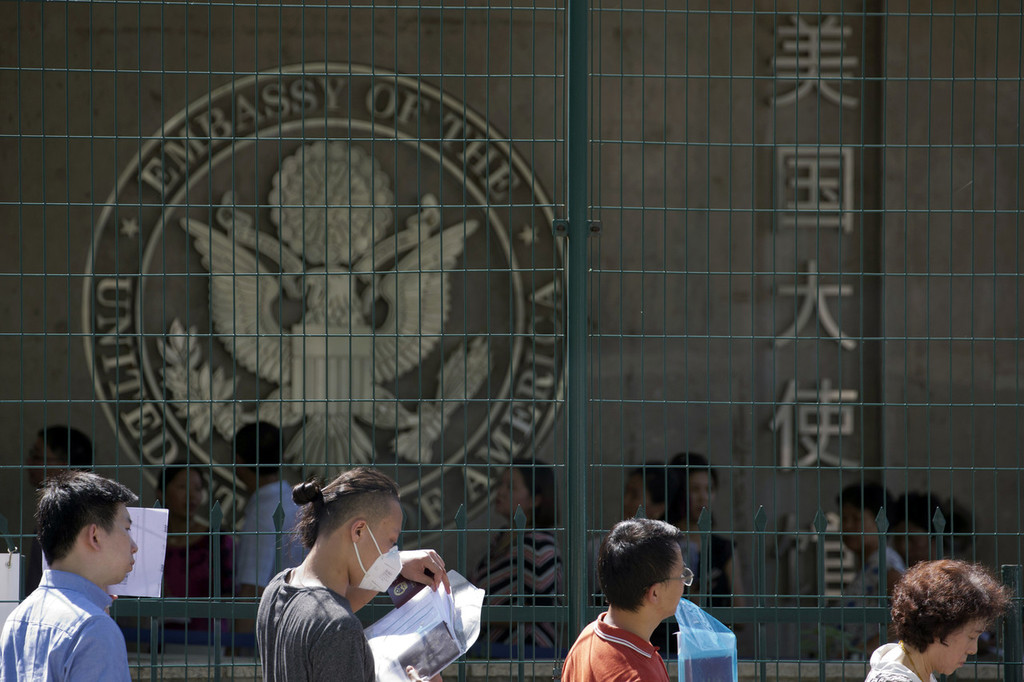
When Wang went to the embassy to get a new visa: "They kept asking me questions like whether I visited the US to obtain intelligence information or technology. I said no, and they kept my passport."
Days after, Wang received another email from the embassy telling him to provide extra information, including his travel record for the past 15 years, his family members' information, social media accounts, bank accounts and some other personal information, "for no reason, again", he said.
As a scholar in international relations, Wang had visited the US about 60 times for academic exchanges in the past decade, but he said the embassy's requests are "intrusive and unreasonable" and that he'll choose not to travel to the US, at least for the next few years.
"It's regrettable that the US treats academics like me in such an unfriendly and offensive manner," Wang said, adding that Washington's decision shows that the country has become an "oversensitive and paranoid one which has a lack of confidence in dealing with diplomatic relations".
A number of Chinese social scientists have had similar experiences when their US visas were revoked.
Zhu Feng, executive director of the China Center for Collaborative Studies of the South China Sea at Nanjing University, told the Global Times newspaper in Beijing that his 10-year US visa was crossed out by FBI agents, canceling it, when he was about to board a flight back to Beijing at Los Angeles International Airport in March 2018.
Zhu said the FBI first threatened to revoke his visa if he did not cooperate with their inquiry.
"'Go back to China',"
Zhu recalled an agent telling him during that visit. "You will receive a notification."
As a prominent expert on China-US studies for decades, Zhu also was twice denied single-entry visas to the US.
"This shows how the US is trying to block normal social exchanges between the two countries, an important channel for mutual understanding and trust," Zhu said.
Besides scholars in social sciences, the US also began last year to make it harder for Chinese graduate students to get visas if they study in "sensitive research fields". It warned biomedical researchers at US universities to beware of "Chinese spies trying to steal information from their laboratories", according to The New York Times report.
Jon Taylor, a professor of political science of the University of St. Thomas in Houston, said the decision is "both absurd and exceedingly shortsighted".
"These scholars and researchers are social scientists with a long history of interacting with their American counterparts as well policymakers in both countries," he said.
"They are scholars teaching and researching what I teach and research. What are they going to steal?"
Taylor said the US will ultimately "pay the price for this", in the form of an incomplete and inaccurate understanding of China by barring scholars who have great familiarity with US politics and policymaking and have the ear of Chinese officials.
Douglas H. Paal, vice-president of the Asia Program at the Carnegie Endowment for International Peace, said it appears that the scholars who best understand the US and communicate well with China's leaders are being denied visas or threatened with denial.
"I don't see how this is in America's interest," Paal said.
Some US media have mentioned that China also denies visas to US academics, but Taylor and Paal said that has not been their experience when applying for Chinese visas to visit China for academic exchanges.
In a news conference on Thursday, when asked if China rejected a visa application from an adviser to US President Donald Trump, Foreign Ministry spokesman Lu Kang said Chinese embassies and consulates overseas always handle visa applications according to law.
China welcomes cultural exchanges between China and the US and will actively promote mutual understanding between the two countries, Lu said.
Wang, the Chinese think tank member, said many of the international relations scholars of his generation think of the US as an example of the value of "freedom, democracy, fairness and human rights".
"But those words are no longer applicable to describe the US today," he said.
Wang said that for him, cancellation of the visa is nothing more than a short-term absence from US academic activities, and "it is the US' loss, not ours".
He also said the decision would not affect the Chinese think tank he leads in continuing academic exchanges with the US, and he suggests that China should not take countermeasures over such matters.
"No matter how petty the US becomes, China should still stick to its open attitude rather compete for who's worse," he said.
Contact the writers at panmengqi@chinadaily.com.cn