


An ancient thoroughfare sleeps below the soil









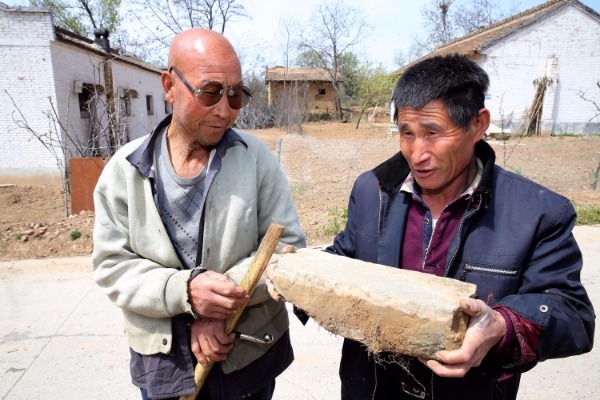
Noble's Belt
"Senior villagers call the dirt path 'the Noble's Belt' or 'the Emperor's Route'," Xing said. "It is probably part of the old Qinzhidao, which has been lost for a long time."
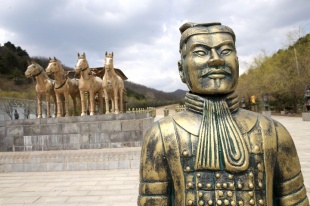
To locals, the Qinzhidao, or "Straight Road" of the Qin Dynasty (221-206 BC), is a legendary engineering wonder, equal to the Great Wall and the Terracotta Warriors. Yet unlike those relics, which have long been regarded as symbols of China and listed as part of world's cultural heritage by UNESCO, most sections of the Qinzhidao are forgotten, buried in wild grass.
The annals of Sima Qian, a historian of the early Han Dynasty (206 BC-220) who traveled the Straight Road, are the earliest and most detailed records of the road, and they are still consulted by most researchers of this magnificent project.
According to Sima Qian, the road stretches about 800 kilometers north from Liangwudi village in Chunhua county, Shaanxi, to Baotou in the Inner Mongolia autonomous region.
Qin Shihuang, who founded the Qin Dynasty after conquering six other major kingdoms, ordered General Meng Tian to build a road connecting the Guanzhong Plain - the Qin's heartland - with the Great Wall in the north.
Although it should have been a time to give the people a period of rest after years of war, the Qin rulers forced them to undertake grand projects, including building a road network of 6,437 kilometers within a short time, among which the Qinzhidao was the most important.
The highway was intended to facilitate the transportation of soldiers and provisions to the borders of the nomadic peoples, and also to make the emperor's inspection tours of the dangerous north more convenient.
Leading 300,000 of Qin's best troops, Meng started work on the project, supervised by Fu Su, the emperor's oldest son. However, the work only lasted about two years after Qin Shihuang's sudden death in 210 BC prompted a palace coup.
Meng and Fu were purged and both died in 210 BC. They were buried in Suide county, Shaanxi, not far from the road, where they were honored by local people.
Ironically, the only time Qin Shihuang used the road was when his body was transported back to Xianyang, the Qin capital. The dynasty was overthrown by a peasant uprising a few years later.
"It is no surprise that many of Qin's grand projects, which were built to promote lasting peace and the stability of the Qin (Dynasty), expedited its collapse," said Zhang Xiaobing, a professor of history at Yan'an University in Shaanxi.
Zhang conceded that his opinion echoes that expressed by Sima Qian in his annals after he visited the Qinzhidao with the seventh emperor of the Han Dynasty in 110 BC.
"The Qin rulers' desire for greatness and success left so many engineering wonders for future generations, but it also doomed them," he said.
Work on the Straight Road was largely suspended, though its main parts were completed, leaving an even road with an average width of about 50 meters, with dozens of courier stations, passes and fortresses built along its length, most of which are ruins today.