Green routes to high-quality development









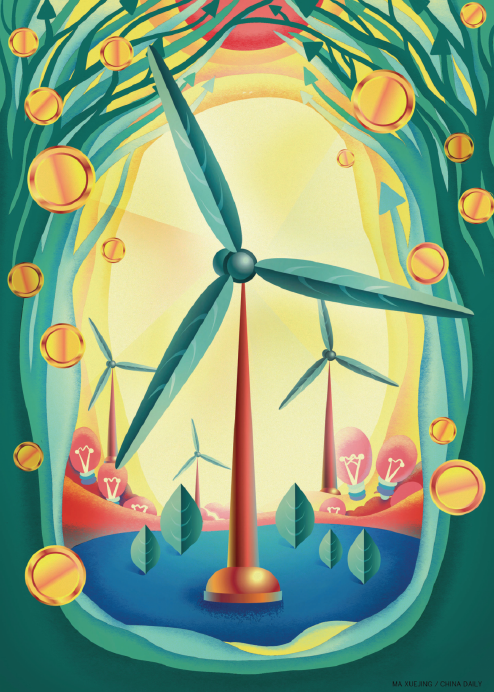
According to a report by the Global Development Policy Center's Global China Initiative at Boston University, China's investments in power generation have been "more green than black" over the past few years.
Over 50 percent of the country's investments in power generation projects around the world are related to clean energy that has water, wind or the sun as the main source, the report said.
The total investment in energy projects in BRI-related countries and regions has reached $186.3 billion. Of this, the clean energy sector accounts for 26 percent.
In Chile, South America, the first batch of 100 Chinese-made electric buses of BYD, which offer quiet, smooth, quick and green rides, are being inducted into the local public transport fleet.
Chilean President Sebastian Pinera said the nation hopes to cooperate with Chinese companies like BYD in clean energy. Chile boasts solar, wind and tidal energy resources and is in need of such projects that can exploit them, he said.
KPMG's Wong allayed fears that the BRI may gradually morph into a vehicle that transports pollution from China to other countries. "China's green BRI proves that the concept of production capacity cooperation does not really mean shifting industry that may be highly polluting and a big consumer of energy, from China to BRI countries.
"Instead, China is sharing advanced technologies and industry expertise to benefit BRI countries, helping them develop the local industry, and enabling sustainable growth."
Besides technologies and expertise, effective financing is crucial for green development. The Asian Development Bank estimated that Asia would need $1.7 trillion of infrastructure investment annually between 2016 and 2030.
So, China has led the path of green finance by encouraging flow of capital into more sustainable projects. It helped found the Silk Road Fund in December 2014 to offer investment and financing support for trade and economic activities within the framework of the BRI.
The Chinese government contributed $40 billion to the fund and added 100 billion yuan ($14.5 billion) in 2017. By the end of last year, the fund had pledged to back 28 projects entailing investments of over $11 billion.
At the WEF's Dalian event, Sun Chanthol, Cambodia's minister of public works and transport, acknowledged the significance of this move. "It was not easy for most developing countries to get financing for road and railway construction, yet China-led BRI, including the Silk Road Fund, has offered a (helping) hand."
Such help enabled Cambodia to build its first high-speed railway, which is expected to reduce air pollution and congestion as well as promote economic prosperity, he said.
Another shining example of development-oriented finance is green bonds. When the World Bank issued the first-ever green bond over 10 years ago, it was a novelty that raised tens of millions of dollars. But by mid-2018, the world had $1.45 trillion of climate-aligned bonds outstanding.
"China has been leading the region's shift toward financing with green bonds … and has been at the forefront of using green bonds to finance sustainable development," said Rajiv Biswas, Asia-Pacific chief economist at IHS Markit, in an article published in China Daily.
In 2016, China officially launched its green bond market and issued labeled green bonds worth 205.2 billion yuan.
China was also the first country to make it compulsory for all listed firms and bond issuers to disclose the environmental, social and governance risks associated with their operations by 2020.
Several large Chinese banks, including Industrial and Commercial Bank of China Ltd, Bank of China Ltd and China Development Bank Corp, have issued climate bonds.
This April, ICBC also issued its first green bond focusing on Belt and Road interbank cooperation. Offered in three currencies, the bond aims to support the development of green projects under the BRI and boost interbank cooperation in the region.
Media reported that China is by far the largest issuer of green bonds among the world's emerging markets. Internationally aligned green bond issuance from China reached $31.2 billion in 2018, accounting for 18 percent of global issuance, said a report published by the Climate Bonds Initiative and China Central Depository& Clearing Co Ltd.