


Ethnic dance captivates Tujia people for five centuries










Baishou Dance, a 500-year-old ethnic dance, is well preserved in villages in central China.
The dance uses 70 rituals and originated in the Youshui river area where Chongqing municipality and Central China's Hubei and Hunan provinces meet. It is particularly popular in Laifeng county in Hubei, Youyang county in Chongqing and Longshan county in Hunan.
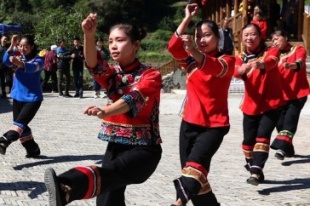
Baishou Dance can be performed by a varying number of dancers, from dozens to more than 10,000 people simultaneously. The dance reflects the group's production, real lives and their joy in the harvest. Movements are mainly evolved from their everyday work and lives, and by imitating animals. Among the animal-like actions are chasing monkeys, the way a toad jumps, an eagle hawk flapping its wings, a rhinoceros watching the moon and the way a pheasant drags its tail. The movements also mimic farming activities, including digging soil, sowing seeds, spinning cotton and transplanting rice seedlings.
The music of Baishou Dance is very distinctive and is typical to the Tujia ethnic group in style and features. When Baishou Dance is performed, a Baishou song will be sung in the Tujia dialect by dancers and onlookers who wear ethnic costumes. They are accompanied by the beating of gongs and drums and a performance on the suona, a type of woodwind, and other Tujia musical instruments.
Baishou Dance integrates the dancing arts and sports fitness and is dubbed, "oriental disco". Baishou Dance is usually performed by Tujia people at night when bonfires have been lit.
In Laifeng county of Central China's Hubei province, Tujia people there perform the most traditional baishou dance. They play it during important festivals, such as Lunar New Year.
The Tujia people start performing Baishou Dance on the third day of Lunar New Year and it will not end until the 17thday on the lunar calendar.
But dress rehearsals for the festival celebration usually start in Tujia villages after Jan 1 every year.
When night arrives and bonfires are lit, many local villagers carry bull's heads, cooked meats, rice wine and other offerings to worship their ancestors before they blow horns and suonas, and light lanterns and torches to start the Baishou Dance in front their villages' ancestral halls.
In Shemihu village, 20 kilometers from Laifeng county's Baifusi township, a 400-year-old Baishou Dance performance ground is still well preserved, and the special ground is said to be the birthplace of Baishou Dance.
The ground is in front of the village's clan hall that is usually a place for local villagers to spend their leisure time by day, and is surrounded by stone walls on all four sides, with a gate resembling an archway.
A villager surnamed Peng said the village now has 70 households of more than 600 residents.
"And all the villagers are Tujia nationality people, with more than 90 percent surnamed Peng," Peng said.
"The villagers have been engaged in farming for generations and their biggest hobby is performing the Baishou Dance," Peng said.
"Baishou Dance is beautiful and easy to learn, and all the people in the village, including the kids who can just walk, can perform the Baishou Dance," Peng said.
Baishou Dance has become a link that helps connect all the people of the village and is passed on from generation to generation, Peng said.
"It has also become the common perseverance and memory of generations in the tiny village," Peng added.