How developing world will end Silicon Valley's dominance









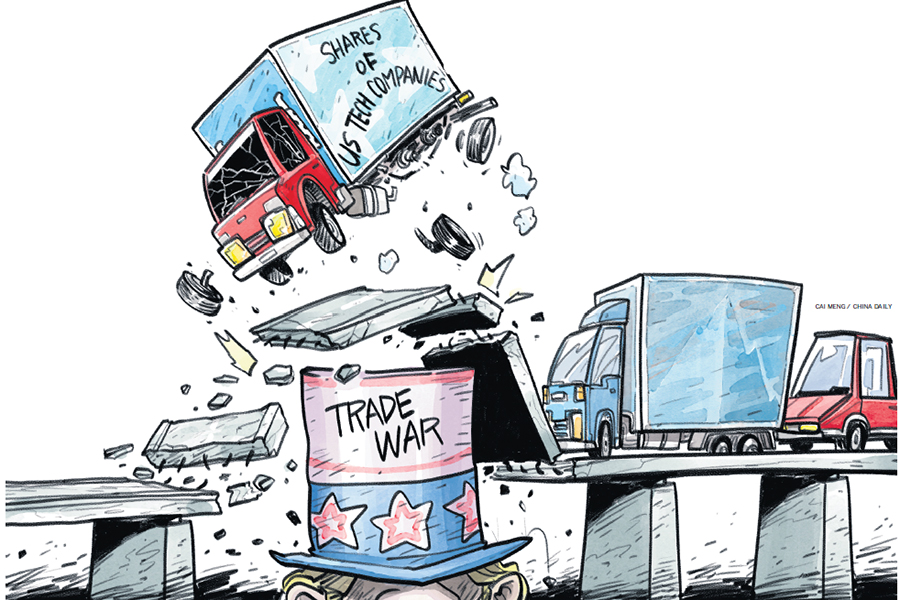
Immediately after the US announced that it was raising tariffs on an additional $300 billion worth of Chinese products on Aug 1, the US stock market tanked. By Aug 5, the Dow Jones Industrial Average had fallen 3.3 percent and the S&P 500 index had fallen 3.7 percent.
The hit on tech stocks was even sharper. Their fall was obviously triggered by the trade war, but also reflects fundamental underlying weaknesses in US tech companies.
Apple's share price fell almost 8 percent from Aug 1 to the market close on Aug 5. In the same period, Facebook fell 6.5 percent, Alphabet (Google's holding company) 5.5 percent, Amazon 5.7 percent, Microsoft 4.2 percent, and Netflix 4.2 percent.
Since then, it has been a wild ride. The tech stocks have gone up and down following the on-again off-again announcements about tariffs. At the time of writing this on Aug 19, most of the tech stocks had risen slightly so that the net fall from Aug 1 to Aug 19 was roughly 4 to 5 percent. They remain highly volatile.
Tech companies fell more sharply than the overall economy because of doubts about the continuing sustainability of the high profits they have gained from their monopolistic business models. Over the last five years, the entire rise in value of the US stock markets was caused by stock price rises of the internet-based FAANG companies (Facebook, Apple, Amazon, Netflix and Google) plus Microsoft. So, the drops in these companies are scary for all investors and for the overall economy.
These few big tech companies are sitting on hundreds of billions of dollars cash. In 2017, Moody's calculated that US corporations were holding $1.84 trillion in cash, with more than $500 billion of that held by just Apple, Google, Microsoft, Cisco, and Oracle.
That might seem like a good thing for them, but it's really a sign that they can't think of productive ways to invest all that money.
This portends a future where the big tech companies are no longer driving innovation.
The Santa Clara Valley of northern California, better known as Silicon Valley, was known as the prune-growing capital of America as late as the 1950s, but it has dominated the business of electronic and software development for the last 60 years.
The Code: Silicon Valley and the Remaking of America, a new book by Margaret O'Mara, lays out the history of the region and includes some explanations of how it maintained its lead for so long.
At the end of the book, David Morgenthaler, a leading venture capitalist, is quoted as wondering "whether the future of tech would be in the Valley at all". He explained that it had "reached the outer limit of its S-curve".
Why would Silicon Valley lose its leading role?
First, the most promising future technologies will apply artificial intelligence, robotics and the internet of things to real-world problems in advanced manufacturing, transportation, and healthcare. Any company wanting to master these technologies needs experience in manufacturing as well as in software.
As its name implies, Silicon Valley was once a manufacturing center. Even into the 1980s, many personal computers were manufactured there. But, for the last 30 years or so, the region has concentrated almost exclusively on software, not hardware.
Places like Shenzhen, with lots of manufacturing expertise, are likely to take the lead away from companies whose core expertise is creating phone apps.
Second, Silicon Valley is becoming so monopolistic that it stifles innovation. Until 10-15 years ago, hundreds of small companies there saw opportunities to grow into larger firms. But now Google, Facebook and Apple are so dominant that they either buy potential competitors or devote their overwhelming resources to copying the innovations of the small companies.
For example, Instagram and Whatsapp, appeared to be a possible social media competitors to Facebook - so Facebook just bought them. Snapchat is a potential competitor, so Facebook has copied many of its most innovative features.
Instead of aiming to create an ongoing company, most Silicon Valley entrepreneurs now aspire to being bought out by one of the big guys.
TikTok, called Douyin in China, which is owned by Beijing-based Bytedance, is one of the few possible social media competitors that have survived.
Except in China, the big US firms have used their market power to prevent the growth of similar firms around the world. You don't find competitive search engines or social media platforms in India or Europe, even though both have great software expertise. One exception is that Russia has used antitrust law to prevent Google's search engine from swamping home-grown Yandex.
It is sometimes argued that the tech companies provide services free to users, so they must not be hurting consumers. This argument ignores the fact that the Google/Facebook duopoly controls more than 80 percent of online advertising in the US and an even higher portion in Europe. So, they are able to raise advertising rates above those that would be found in a competitive market - thus raising costs throughout the economy. This control of advertising also makes it impossible for a new search engine or social media website to make enough money to get started.
Amazon's retail business and Netflix have been losing money since they were founded. Their business models are based on relying on investors' capital so they can use low predatory pricing to drive competitors out of business - setting themselves up to take advantage of future monopolistic power.
And, the big tech companies are using their market power for more than just economics. Tulsi Gabbard, a candidate for the Democrat party nomination for president who has frequently criticized Google, is suing the company, alleging that it cut off her online advertising just after she made a big splash in the recent debates.
The US Department of Justice recently began an investigation of monopolistic practices by the tech companies, following similar European Union and Australian investigations. Since antitrust enforcement would reduce the monopolistic profits that have been driving the share prices of the tech companies, the recent falls may also reflect these investigations.
The third reason Silicon Valley's dominance is slipping is that financing used to be more easily available there, but that is changing.
As O'Mara discusses, the major funding source for Silicon Valley companies was contracts from the US Defense Department or NASA until the late 1980s. Without such government support and government-funded R&D, Silicon Valley would never have developed.
After the 1980s, favorable changes in tax laws and financial regulations, allowed the development of specialized venture capital firms that became the critical funding sources.
In the 1990s, more than 90 percent of world venture capital was invested in the US, mostly in Silicon Valley. Throughout 2000-2010, the US still received more than 70 percent of total world VC investments. But the US share fell to less than half starting in 2017.
Europe, India, Israel and others have created venture capital ecosystems and are also increasing government-supported R&D.
The biggest tech rise has been in China. A 2018 paper by INSEAD, the French business school, concluded that China's VC market is likely to overtake that of the US in terms of aggregate deal value in 2019 or 2020. Three drivers are behind this growth - government policies to support entrepreneurship, a flourishing private sector, and market demand, according to INSEAD.
However, Bloomberg reports that Chinese VC has plunged in 2019 as a result of trade uncertainties and high startup valuations.
The final driver ending the dominance of Silicon Valley is that the developing countries will be the largest purchasers of tech going forward. FAANG products have been designed for high-income markets but have found less traction in developing countries. Instead, Chinese hardware and software are growing in India, Africa, and elsewhere. In Africa, for example, local products are often more useful than those coming from the tech giants.
The growth of multiple competing tech centers will be a good thing for the world.