Innovations, apps and ingenuity guide residents toward a smart life









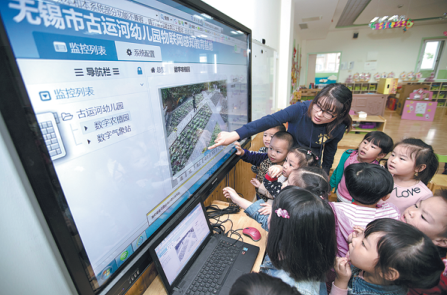
An app that can lead patients to treatment rooms, a camera that notifies police of wanted criminals in public places and a cooling system capable of alerting problems to the manufacturer are all contributing to making the concept of a smart life possible.
And there is no better place to witness these developments than in Wuxi, a national hub of the internet of things sector that has been promoting and developing IoT applications for the past decade.
The State Council approved the Wuxi National Sensor Network Innovation Demonstration Park in 2009, marking the beginning of China's entry into the IoT industry. At that time very few people knew of IoT, but today there are more than 2,000 IoT-related companies in the city.
By 2018, sales from these companies surpassed 263 billion yuan ($37 billion), accounting for almost half of the IoT revenue in Jiangsu province.
Hongshan IoT town, located in the city, is a magnet for those wanting to find out what a smart town of the future might look like. Using the Feifeng platform, backed by leading Chinese tech company Alibaba Group, everything in the town-from medical care, transport to tourism-is smart.
For instance, trash cans will open their lids as people approach, and send an alert to sanitation department when the receptacle is nearing capacity.
Street lamps will automatically adjust their brightness according to what's required, which can help to reduce energy consumption by as much as 40 percent. At major intersections traffic lights can read the situation on the roads and change their timings accordingly to ease congestion.
"If there were no applications there would be no development," said Gao Yaguang, vice-mayor of Wuxi. "In the past 10 years, Wuxi has done its best to promote IoT technology. Today, from the necessities of life to government decision-making and urban governance, there is a brain of the city based on IoT technology."
Giants in the IT field have made their forays into the sector and beefed up their presence in Wuxi. Among them are telecommunications behemoth Huawei and home appliance leader Haier.
The fast development of IoT technology has also brought about massive changes in the service sectors, such as healthcare and elderly care.
Patients in eight hospitals in Wuxi can use an app called Wuxi Smart Medical App, available on the Apple and Android store, to register for treatment, pay medical bills, check relevant information and get examination results.
"It is designed to alleviate the common problem of long queues at local hospitals," said Liu Xingyu, from the health commission in Wuxi, which is the app's developer. "After typing in symptoms, the app will tell patients which department to go to."
In the future, information of well-known hospitals in Shanghai, Nanjing in Jiangsu province and Guangzhou in Guangdong province will also be available on this app, Liu added.
Baihe Nursing Home in Wuxi shows just how IoT technology is improving elderly care services.
The nursing home features a host of innovations, from intelligent mattresses that can measure the occupants' physical condition and send real-time data to a central platform for monitoring, to a mobile app for daily care and special ID cards with SOS buttons that can be activated in emergencies.
"The system realizes the efficient monitoring of caretakers' work by quantifying their tasks on the mobile app, while the intelligent devices guarantee efficient care for the elderly as caretakers don't need to manually measure and record the elderly's conditions," said Zhang Wenjun from CAS Nor-West Star, the Wuxi-based service provider of the entire system.
She added that more than 300 units in Wuxi are using this system, covering 160 institutions and 136 communities.