


Old music's new appeal









Ji Lijuan is a guqin player and maker. She's a founding member of the new Yushan School of Guqin Art (started in 1984) and is dedicated to the techniques of making the instrument. Her studio sits at the foot of the Yushan hills in Changshu.
"We use old wood, because after decades of aging, the structure is stable and reliable," she says.
Each guqin has a "personality", and experienced musicians have special preferences that can't be satisfied through standard mass production, she adds.
Chinese museums host old guqin instruments named after their makers.
"My ambition is to make the best instrument I can, and hopefully it will survive after I pass away," she says.
It is said that guqin playing was introduced to Changshu in the the Warring States Period (475-221 BC).
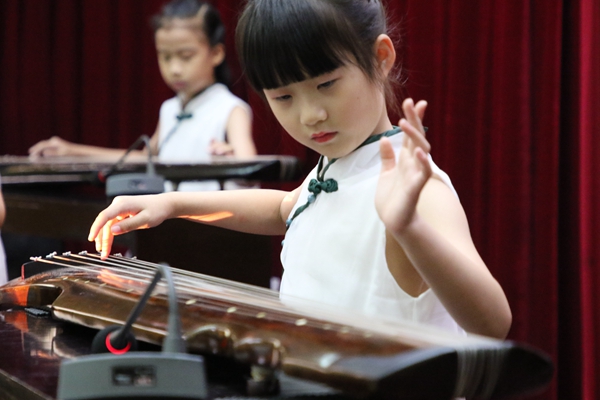
It's an instrument that represents the aesthetics of ancient Chinese literati. Guqin playing was an elite art practiced by intellectuals for its refinement and subtlety.
Yan Yan, one of the 72 disciples of Confucius, returned to his hometown at the foot of the Yushan hills, which later became known as Changshu. He shared with his own disciples what he had learned from Confucius, and guqin music was an important part of his teachings. Since the 17th century or so, Changshu was also known as Qinchuan, because seven streams used to run through the town, like the seven silk strings of a guqin.
The recorded heritage of guqin playing in Changshu dates back to the early 17th century. Yan Tianchi (1547-1625) was the most representative master. He and Xu Qingshan (1582-1662) founded the Yushan school of music, which carried on the guqin tradition in the region and developed a distinctive style that scholars later described as "peaceful and immense, clear and distant", and praised its emphasis on aesthetics and the "emotional expression of music".
Following the introduction of Western culture and urban lifestyles in the Yangtze River Delta area in the early 20th century, Chinese scholars rediscovered guqin and the traditional values it contained in their pursuit of spiritual connections. In Shanghai and Suzhou, 28 guqin artists, led by Zha Fuxi, founded the Jinyu Guqin Society in the hope of reviving the aesthetics of the Yushan school in the modern age.
For more than 1,500 years, guqin music was written with a tablature in which each tuning, finger position and stroke technique is clearly defined.
Wu Jinglue (1907-87) was the first musician to transform the traditional tablature into stave. Wu was an active member of the Jinyu Guqin Society since the 1920s and became a professor at the Central Conservatory of Music in Beijing in 1956. As a researcher and educator, Wu compiled the first modern textbook on the guqin in four volumes and transcribed more than 40 pieces of classical guqin music into stave.
In 1984, one of Wu's students in Changshu, Weng Shoucang, called for the revival of the Yushan Guqin Society and invited Wu to be the director. Since then, the new Yushan Guqin Society has made efforts to promote the instrument. It has hosted educational projects and exchanges in Changshu and Suzhou.
Changshu has put emphasis on the inheritance and promotion of guqin art since the early 2000s. In 2002, Changshu opened the first test center for guqin playing, which has since become one of the largest in the country. It receives hundreds of players a year. In 2005, a museum dedicated to the Yushan school was established.