Institute at forefront of infectious diseases fight









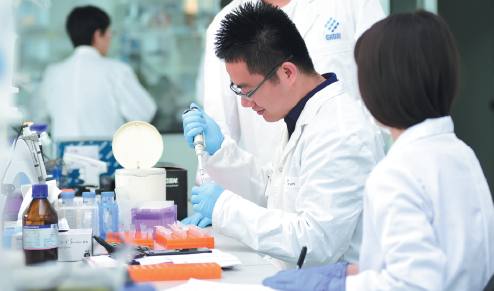
Links formed with leading global institutions and companies
When explorer Li Huacan took a photograph of Sanji, a 15-year-old Tibetan girl, in 2015, the teenager's yellowing eyes and skin showed that she had a severe illness.
Li was in Qinghai province, kayaking down the Yellow River on a journey of more than 5,400 kilometers to its estuary in Dongying, Shandong province, which he reached in 234 days
Hailing from Qinghai, Sanji had the parasitic disease echinococcosis, which had blocked her gall bladder, causing bile to enter her blood. All she could do was tell her doctor the high degree of pain she was experiencing.
Li said the girl might only have had a slim chance of surviving.
The disease is little-known to most Chinese, but according to the World Health Organization, the country is estimated to have the highest number of such cases worldwide.
In nine western and northern provinces and autonomous regions, an estimated 50 million people are at risk from the disease, and about 170,000 of them are infected, according to a report published in 2017 in the Chinese animal health journal Zhongguo Dongwu Baojian on the epidemiology and spread of echinococcosis in China.
Widely prevalent in rural areas, the disease is caused by some types of tapeworm and is usually transmitted to humans from animals, especially dogs.
People can become infected if they have direct contact with animal hosts, or even by ingesting parasites' eggs in polluted food, water or soil.
Once the tapeworm enters the body, almost all the organs and tissues, such as the liver, lungs, brain and bones, will become damaged.
Echinococcosis is often expensive and complicated to treat. The drugs available on the market have multiple side effects and unreliable efficacy, while surgery is high-risk and costly.
Lu Manchun, chief operating officer at the Global Health Drug Discovery Institute, or GHDDI, in Beijing, said: "Prevention is far simpler than treatment. However, due to poor medical conditions, local residents cannot be screened promptly, and when they are diagnosed, they have often entered the late stage of the disease."
Since last year, the institute has worked with the First Affiliated Hospital of Xinjiang Medical University in Urumqi, Xinjiang Uygur autonomous region, conducting a project that optimizes and tests new methods of experimentation to help improve research efficacy and develop new drugs to treat the disease.
In July, a similar cooperation project was launched by the institute and Qinghai University Affiliated Hospital in Xining, Qinghai province.
Lu said, "We have a lot of experience and knowledge of other parasitic diseases, and there is an urgent need to improve the health situation in rural areas, so we decided to choose echinococcosis as one of our research areas."
In 2016, the institute was jointly founded by Tsinghua University, the Bill & Melinda Gates Foundation and the Beijing Municipal Government. It is run as a not-for-profit organization.
Lu, who joined the institute at the start, said everything it does is "unique and innovative".
In addition to parasitic diseases, it focuses on tuberculosis, malaria and intestinal diseases, which are widely prevalent in many less-developed countries.
Such diseases are usually difficult to cure, highly resistant to drugs, globally and regionally contagious, and can easily be neglected. Even if drugs are available, patients may not be able to afford them.
According to Li Yinuo, chief representative of the Bill & Melinda Gates Foundation's Beijing office, there is a huge imbalance between the burden caused by infectious diseases worldwide and investment in ways to treat and prevent them.
Since the 1970s, some 1,500 new drugs have entered the market, but fewer than 20, or just over 1 percent, are for infectious diseases, Li added.
"Developing countries bear 90 percent of the world's infectious disease burden, but global investment in such diseases accounts for only 10 percent of that in drug research and development worldwide," she said.
Without fundamental changes or updates to existing drugs, parasites or germs in the human body will develop long-term resistance.
For example, research published in July in the monthly journal The Lancet Infectious Diseases showed that a widely-used frontline therapy has had a high rate of treatment failure due to multidrug-resistant malaria that has spread across Cambodia, Thailand and Vietnam.






- PLA conducts drills on regional patrol, aerial confrontation, and information support in airspace to the southwest of Taiwan Island
- China allows qualified doctoral candidates to pursue interdisciplinary master's degrees
- Horse sculptures gallop into Harbin Ice and Snow World
- Fuwa, the giant snowman, debuts in Harbin, taller than last year
- AI short video: Joint operations to thwart 'Taiwan independence' attempts
- China's Xinjiang Oilfield reports CO2 storage and utilization breakthrough