Policies promoted to solve population problems









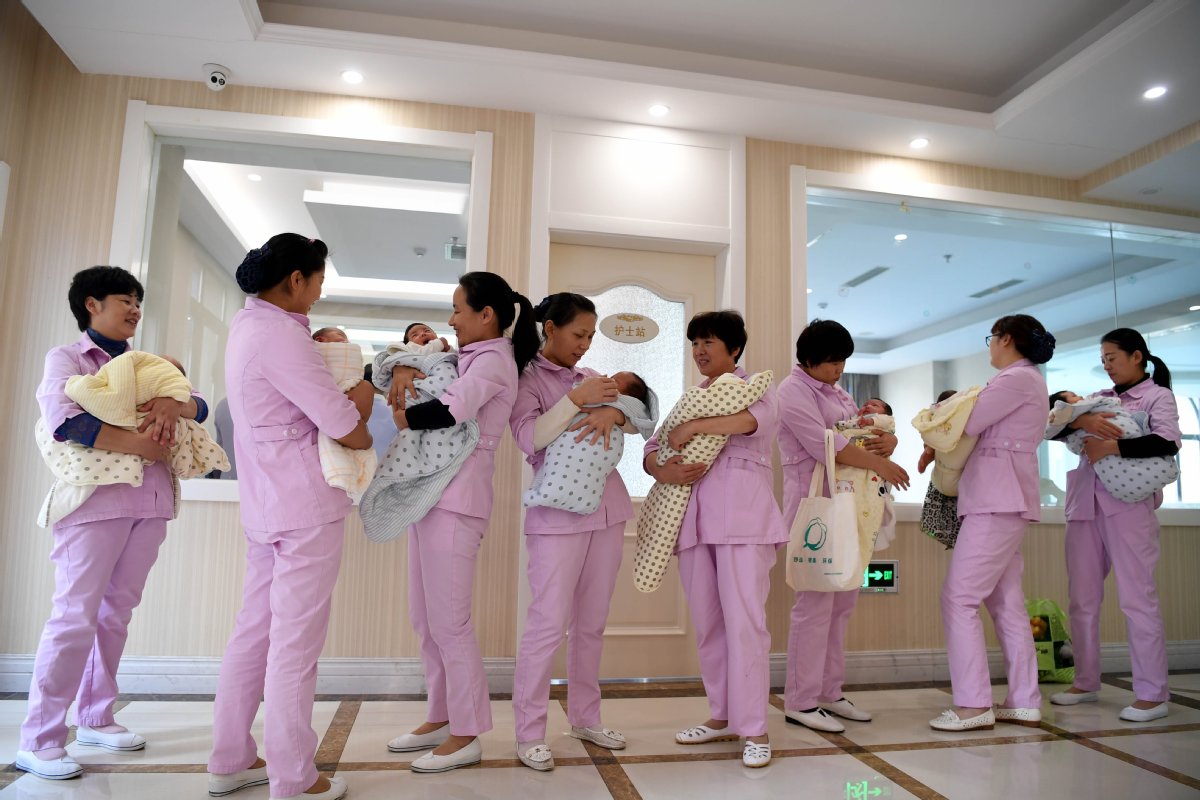
Government moves to address slowing birth rate and aging workforce. Wang Xiaodong reports.
Editor's note: To celebrate the 70th anniversary of the founding of the People's Republic of China, we are publishing a series of stories reflecting on changes and developments in fields such as law, education, transportation and the environment. This is the seventh, and last, in the series.
Yang Dan, the mother of a 6-year-old boy, has occasionally considered having another child, but she has never taken the idea seriously.
"It's so expensive to raise a child nowadays. The pressure of having a second child is too much for us to shoulder at the moment," she said.
The 32-year-old works at an agricultural research institute in Panjin, Liaoning province, and she and her husband, 34, spend more than a third of their combined monthly income on their son.
Having another child would mean they would either have to spend half of what remains of their salary to find a nanny, or Yang would have to quit her job and become a full-time housewife to care for the children. Neither option is affordable, she said.
"In the past, having one more child did not raise a family's expenditure too much, but things are different now because you have to provide the best things available for them," she added.
Many other young couples in China share that opinion. Despite the latest policy changes designed to encourage couples to have two children, many seem unwilling to do so, as indicated by official statistics and surveys.
In the past two years, the number of births on the Chinese mainland has fallen, despite a notable rise in 2016, the year the universal second-child policy was adopted.
Last year, the number was 15.23 million, a fall of 2 million from 2017, according to the National Bureau of Statistics.
Population surveys for the first half, conducted in cities such as Chongqing, in the southwest, and Weifang, Shandong province, suggest the number is likely to fall again this year.
Moreover, many population experts have predicted declines over the next few years. They warn that a decline in the total population is an irreversible trend, despite the positive effects of the universal second-child policy. That would exacerbate problems such as the aging population and dwindling workforce.






- Guangdong urged to drive high-quality development
- Shanghai hosts 6th intl 3E talent fair
- Xi's special envoy attends inauguration of Bolivian president
- Countdown to 15th National Games: On-site warm-up entertains audience
- Eight missing after cargo ship collides with fishing vessel near Shandong
- Investing in people: a worthwhile investment