


Traditional game marks new era of cultural exchange









"Go is like a mirror, if you allow yourself to look into it. You should accept all of your mistakes and realize how flawed your plans are and how inconsistent your ideas are, maybe see ideas you didn't even know. In daily life, you don't have that," describes Timo Schreiber, vice chair of Berlin Go Association during an interview with China Daily Website at China Cultural Center in Berlin.
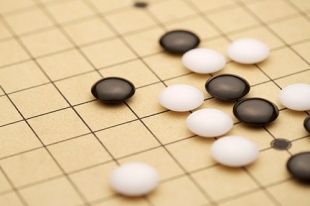
Go, commonly known in China as weiqi, is a board game for two players that demands strenuous abstract and logical strategies. To win, the players must use black and white playing pieces, called stones, to surround more territory than the opponent on a checkered board.
The game was invented in China more than 2,500 years ago and enjoys a wide fan base, mostly in East Asia - but it is becoming more prevalent in other areas of the world. Andreas Urban, chair of Berlin Go Association, estimated that there are roughly 2,500 regular players in Germany.
Schreiber was introduced to the game 16 years ago by a classmate, but thought the game rather mediocre and boring at first. "That is the problem when you teach new players," he said. "At first they cannot see that it's a very interesting game. At the beginning you cannot understand."
Similarly, Urban, accidentally discovered a book on Go on his mother's bookshelf when he was 37 years old. "I tried to understand the rules because I love board games and I did not get it," added Urban.
But both found the game more and more intriguing after practice. The rules are rather simple, and the battlefield is clearly laid before the player's eyes - but the game is so much more than just moving stones around the board.
"It is certainly an established form of art. In ancient Chinese history it is already one of the four traditional fine arts, along with playing guqin (a seven-stringed zither), writing and painting. It is also nicknamed 'hand talk' in Korea. They say it's like speaking to another but with your hands. If you play against somebody who's very experienced, it's like you talk to each other except you cannot tell any lies or be unclear. You make a very direct message. It's very interesting to play on the Go board, something I've never seen in any other game," explained Schreiber.
And it is this straight-forwardness, elegance and need to think logically that Schreiber believes could be beneficial for children.
"I recommend children to learn Go. They learn that there is always someone stronger, which is okay, and they learn that it's okay to lose. They learn how to improve from their mistakes and say tomorrow will be better than today, because I looked at my mistakes and learned from them," he explained.
To the experienced players, Go can be very addictive, as it carries significance not just in leisure, but also a much more philosophical meaning on a deeper cultural ground.
When two players meet on the Go board, they are restricted by the same rules, faced with the same game, but carry completely different tactics. As it is with many games and sports, one of the best ways to improve is to play against someone who's stronger, as well as from different backgrounds.
A game of Go takes a lot of time and effort to understand the opponent's ideas. To Schreiber, cross-cultural communication and Go share that at their roots.
"Many are too quick to judge other people's cultures. Confucius said, 'Tell me, I'll forget; Show me, I may remember; Involve me, and I will understand.' [With Go], you only get stronger if you play against different players. [With culture], you need to go and talk to people, even better if in their language. If you can't, maybe it's enough to use the Go board as the language."
As cooperation between China and Germany deepens in many aspects of life, including art and culture, efforts have also been made to further popularize Go in Europe.
The European Go Congress has been hosting annual tournaments since 1983. The Berlin Go Association has worked together with the China Cultural Center in Berlin to host The China Cup, an international Go tournament which sees roughly 50 to 100 players a year. The tournament has helped to develop the Go scene in Europe for 10 years.
Training courses are also offered, and the duo also sometimes invite professional players from China to deliver lectures for game lovers in Europe. A Grand Slam Tournament chooses professional players, who are in turn acknowledged by the Chinese Go Association, and offers them chances to study the skills of the game in China.
To give players on both sides a chance to try their hands at one another, Urban believes China and Germany could both do their parts.
"You have so many players, especially very young pupils, I heard about 2 million. Here we have more adult players. Maybe we could learn from each other; maybe Chinese could also get more adult players," he said.