Reporter's log: Hospital stands as witness to nations' friendship









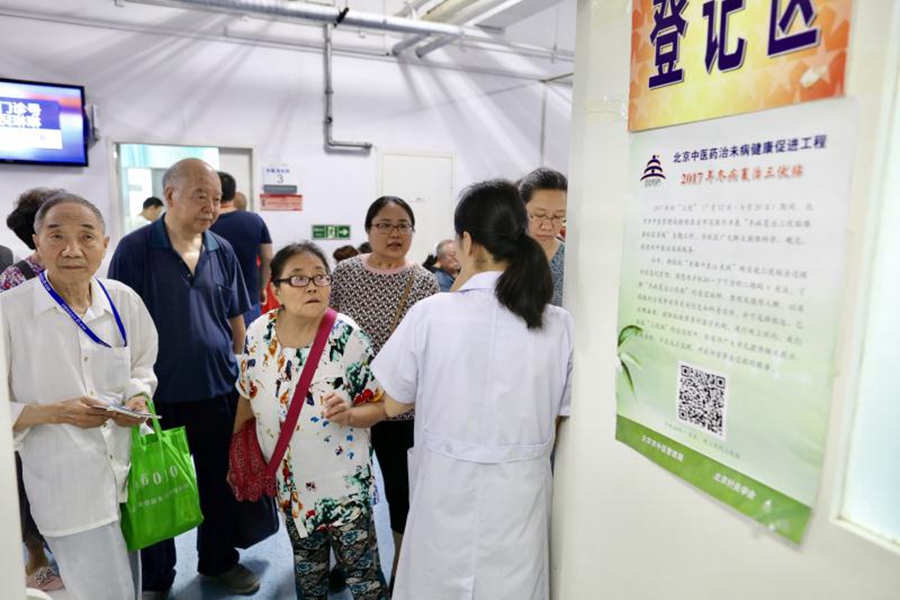
The China-Japan Friendship Hospital is the one closest to where I live and work in Beijing, so it is my first choice when I need to see a doctor.
During one visit, probably brought about by influenza, I discovered a tall statue of a Chinese monk in the hospital's garden.
I asked myself why a statue of a monk, and not a doctor or nurse, had been erected at a hospital rather than at a temple. Although the flu made me dizzy, I wanted to find out, so I approached the statute in the hope of discovering the answer.
I found the statue was to Jianzhen, a Chinese monk who arrived in Japan in AD753 after five failed attempts during the Tang Dynasty (618-907).
The statue's information board states that during Jianzhen's 10-years stay in Japan, he not only introduced Buddhism to the country but also Chinese calligraphy, architecture, music and medicine.
When Jianzhen finally succeeded in reaching Japan at the sixth attempt, he had lost his eyesight. He died in Japan a decade after arriving, and a statue similar to the one at the hospital still stands in the ancient Japanese city of Nara.
The spirit of learning from and helping each other as neighbors has remained unchanged between China and Japan, something Jianzhen may never have imagined in his day.
The hospital itself is proof of this.
In the late 1970s, China decided to establish a hospital with the aim of integrating Western and traditional Chinese medicine. The Japanese government responded, providing 16.4 billion yen to help with the building.
In 1984, the hospital, equipped with the latest Japanese medical equipment and facilities, opened in northeast Beijing. Numerous Japanese doctors and nurses traveled to China at the time and shared many techniques, including those for operations, medical examinations, diagnosis and how to write clinical records.
The two countries have maintained frequent exchanges in various areas.
For example, China is Japan's largest source of imports and second-largest export destination, while Japan is China's fourth-largest trading partner. Chinese investment in Japan reached $3.69 billion in 2017 and covered many areas, including manufacturing, exports and imports, energy and mineral resources.
Japan is also the largest destination for China's outbound tourism, with the number of tourists traveling from the Chinese mainland to Japan last year reaching 8.3 million, up by 15 percent year-on-year.
Nearly 100,000 Chinese students are studying in Japan, making China the country's largest source of international students, while the number of Japanese students in China stands at about 14,000.
With their geographical proximity, shared culture and customs, as well as a history of bilateral exchanges stretching back centuries, the two nations have many reasons to interact with each other.
But the most simple and important one that came to mind as I stared at the huge statue of Jianzhen, is that no matter how many difficulties there are, only by communicating with each other can China and Japan and their people understand each other.
Five failed attempts to reach Japan while sailing into stormy waters failed to dent Jianzhen's determination to communicate with China's neighbor.
The past 40 years have also witnessed Japan's increasingly extensive engagement in China's reform and opening-up.
There may be ups and downs in bilateral relations in the future, as the historical issues between the two nations cannot be ignored and forgotten, but exchanges to boost mutual understanding should always be welcome.
- Safety priority in dedicated chemicals law
- Self-reliance on camellia oil production bolstered
- Under-forest industry grows as economic pillar in Hunan
- Probes expose safety failures behind two deadly incidents
- Construction underway on aircraft maintenance hub
- Ministry seeks to tighten air quality norms