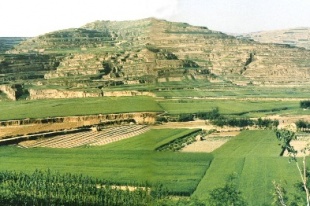



Dadiwan Ruins









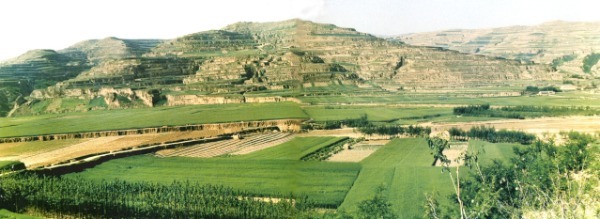
Dadiwn Ruins are located southeast of Shaodian village and west of Fengjiawan village in Wuying township, Qin'an county. The ruins are mostly distributed on the second-tier and third-tier terraces on the south bank of Qingshui River, a secondary tributary of Weihe River, and the connected slopes.
The ruins extend to the second-tier terrace on the south bank of Qingshui River on its northernmost point, ShandingPuzi on its southernmost point, Yanjia Gully on its westernmost point, and Liujiapo on its easternmost point. With an elevation of 1,458 to 1,673 meters, the ruins cover a total land area of about 2.75 million sq m.
Dadiwn Ruins feature thick cultural layers of typically one to two meters thick and up to three meters in certain parts. Judging from the stratigraphy and unearthed items, the ruins date back to five cultural periods, namely the pre-Yangshao period, the early Yangshao period, the mid Yangshao period, the late Yangshao period, and the Changshan low layer culture period.
Dadiwan Ruins have provided a chronological benchmark for the period 7,800 to 4,800 years to now in east Gansu region, established a complete set of protoculture development sequence, and contributed to breakthroughs in Neolithic archaeology in northwest China. It is an indisputable fact that Gansu is an important cradle of the Chinese civilization and culture.
The Phase IV villages of Dadiwan Ruins have become central to the ruins on the bank of Qingshui River, or more appropriately, a predecessor of the townsite. Its existence indicates an important transition from a primitive society to a civilization.
Since June 2006, teams from the Institute of Vertebrate Paleontology and Paleoanthropology under the Chinese Academy of Sciences, Gansu Provincial Institute of Cultural Relics and Archaeology, and Lanzhou University have conducted rounds of small-scale archaeological excavations here. Relics from the Paleolithic Age have been unearthed, reaffirming continued existence of Paleolithic relics under the Neolithic layer in the Dadiwan Ruins. Research on the ruins is still underway.
In 1961, Dadiwan Ruins were announced as a cultural relics unit under Qin'an county protection. In 1986, Dadiwan Culture Management Institute was established, which was renamed to Dadiwan Cultural Relics Protection Research Institute in 1999.
This organization shoulders responsibilities of protecting, managing and studying and developing the ruins. In 1981, the ruins were announced as a cultural relics unit under Gansu provincial protection. In 1988, the State Council named it among the third batch of key cultural relics units under national protection.
According to the Circular of the People's Government of Gansu Province on Promulgation of the Protection Scope of Key Cultural Relics Units under National Protection in Gansu Province (GZF No. [1999] 22), "The protected scope starts from Fengjiawan on the east and ends at Yanjiagou on the west, and begins from ShandingPuzi on the south and concludes at the front edge of the second-tier terrace of Qingshui River on the north. The total protected area covers 1.1 million sq m.
The construction controlled zone extends 500 meters both eastward and westward with Fengjiagou and Yanjiagou as the center line, stretches over a fan-shaped area behind the mountain with ShandingPuzi as the center at a radius of 500 meters on the south, and extends to the existing course of Qingshui River on the north. The total construction controlled zone covers about 1.5 million sq m." After issuance of this circular, a demonstration hall was built for F901, and a small number of residue houses were restored and opened to the public.