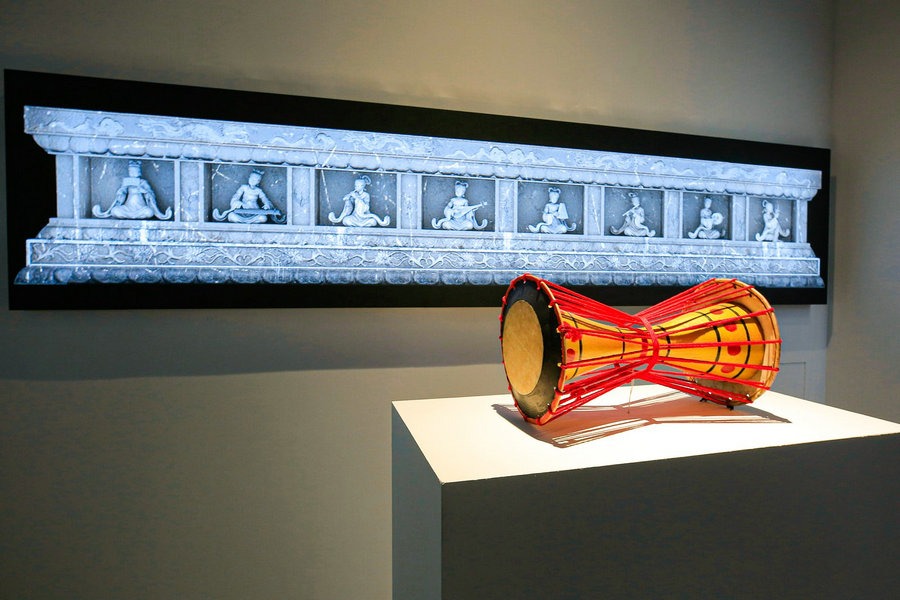
Maiji Mountain Grottoes









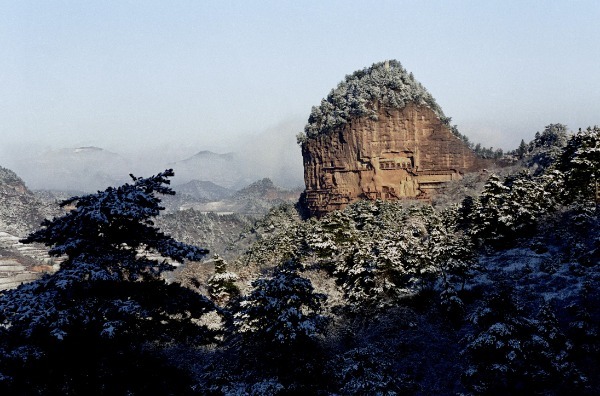
Located 45 kilometers to the southeast of Maiji district, Tianshui city, Maiji Mountain Grottoes sit in the forests of Xiaolong Mountain to the north of the west extension of Qinling Mountains. "Maiji" in Chinese means grain stack and the mountain got its name because of its resemblance to the shape of a stack of wheat. The mountain is formed by red sandy conglomerate and towers at 142 meters.
Surrounded by a group of lower mountains, Maiji Mountain stands out with steep cliffs on three sides. The grottoes were discovered on the red-gravel cliffs of the mountain 20 to 80 meters above the ground. "In the clouds and between the cliffs, stones were carved to make Buddha.
One cannot help but wonder if it is a work from heaven even if it is known that the thousands of grottoes were man-made." Dense grottoes and layers of interconnected plank roads on the cliffs make a marvelous spectacle in the history of ancient cave digging. Compared with its Chinese peers, Maiji Mountain Grottoes are representative works of those from the Northern Wei and the Northern Zhou dynasties. Known as the "Oriental Sculpture Exhibition Room", Maiji Mountain Grottoes mark the continuation and further development of China's Buddhist grottoes after the localization by the Yungang Grottoes.
As per written records and inscriptions from stone tablets, Maiji Mountain Grottoes were first carved from 384 to 417 A.D. (the Later Qin of the Sixteen Kingdoms of the Eastern Jin Dynasty) by "digging the mountains to make tens of thousands of statues on thousands of cliff surfaces and turn cliffs into Buddha pavilions". Through renovations in a dozen of dynasties (including the Northern Wei Dynasty, the Western Wei Dynasty, the Northern Zhou Dynasty, the Sui Dynasty, the Tang Dynasty, the Five Dynasties, as well as the Song, Yuan, Ming and Qing dynasties) over a period of more than 1,500 years, Maiji Mountain Grottoes now house 221 Buddhist grottoes dating back to the 5th to the 13th centuries. Specifically, apart from the 20 discovered in the Wangzi Grotto and the three empty ones found in the deposit of collapsed cliffs in the central section, all the rest 198 grottoes are carved on the eastern and western cliffs of around 120 meters long and 50 meters high (including 56 on the eastern cliff and 142 on the western cliff).