Qingdao Port takes lead in automation
Handling capacity expected to reach 1.7 million TEUs per year with zero carbon dioxide emissions









A new automated container terminal employing hydrogen energy and 5G technology in Qingdao, Shandong province, represents the future trend of port operation with highly efficient and environmentally friendly features, industry insiders said recently.
The second project of the fully automated container terminal at Qingdao Port was officially put into use on Nov 28 and its handling capacity is expected to reach 1.7 million TEUs (20-foot equivalent units) per year, according to port operators.
"Along the 660-meter shoreline, the terminal owns two berths and has high-end automated facilities including nine ship-to-shore cranes, 38 automatic high-speed tract cranes and 45 automatic guided vehicles," said Yang Jiemin, executive deputy general-manager of Qingdao Port Automated Container Terminal Co.
It took only one year and a half to build this terminal, five times faster than it usually takes, with six self-developed innovative solutions at the forefront of relevant fields across the world, said Yang.
The rail-mounted gantry cranes at the terminal are driven by a hydrogen battery pack, which Qingdao Port claimed was the first used in the port sector worldwide.
Lyu Xiangdong, an engineer of the company, said the new energy replaced coal and oil and produced more electricity with zero carbon dioxide emissions.
"What's more, the new method reduced the weight of the facility by 10 metric tons and lowered its complexity as well as maintenance costs," said Lyu.
Lyu added that the hydrogen is mainly leftover from chemical enterprises in Shandong province and it is a perfect way to turn waste into a resource.
The port operators estimated that the hydrogen energy could reduce electricity consumption by 3.6 percent for carrying every container and save about 20 percent of the cost of purchasing every unit of power equipment.
If this terminal handles an annual throughput of 3 million TEU, it would reduce 20,000 tons of carbon dioxide emissions and 697 tons of sulfur dioxide discharges.
The automation at the terminal has been enlarged by application of 5G technology, "which has covered every corner of the terminal", said Li Yongcui, a deputy general manager of Qingdao Port Automated Container Terminal Co.
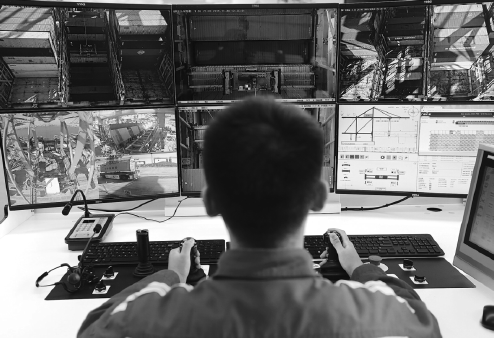
Qingdao Port started to use the 5G technology early this year, an advantage of which is that the quay cranes could automatically move containers. It is considered to be the first case of 5G-based technology applied in remote-controlled cranes in the world.
The port also joined hands with China's tech giant Huawei and major telecom company China Unicom to give a special solution to communication between different facilities in the port.
"Compared with optical fiber and other means of traditional communication, the 5G technology features flexibility, low costs of construction and maintenance and scalability.
"Earthwork is usually needed before we install optical fiber to connect different facilities, while the 5G network is not confined to a geographical position and numbers of facilities, some of which will be added later," said Li.
Currently, 5G technology has been applied in the operation of quay cranes and rail-mounted gantry cranes, container movement as well as high-definition video data transmission.
The first project of the fully automated container terminal at Qingdao Port was put into commercial operation in May 2017, which was believed to be the first of its kind in Asia.
The project reduced 80 percent of labor work and improved efficiency by 30 percent. The loading and unloading efficiency reached an average of 36.2 containers per hour from 24.2 when the terminal was operated at the beginning. Its peak efficiency reached 43.8 containers per hour, 50 percent higher than in similar terminals in other countries. It has been considered the first automatic terminal to surpass any human-labor dominated terminal in terms of efficiency.
Zheng Qingxiu, an official in charge of waterway management with the Ministry of Transport, said that Qingdao Port has made its way to becoming an intelligent and green port, setting an example for other domestic ports.
Qingdao Port reported its cargo handling capacity as 540 million tons and 19.32 million TEUs in 2018. Qingdao Port merged with its neighbor Weihai Port in July and then become a subsidiary of the consolidated Shandong Port Group in August.
China has been leading in terms of automated port construction with its considerable number of automated container terminals in the country, according to a report on intelligent shipping development in late October.
Another two examples are Xiamen Ocean Gate Automated Container Terminal in Fujian province, the first intelligent green terminal in China, and the Yangshan Deep-Water Port in Shanghai, the world's largest automated cargo terminal.




Today's Top News
- Xi chairs CPC leadership meeting on Party conduct, anti-corruption work
- Why Hainan Free Trade Port stands out
- Rule of law strengthens business environment
- Documents affirm one-China principle
- Central SOEs urged to push upgrading
- Agreement boosts ocean governance