Master thangka painter eyes worldwide canvas









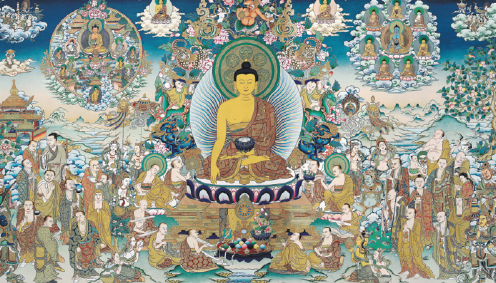
A thangka depicting Shakyamuni Buddha and the 18 arhats painted by master artist Niangben. CHINA DAILY
When master painter Niangben visited the United Nations headquarters in New York last month, he knew there was no better time for his traditional thangka Tibetan painting art form than now.
"The Chinese authorities have been supporting the promotion of cultural activities and art. Interest in thangka has been increasing at home and abroad in recent years. Our paintings have been setting records at international auctions," said Niangben, 48.
A thangka is a traditional style of Tibetan painting on silk or cotton, usually depicting a Buddhist deity, scene or mandala, a circular design containing concentric geometric forms or images of deities.
Betting on the growing global role of the art in recent years, Niangben moved his base from his hometown of Tongren in the Huangnan Tibetan autonomous prefecture of Qinghai province to Beijing to tap the cultural resources of the capital. His numerous accolades include an inaugural national arts award counting other recipients like popular concert pianist Lang Lang.
The painter, who started training in the intricate and religious Regong thangka style when he was 12, has since exhibited at major museums and galleries to wide acclaim, traveling to leading domestic and international art institutions for exchanges and research.
Thangka forms an important part of ethnic Tibetan heritage and culture, which local governments have marked as a pillar of growth and development. According to the United Nations Educational, Scientific and Cultural Organization, the Regong arts of China are inscribed on the "representative list of the intangible cultural heritage of humanity".
In monasteries and villages along Qinghai's Longwu River basin, Buddhist monks and folk artists of the Tibetan and Tu ethnic groups practice painting thangka and murals, with their influence extending to nearby provinces and Southeast Asian countries.
"When I visit the Western art institutions, people there show a lot of interest in thangka. But appreciating thangka also involves a deep understanding of Buddhism, including its religious and cultural context. Our art stretches back millennia, with its history and tradition. We must keep up with the times, with the trends, if we want to fully promote thangka to the world," Niangben said.
Expanding the subject of the paintings to cover aspects more familiar to foreigners, such as natural scenery and flora and fauna, while retaining the unique and alluring characteristics of thangka including its ornate use of gold and other mineral-based, resilient pigments and vibrant colors, can significantly broaden its appeal, he said.
Prices of thangka works have been breaking records and heightened interest in it continues to make headlines. In November 2014, Chinese art collector Liu Yiqian bought an imperial piece dating back six centuries for about $45 million, a new high for Chinese artwork sold by an international auction house.
Niangben's own paintings, which can take about seven to eight months each to complete, can top millions of dollars apiece. The sale of his thangka helps support not just the operating costs of his studio but also fund a major training program for future generations of thangka artists in his home province. Poverty alleviation and social welfare efforts feature prominently in his local education projects.
"I'm past my most prolific stage in terms of producing thangka," Niangben said. He has nurtured hundreds of painters, who need about five years to learn the basics of the art.
"Now I want to make sure this invaluable part of our heritage is properly passed on."
To complement his educational and training programs, Niangben is also working on a documentary series as well as researching and collecting thangka-related material from other master artists and craftsmen across the country. One of his main priorities for the coming year is to work on thangka education and exchange programs in the United States.
"We are definitely at an exciting stage in terms of the interest and development in thangka," Niangben said.
"The next few years will be crucial for its growth globally."

- Scholars call for ecological protection of Tunbu culture
- Cross-Strait exhibition highlights Chinese crested tern conservation
- China halts port fees on US vessels for one year
- China moves to cut teachers' administrative workload
- China launches group of internet satellites into orbit
- Former senior official expelled from CPC for serious violations