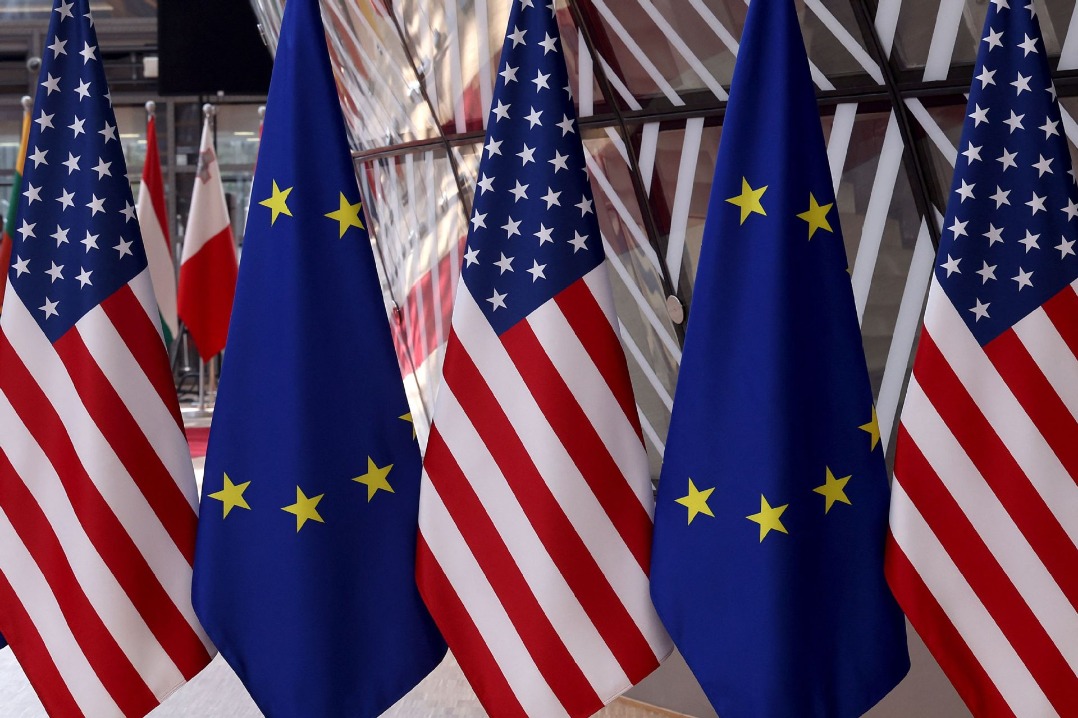
US 'poison pill' clause harmful to free trade









Since there is no sign of a breakthrough in the World Trade Organization negotiations on multilateral trade rules, signing free trade agreements (FTAs) seems to be a feasible option for most WTO member economies to promote trade liberalization.
Regional trade agreements have played an important role in facilitating multilateral trade rules and strengthening the multilateral trade system. No wonder many regional trade agreements have been signed in recent years.
However, a regional FTA should conform to multilateral trade rules. According to the provisions of Article XXIV of the General Agreement on Tariffs and Trade (the precursor to the WTO), "the purpose of a customs union or a free trade area should be to facilitate trade between constituent territories and not to raise barriers to trade of other contracting parties with such territories". Which means the signatories to an FTA should not impose higher tariffs on or raise trade barriers against non-signatory countries, and not make any moves that harm the trade of other states.
Yet some regional FTAs endorsed by some WTO member economies have violated this rule. If not checked, such infringements will give rise to trade barriers and discrimination against non-signatories to regional FTAs, dealing a serious blow to the multilateral trade system.
The trade deal signed between the US and Japan, which took effect on Wednesday, and the United States-Mexico-Canada Agreement violate WTO rules. The US has signed the two trade agreements not only to promote its "America first" policy, but also to extract the maximum benefits from the agreements and ultimately abandon the multilateral trade system.
The US government re-negotiated the 24-year-old North American Free Trade Agreement with Mexico and Canada and threatened to withdraw from the WTO. In fact, by stalling the appointment of new members to the Appellate Body, the US has already rendered the WTO's dispute settlement system dysfunctional since Dec 11.
The total trade volume under the USMCA may be $1.2 trillion, but it has many gray areas, including the absence of most-favored-nation treatment and discriminatory exclusionary clauses. For example, the agreement stipulates that 75 percent of a vehicle's component parts and 70 percent of the steel and aluminum used in it should be sourced from the "original area". Which are not so subtle conditions to keep the car manufacturers from Japan, China and the European Union away from the North American market.
The USMCA also has a "poison pill" clause, which says it is mandatory for a signatory country to notify the other signatories three months before settling an FTA with a "non-market" economy. The signatory country also has to submit the FTA document to the other signatories at least 30 days in advance so they can evaluate whether it would have a negative impact on the new North American trade deal.
So if Canada and Mexico want to sign an FTA with a so-called non-market economy, they have to submit the agreement to the US for review.
The discriminatory rules in the USMCA, including those on "original area" and tariff concessions on goods trade, deal a big blow to the international division of labor, and its exclusionary clauses could become the breeding ground for regional protectionism. Also, by strengthening regional trade protection, the USMCA will eliminate non-regional players from the region. Besides, the US has been harping on the concept of so-called market and non-market economies because it wants its domestic laws to override international laws.
The signing of such regional trade deals by the US is not conducive to the long-term development of Sino-US trade ties. True, the "phase-one" deal China and the US recently reached in their trade talks has eased bilateral tensions, but if the US continues to resort to protectionism, it could render the deal less effective.
Moreover, the US could use the USMCA as the basis for finalizing new trade deals with other economies, and the extension of the US' restrictive clauses could again intensify the China-US trade disputes. In fact, the exclusionary clauses could be aimed at thwarting China's attempts to sign FTAs with economies such as Canada and Mexico. Which means that despite being in trade talks with China, the US' strategy is still to check China's development, and to expand its network of allies.
The author is director of the Research Institute of World Economics, Chinese Academy of International Trade and Economic Cooperation. The views don't necessarily represent those of China Daily.






Today's Top News
- Disrupting market under fabricated veneer of 'national security' hurts US' own interest: China Daily editorial
- Yasukuni visit would add insult to injury: China Daily editorial
- Judicial reform critical for modernizing governance
- Effective use of investment emphasized
- China's shuttle diplomacy strives to reach ceasefire
- Nanjing Museum's handling of donated art, relics being probed