China's strongest low-orbiting communication satellite lifts off










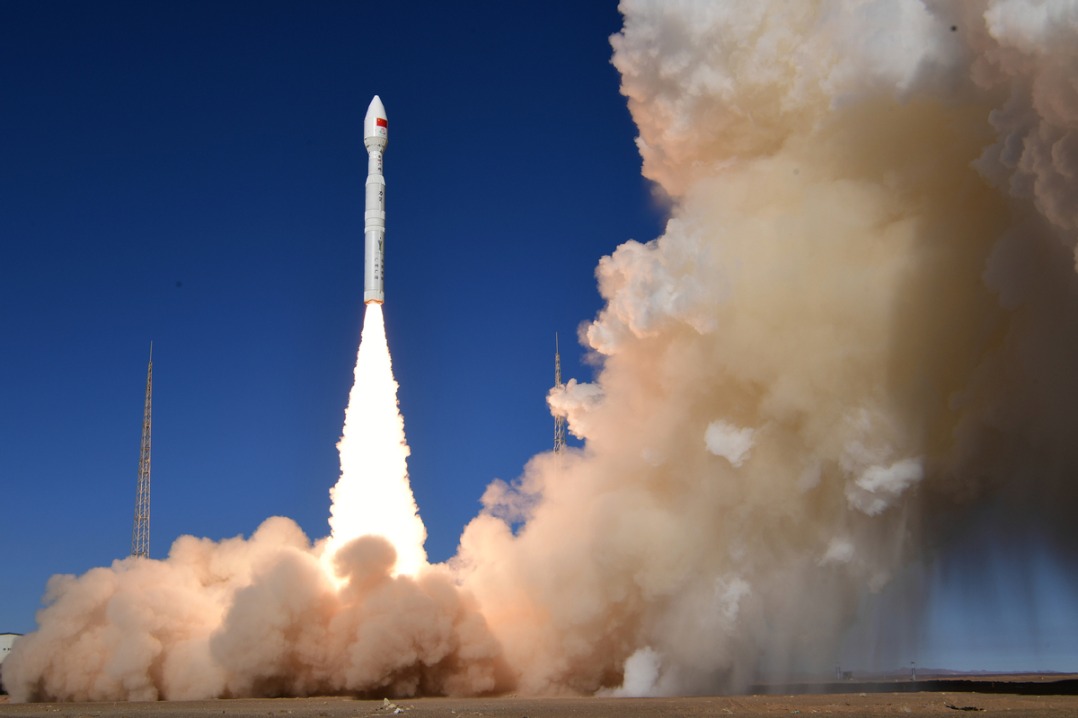
China's most powerful low-orbiting communication satellite, also the biggest spacecraft ever built by a private Chinese company, was launched on Thursday morning in Northwest China.
The GalaxySpace 1, designed and built by Beijing-based startup GalaxySpace, has also been widely considered the country's first 5G-capable satellite, which features a very strong capability in data transmission.
The 200-kilogram satellite was lifted at 11:02 am atop a Kuaizhou 1A solid-propellant carrier rocket from the Jiuquan Satellite Launch Center in the Gobi Desert, according to a statement from Galaxy-Space.
It has a transmission capacity of 10 gigabits per second and uses multiple bands such as Q/V and Ka, the company said.
GalaxySpace aims to build a broadband satellite constellation, which will operate in a low-Earth orbit, and create a 5G communication network with global coverage.
China has been making all-out efforts to boost and promote 5G communication technology, regarding it as one of the major driving forces for future social and economic development.
Zhang Shijie, a satellite technology researcher at the Harbin Institute of Technology in Heilongjiang province and partner at Galaxy-Space, said that though the age of 5G has unfolded, existing communication infrastructure around the globe is still far from capable of ensuring sufficient service in remote regions such as deserts, islands or seas.
"Therefore, low-orbiting, broadband satellites are an ideal solution to offering access to and coverage of 5G services to people in those places," he explained.
Zhang also noted that it is very necessary for China to deploy satellites operating with Q/V band and in low orbit as early as possible because orbital positions and the electromagnetic spectrum are limited resources, and the later a country starts using them, the harder it will be to find them, especially given the rapid expansion of commercial communication satellite networks in the global market.
Internationally, commercial space giants such as SpaceX and OneWeb have been racing to develop and construct low-orbiting communication satellite systems.
Thursday's launch marked the eighth mission of the Kuaizhou 1A, the pillar model of the Kuaizhou series.
The 20-meter rocket has a liftoff weight of about 30 metric tons. It is capable of sending 200 kilograms of payload into a sun-synchronous orbit, or 300 kg of payload into a low-Earth orbit, according to China Aerospace Science and Industry Corp, a State-owned space contractor that develops and makes Kuaizhou rockets.