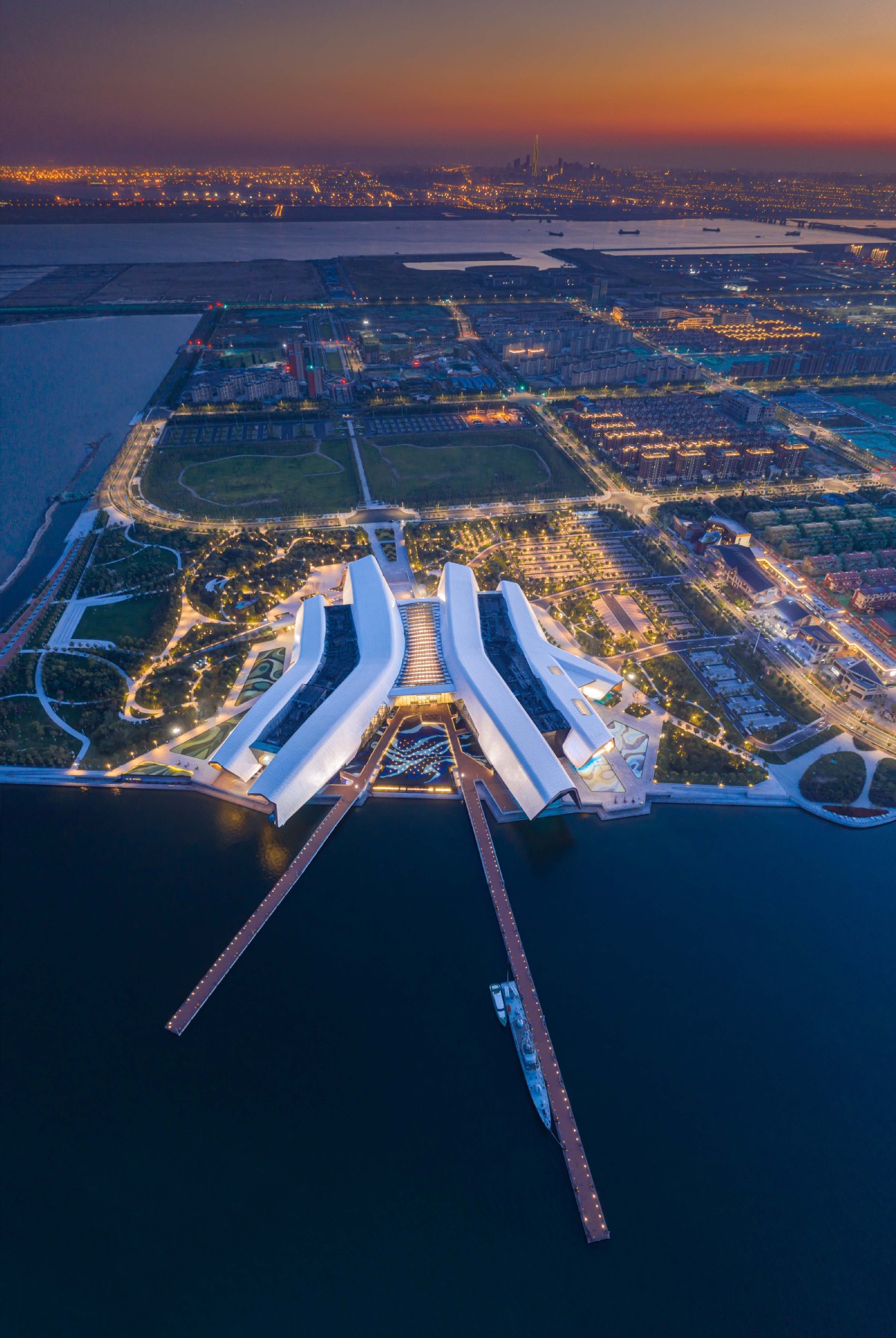
New venue showcases marine heritage










People in the Stone Age, who formed into groups and settled by the sea, left many remains on islands and in coastal regions.
"These inhabitants had a different way of life from those in inland areas, as they were better adapted to the natural environment of the coast," Zhu said.
He cited two examples of the ocean's impact on people's lives: perforated shells found at the Peking Man Site at Zhoukoudian, near Beijing, which are 10,000 to 30,000 years old; and the making of canoes some 7,000 to 8,000 years ago in coastal areas of southeastern China.
He said the remains of ancient canoes found in Zhejiang province are believed to be some of the first built by humans. An adze, a tool used to build a canoe, also provided important evidence to study humans' early migration across the oceans.
Many advanced shipbuilding techniques that emerged in China during the Tang Dynasty (618-907) had a great impact on the global shipbuilding industry, Zhu said.
During the Han Dynasty (206 BC-AD 220), Chinese vessels were known to sail routes to present-day India and Sri Lanka, and between the Wei-Jin Period and the Tang Dynasty — from AD 220-907, boats from China sailed to the Korean Peninsula, Japan, South Asia and West Asia.
During the Tang Dynasty, there was also a route from Guangzhou, Guangdong province, to the Arabian Peninsula.
The Maritime Silk Road, which emerged during the Qin (221-206 BC) and Han dynasties, witnessed significant development in the Tang Dynasty. Many relics were found during this period, proving that maritime trade existed between China and other countries.
Zhu said, "Chinese maritime civilization witnessed prosperity during the Song to Yuan dynasties (960-1368), when development of the Maritime Silk Road reached its peak.
"In the 12th century, the compass started to be used in China for navigation. It was then introduced to Europe by the Arabs, and helped promote development of the shipping industry in the West."
From 1405 to 1433, the expeditionary voyages of maritime explorer Zheng He involved more than 200 vessels and 27,000 crew. He was in command for the biggest long-distance voyage ever undertaken in the world at the time.
"Zheng He's voyage to the west was the climax of ancient China's maritime civilization. It disseminated Chinese civilization to the rest of the world, enhanced cultural communication among different countries and regions, and promoted the prosperity of international trade," Zhu said.
Rejuvenation of the country's maritime tradition started after the founding of the People's Republic of China in 1949, Zhu said. In recent years, its marine industry has developed in "leaps and bounds", in areas such as investigation and observation, deep-sea exploration and polar research.
The legal system covering maritime issues has also been greatly improved, with the launch of a series of laws for deep sea, island, and marine environmental protection, which safeguard development of the marine industry.
Zhu said China's active participation in global maritime cooperation and management, and its contribution to protecting the marine environment have shown that it has taken on such responsibility as a major country.
"China is also working to promote construction of the 21st Century Maritime Silk Road, while promoting the concept of peaceful development and win-win cooperation across the world.
"With the theme of developing the blue economy, China encourages all-round and pragmatic cooperation (under the Belt and Road Initiative).
"Chinese marine civilization is on its way toward rejuvenation, which will be a positive driver for rejuvenation of the nation."