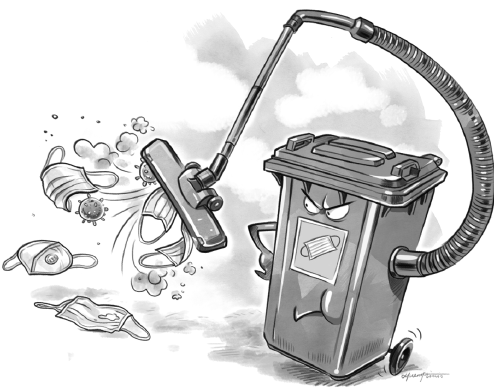
Discarded masks must be properly disposed of









Editor's Note: With people wearing face masks to help protect themselves from being infected with the novel coronavirus, a concern now is how they are disposing of their used masks. Two experts share their views on how to correctly dispose of used masks with China Daily's Yao Yuxin. Excerpts follow:
Prevent used masks being recycled
As used face masks may carry germs involving the coronavirus, they shouldn't be randomly discarded as waste.
Since the virus can survive for one or two days in humid conditions, the used masks may become a new source of infection.
If the waste masks are tossed in a confined space such as an elevator, they may contaminate the environment, posing a potential threat to people within it.
Also, it is inappropriate to mix contaminated masks with household waste.
Given the garbage sorting is currently implemented in only a few cities, mixed waste commonly exists. The mixture of polluted masks and recyclable waste may cause a potential danger to rubbish collectors when they put hands in the waste bins to collect recyclable items.
Worse, if someone just throws a used mask on the street, someone might pick it up, or worse try to collect them to sell second-hand.
Thus, it is necessary for the government to encourage people to make sure the used masks are safely recycled and disposed of. Special trash cans should be set up in communities as centralized disposal points for the used masks of residents.
If no special garbage bins are available, residents could spray disinfectant on both sides of their used masks and fold them up before putting them into a sealed plastic bag in the dustbin.
For the safety of others and themselves, residents have to take care of their used masks. Disinfecting them will help ensure the used masks do not become a second source of the coronavirus.
Masks should be treated as medical waste
The protective gear already used by medical staff and patients is already designated as medical waste. The medical waste management regulation was enacted the same year as the outbreak of severe acute respiratory syndrome (SARS) in 2002-03, which sets out clear rules on the classification, collection, transportation and disposal of infectious medical waste.
Given the regulation, hospitals in China already have a mature procedure to follow in dealing with medical waste. However, with the outbreak of the novel coronavirus, there has obviously been a high demand for protective equipment such as face masks among ordinary people, with the subsequent generation of a huge quantity of what may be considered medical waste.
Thus, the problem is how to cope with this mass of medical waste, particularly the used face masks discarded outside of hospitals.
Communities should place some special trash cans around to collect used masks. If not available, people had better wrap the waste into plastic bags before throwing them away, so they are not exposed to the air.
However, stricter rules must be implemented once cases of novel coronavirus are confirmed in a community. Once those affected are found, people need to handle polluted masks in such communities according to regulations on disposing medical waste.
According to the regulation, only licensed companies should collect, transport and do the final disposal of medical waste. For example, the medical waste must be collected in special containers, and be transported by special vehicles by qualified people.
As the main hazard of medical waste is infectivity, disinfection, no matter whether by steam, chemicals or microwave, is very important.
Since the SARS outbreak in 2003, many cities have built special disposal sites for medical garbage. After disinfection, the hazardous waste can be sent for incineration in the special facilities, or sent to the incineration plants or landfills set for household rubbish.
The views don't necessarily represent those of China Daily.






Today's Top News
- China sets a world record in maglev technology
- Xi chairs CPC leadership meeting on Party conduct, anti-corruption work
- Why Hainan Free Trade Port stands out
- Rule of law strengthens business environment
- Documents affirm one-China principle
- Central SOEs urged to push upgrading