Bridging gender power gap for a better world









Gender inequality is the overwhelming injustice of our age and the biggest human rights challenge we face. Yet gender equality offers solutions to some of the most intractable problems of our age.
Everywhere, women are worse off than men-simply because they are women. The reality for women from minorities, older women, those with disabilities and women migrants and refugees is even worse.
While we have seen enormous progress on women's rights over recent decades, from the abolition of discriminatory laws to increased numbers of girls in school, we now face a powerful pushback. Legal protections against rape and domestic abuse are being diluted in some countries while policies that penalize women, from austerity to coercive reproduction, are being introduced in others. Women's sexual and reproductive rights are under threat from all sides.
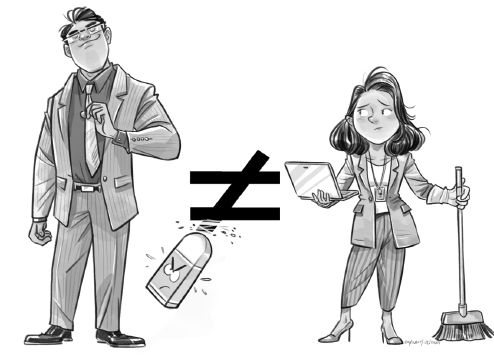
All this is because gender equality is fundamentally a question of power. Centuries of discrimination and deep-rooted patriarchy have created a yawning gender power gap in our economies, our political systems and our corporations. The evidence is everywhere.
Women are still excluded from the top table, from governments to corporate boards to prestigious award ceremonies. Women leaders and public figures face harassment, threats and abuse online as well as offline. The gender pay gap is just a symptom of the gender power gap.
Even the supposedly neutral data that informs decision-making from urban planning to drug testing is often based on a "default male"; men are seen as standard while women are an exception.
Women and girls also contend with centuries of misogyny and the erasure of their achievements. They are ridiculed as hysterical or hormonal; they are routinely judged on their looks; they are subjected to endless myths and taboos about their natural bodily functions; they are confronted by everyday sexism, mansplaining and victim-blaming.
This profoundly affects us all, and is a barrier to solving many of the challenges and threats we face.
Take inequality. On average, women earn 77 cents for every dollar earned by men. The latest research by the World Economic Forum says it will take 257 years to close this gap. Meanwhile, women and girls do some 12 billion hours of unpaid care work every day that simply does not figure in economic decision-making. If we are to achieve a fair globalization that works for everyone, we need to base our policies on statistics that take into account women's true contributions.
Digital technology is another case in point. The lack of gender balance in the universities, start-ups and the "silicon valleys" of our world is deeply worrying. These tech hubs are shaping the societies and economies of the future; we cannot allow them to entrench and exacerbate male dominance.
Or, take the wars that are ravaging our world. There is a straight line between violence against women, civil oppression and conflict. How a society treats the female half of its population is a significant indicator of how it will treat others. Even in peaceful societies, many women are in deadly danger in their own homes.
There is even a gender gap in our response to the climate crisis. Initiatives to reduce and recycle are overwhelmingly marketed at women, while men are more likely to put their faith in untested technological fixes. And women economists and parliamentarians are more likely than men to support pro-environmental policies.
Finally, political representation is the clearest evidence of the gender power gap. Women are outnumbered by an average of 3 to 1 in parliaments around the world, but their presence is strongly correlated with innovation and investment in health and education. It is no coincidence that the governments that are redefining economic success to include well-being and sustainability are led by women.
This is why one of my first priorities at the United Nations was to bring more women into our leadership. We have now achieved gender parity at the senior level, two years ahead of schedule, and we have a road map for parity at all levels in the years to come.
Our world is in trouble, and gender equality is an essential part of the answer. Manmade problems have human-led solutions. Gender equality is a means of redefining and transforming power that will yield benefits for all.
The 21st century must be the century of women's equality in peace negotiations and trade talks, in board rooms and classrooms, at the G20 and the UN.
It is time to stop trying to change women, and to start changing the systems that prevent them from achieving their potential.
The author is secretary-general of the United Nations. The views don't necessarily represent those of China Daily.


Today's Top News
- Militarism revival efforts criticized
- Leadership highlights Party conduct
- Forging a human-centered future in era of smart machines
- Land-sea trade corridor key to regional progress
- Local rules to be reviewed to help disabled
- Stronger RMB points to resilience