


Art: Ancient Chinese bronze in Texas










Touted as the largest and most prestigious collection of Chinese bronzes ever seen in Texas, the exhibition Eternal Offerings: Chinese Ritual Bronzes that opened recently at Houston's Asia Society Texas Center (ASTC) stands out in quality.
"It's a very special opportunity to have so many bronzes of such a wide variety, such high quality and the very good condition most (of the) objects are in. It's a combination of different positive aspects coming together in this exhibition," said Bridget Bray, curator and director of exhibitions at ASTC.
The collection belongs to the Minneapolis Institute of Art and is regarded as one of the best collections of Chinese bronzes in the US, said Bray.
A total of about 100 pieces in this exhibition give viewers an opportunity to appreciate the innovations both in form and techniques of bronze casting from the Shang Dynasty to the Han Dynasty (1600 BC-AD 220).
Besides the high quality of the works, the collection is also outstanding in its breadth and depth. "There are so many different representative examples from different dynastic periods as well as different vessel types for different purposes. It can become a comprehensive learning experiences whether someone is a connoisseur or a complete novice," said Bray.
Pointing at a wine vessel in the shape of owl from the late Shang Dynasty (1300 BC-1046 BC), Bray explained its uniqueness.
"Its size, form and the execution of the object is very high on the technical level," said Bray. "The patina (of many bronzes) is extensive, and one can't make out exact details, but this one you can make out each particular feathery type on the surface. It helps people to understand that the artists at that time were not only interested in function but also very concerned with its aesthetic impact. They worked so hard to have the technique of bronze casting supporting this stunningly beautiful form."
An owl-shaped bronze has achieved a star status among the objects in the show. During a preview in late February, it garnered the most attention and admiration from the viewers who marveled at its beauty, exquisite pattern and relatively intact condition.
A food vessel from the Warring States Period (475 BC-221 BC) is another piece Bray considers worthy of special attention.
"The lid with tripod feet lift off and can be set aside to serve as well," she explained. "I would like to invite visitors to pay attention to the very fine detail on the surface. You can think about how advanced the technical aspects of bronze casting were. To receive that exact level of detailed low-relief casting is very complicated."
Technology is one of the aspects that people should think about when viewing this collection, Bray said.
"Nowadays, when we think technology, it's almost always digital technology. If you can cast your mind back 3,000 years to the Bronze Age, (you will see) technology interrupted different parts of the globe in such a unique and magnificent way in China. We can be grateful to Chinese civilization for such high tech in bronze technology," said Bray.
Another aspect of the collection shows the continuity of Chinese culture. One case displays a bronze wine vessel from the early Western Zhou Dynasty (1046 BC-977 BC) and a porcelain vessel of similar shape from the Qing Dynasty (1644-1911).
"In this instance, you can see this one from the Zhou impacted the later artists and collectors," observed Bray. "The earlier form was so valued and appreciated that people would commission much later into the Qing Dynasty something in similar shape. The vessels are very similar in form, but obviously the blue and white porcelain body takes on a different life."
"It may not be used in the same way, but you can see the continual impact of all those centuries later. Reverence and appreciation for prior achievement is something seen very much in the centuries of Chinese art history," she said.
Four vessels in one case are examples that show the evolution of Chinese art, said Bray. "When you look at these vessels, you notice how similar the first two are to each other with the taotie (mythical creatures). As you go further along, the taotie disappear, and you start to see beautiful abstract forms. We get to see technology evolve and change over time."
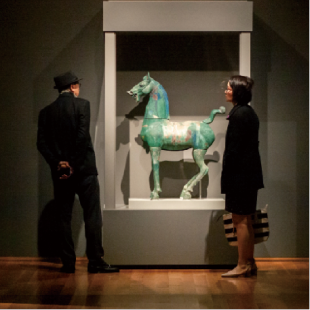
A large celestial horse from the Han Dynasty (206 BC- AD 220) is another major draw at the exhibition. "Now we are seeing bronze not necessarily serving that purpose (of ancestor worship) but still has a ritual purpose to play," said Bray. "This idea of a heaven horse — it can convey someone back and forth between heaven and earth. It's cast in different pieces (and) put together. To really play up the scale, the artists had to be creative and adaptive in their casting techniques."
So far, the feedback from visitors has been very warm, said Bray. "The feedback is so strong and positive that I feel gratified that people seem to understand the experiment we are trying, which is helping people to think about technologies and rituals in periods very different than our own in 21st century Houston. There is appreciation for beauty."
Eternal Offerings is now open through Aug 9 at ASTC and is free to the public.
The exhibit will be on display for two months longer than a typical exhibit. "We want to keep it on view as long as possible," said Bray. "By coming to the Asia Society, you can learn and go away with much richer appreciation for the artists working in those periods and a larger sense for Chinese history in general."