Outbreak to impact EU-US-China ties









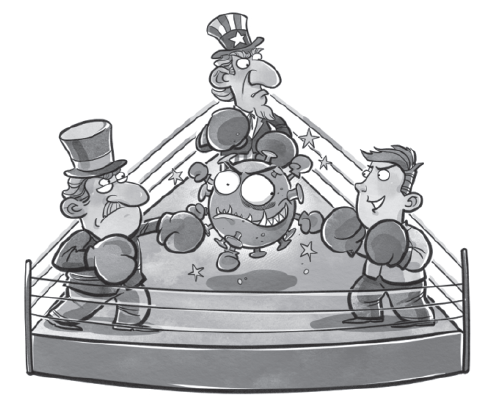
The novel coronavirus outbreak will have a major impact on relations between the European Union, China and the United States, the world's three biggest economic actors responsible for more than 50 percent of global wealth.
Some US politicians have sought to blame China and the EU for failing to tackle the outbreak, thereby showing zero understanding of the need for global cooperation to combat the worst pandemic in decades. Trust in US leadership is certain to take a further tumble after the US administration's erratic handling of the crisis.
US-EU ties frayed even before travel ban
Relations between the EU and the US were already frayed before the US banned passenger flights from Europe (initially excluding the United Kingdom). The move came as a huge shock to the EU and prompted a strong protest from EU leaders who were neither consulted nor informed in advance. European Council President Charles Michel and European Commission President Ursula von der Leyen, in a joint statement, said the coronavirus outbreak is "a global crisis, not limited to any continent and required cooperation rather than unilateral action". This was an unusually blunt critique of the US' action and revealed the lack of trust between Brussels and Washington.
For the first time since the creation of the EU, there is an occupant in the White House opposed to European integration, and who has gone so far as to describe the EU as a "foe" actively seeking to take advantage of the US by its trade surplus and not paying enough for its defense. The US administration also sought to weaken the EU by supporting Brexit and suggesting the US leader's "friend", Boris Johnson, should be prime minister even when Theresa May was still in office.
Transatlantic relations have also been poisoned by the US leader's disavowal of the Paris climate change agreement and the Iran nuclear deal, two major feats of European diplomacy. The US' withdrawal from the Intermediate-Range Nuclear Forces Treaty and unilateral support for Israel's expansionist policies in the West Bank have left the US leader at odds with European leaders. The US has also imposed tariffs on European steel and aluminum on the spurious grounds of national security, and has pushed the EU to open up its agricultural market and threatened to impose tariffs on European cars if it does not.
The US administration's mishandling of the coronavirus crisis and its economic impact, especially on global stock markets, could influence the US presidential election and throw up a surprise result. Certainly, this would be welcomed in Europe but it would be illusionary to think that all transatlantic problems would be resolved if, say, Joe Biden were in the White House. Transatlantic cooperation would improve on climate change and Iran, but tensions would remain over defense, trade and China, because these reflect a more structural and longer-term divergence of EU and US interests.
Conspiracy theories add to poor US-China relations
The novel coronavirus pandemic has increased mistrust between the US and China with conspiracy theories being aired, and each side blaming the other, which has hampered efforts at global coordination to tackle the crisis. Before the pandemic, US-China relations were characterized by Washington's trade war with Beijing. And only after months of wrangling did the two sides agree an interim trade deal in January.
Both parties have an interest in the "phase one" trade deal being implemented, but the extent of the impact the coronavirus outbreak will have on trade is not clear. The US administration wants to portray the deal as a success before the November election. Beijing, too, wishes to keep the deal in place to avoid a return to previous tariff levels and increased uncertainties, especially amid efforts to jumpstart the Chinese economy. A prolonged crisis will mean further disruption to the Chinese economy and to the country's pivotal role in global supply chains.
There are already calls in the US Congress and elsewhere for the US to decouple from China. So far few companies have done so, but that could change. The incumbent US administration has overseen a transition from the Barack Obama administration's position of regarding China as partner in some areas such as climate change to a potential enemy that must be contained. And trade rivalry has now transformed into technology rivalry as is evident from the US' pressure on European countries to ban Huawei.
EU, China are partners and competitors
The EU and China have cooperated closely in the fight against the coronavirus outbreak, exchanging information and sending medical supplies and experts to the worst affected regions including Wuhan in China's Hubei province and Lombardy in Italy.
Regrettably, the pandemic has led to the postponement of the EU-China summit scheduled for the end of March in Beijing. That would have been an ideal opportunity for the new EU leaders to get to know their Chinese counterparts. The pandemic has led to a lockdown of EU institutions and thus slowed the important negotiations on an EU-China investment treaty. Last year the EU made clear that there would have to be measured progress toward this agreement, otherwise a raft of defensive trade measures would take effect.
The EU and China are partners in several areas, from climate change and ocean governance to the Iran nuclear deal and promoting security in Afghanistan. But they are also competitors in some areas. But interestingly, European governments have not followed the US' "diktat" on banning Huawei, with several EU member states allowing the Chinese tech giant to participate in their 5G infrastructure construction. Trade between the EU and China will inevitably slow this year as a result of the pandemic, but unlike in the US there is little talk of decoupling the two economies.
The pandemic is thus having a major impact on EU-US-China relations. It has disrupted trade and travel, and sparked a national rather than an international response. In an ideal world, there would be no talk of a "foreign virus"; instead, there would be acknowledgement that a pathogen knows no borders and has no political loyalties. The pandemic is a common threat that requires a coordinated global response. But that is not the way the US administration thinks and thus the US' relations with both the EU and China may continue to suffer.
The author is director of the EU-Asia Centre. The views don't necessarily reflect those of China Daily.





Today's Top News
- Wang to meet foreign ministers of Cambodia, Thailand in Yunnan
- China's top legislature concludes standing committee session
- Thailand and Cambodia agree to temporary ceasefire
- NPC's 4th annual session slated for early March
- Civilizational links for a fairer world
- Manufacturing in China spurs global growth