On the mend









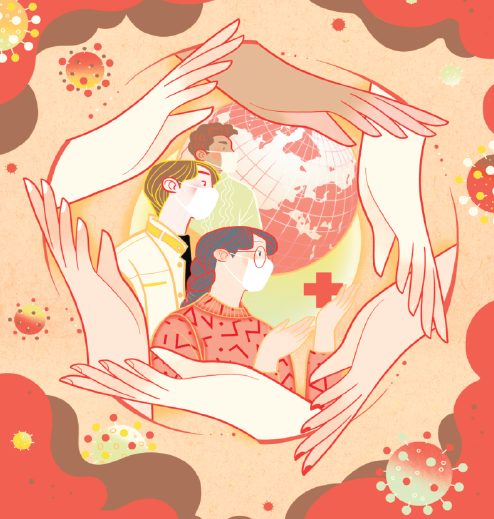
Response to novel coronavirus outbreak shows China can play a meaningful role in improving global health governance
The novel coronavirus epidemic has again put global health governance under the spotlight. The epidemic, along with other outbreaks in recent years, such as the severe acute respiratory syndrome (SARS), the Ebola virus and Middle East respiratory syndrome (MERS), have revealed the huge threat infectious diseases pose to humankind and has demonstrated the urgency of strengthening global health governance. China's efforts in fighting the novel coronavirus have been praised by the international community and have demonstrated its potential to further contribute to global health affairs. At the same time, China still has a long way to go to play its due role. How then can China play a bigger role in global health governance?
First, it should formulate its own strategy of global health governance. A country's strategy for global health governance is the guidebook for it to participate in global health affairs, a common practice for major countries in the world. As China has not yet developed such a strategy, it lacks a consistent vision and plan for taking part in global health affairs. To have such a strategy, China should first incorporate health security into its national security strategy, something which has not been given due attention. Moreover, the strategy should encompass objects, subjects and methods. China should make a global health governance strategy that suits its international status. It should have diversified funding sources, and enable mutual assistance and experience sharing.
Second, China should increase its influence in global health affairs. As a developing country, China has long been a beneficiary of international medical assistance, and a follower of established rules and frameworks in global health governance, a role that is no longer deemed suitable to China's growing economic strength, improving healthcare services and rising global status and which fails to meet the expectations of the rest of the world. Actively engaging in global governance is China's national strategy in the new era, which is to build a global community with a shared destiny. In this context, it is an obligation for China to deeply engage in global health governance and increase its influence. To this end, China should actively join all kinds of global health bodies and forums, and make its voice heard while playing the role of coordinator in international health organizations.
Third, it should promote reform of the global health governance system and mechanism. International organizations, such as the World Health Organization, have played a key role in coordinating global efforts in fighting the novel coronavirus pandemic. However, some problems remain in the current global health governance system, and it has not been able to respond to the continually aggravating and complicated situation of the pandemic. These organizations lack authority, and coordination among participants is poor. The governance mechanism should be reformed to solve the problems.
Despite the problems emerging in its responses to the outbreak, the WHO is still the sole platform for international health cooperation that is recognized globally. Reform is needed to improve its transparency, efficiency and accountability, as with other international organizations, such as the World Trade Organization and the United Nations Children's Fund. Besides, coordination among participants should be enhanced, and resources should be pooled together to better cope with global health problems.
Fourth, it should strengthen cooperation with other participants in global health affairs. China has long been taking part in global health affairs through official and diplomatic ways, which has kept it from deeply engaging in the global system. In addition to international organizations such as the WHO and the United Nations, the bodies that take part in global health governance also include multilateral mechanisms, non-governmental organizations, foundations, private sectors and civil organizations. These participants have diversified ways to engage in global health governance. They focus on specific areas where they have expertise, and are more agile in gathering information and raising funds. China should collaborate further with these participants, through official or civil ways, thus better integrating itself with the global system.
Fifth, China should promote its successful experience. Since the founding of the People's Republic of China, the country has made leaps and bounds in healthcare. Its efforts in fighting the novel coronavirus have set an example for the rest of the world. To promote its experience, China should introduce its healthcare system to other countries, especially developing nations; it should also export its medical expertise, such as traditional Chinese medicine. Traditional Chinese medicine has helped safeguard Chinese people's health for thousands of years, and it has also played a significant role in treating patients infected with the novel coronavirus. Of course, China's economic development and medical services still lag behind those of developed nations, so it should follow an active, but moderate, pattern in contributing to global health governance.
To sum up, China should play a bigger role in global health affairs, through formulating a global health strategy, increasing its influence, pushing for reform of the global health governance system, strengthening cooperation with various international participants and promoting its successful experience, thus playing a role suitable to its global strategy and status.