ICU expert expresses pride in livesaving role
Leading physician uses long experience to treat seriously ill patients in South China. Li Bingcun reports from Hong Kong.









It was mid-February, and the battle against the novel coronavirus seemed to be at a stalemate.
Those were the worst days for Li Xu, a physician and intensive care unit specialist, during his ongoing assignment at the Third People's Hospital of Shenzhen, the only facility in the Guangdong province city designated to treat patients confirmed as having COVID-19.
"Though no new patients came in, existing patients were not improving. It was like the battle had reached a standstill," he said.
The morale of Li, 35, and his colleagues plummeted when two patients died in quick succession.
On Jan 31, Li was transferred to the Third People's Hospital from the University of Hong Kong-Shenzhen Hospital, another medical center in the city, tasked with treating the most severely ill patients.
A 36-year-old patient surnamed Hu was close to death. Large areas of her lungs were severely infected and she was being kept alive by a ventilator. Li was determined to save her life.
In late January, Hu had visited relatives in Wuhan, Hubei province, the city once regarded as the epicenter of the outbreak.
When she returned to Shenzhen she was already infected with the coronavirus, which took a heavy toll on her family as her husband, mother and 7-year-old daughter also became infected.
In time, they recovered and were discharged from the hospital, but Hu's condition deteriorated. She was intubated and placed under sedation for more than 10 days.
The medical team made several attempts via different approaches to treat her, but nothing worked.
The team was disappointed, because no treatment seemed to improve Hu's condition and she was likely to die. Li decided to bring Hu out of her sedated state and adjust the treatment according to her reactions.
It was a risky decision. After Hu regained consciousness, her breathing became more rapid, which could have affected the exchange of oxygen and carbon dioxide in her body. Many other serious complications were also likely.
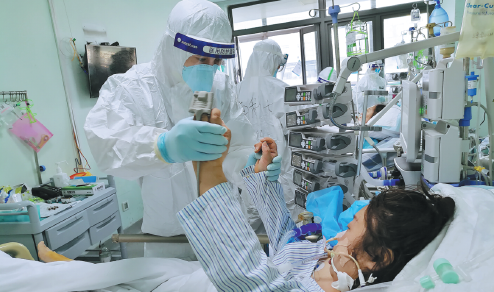
The patient's mood fluctuated wildly and she had to be restrained from pulling the breathing tube out of her mouth. Li sat beside Hu and explained the situation to her, stressing that removing the tube could end her life.
Li encouraged her in the days that followed, telling her not to breathe too quickly, helping her adapt to the tube and exercising her arms and legs. He cured her diarrhea, improved her nutrition and arranged for her husband and daughter to cheer her up via a video call.
After many trials, Hu's condition gradually stabilized and the tube was removed on Feb 23. That was four days after Li took charge of her case.
She showed signs of returning to good health and was later transferred to a general ward. A senior doctor told Li that Hu's recovery had lifted the morale of all the medical teams at the hospital.
Hu also credited Li with her recovery. She talked about the heavy blow to her and her family, and how her plans had been upended. She said that she had survived thanks to the encouragement of doctors and family members and she knew she would be discharged soon.
Call to arms
In late January, when Li was asked if he was willing to work on the front line against the pandemic, he stepped up, saying it was the duty of every medical worker.
He spends most of his time at the Third People's Hospital in the ICUs. A normal shift in the department is four hours, but he sometimes stays for more than seven.
He checks patients from head to toe and adjusts their equipment as required. He has also manually performed colonic cleansing for comatose patients every two or three days to prevent bacterial infection.
Each doctor takes charge of three patients during peak hours. When Li finishes work with his patients for the day, he walks through the wards checking other severely ill patients and encouraging them.
He even regularly visits patients in his free time.
Light in the dark
Li said many ICU patients are extremely anxious. They constantly ask "When will I recover?" and "When can I be discharged?"
Li takes the time to encourage them and help them endure the ordeal. He helps them get out of bed, explains breathing exercises and provides psychological counseling.
One evening, he took three severely ill patients in wheelchairs to watch the sunset together.
"All they ever saw was doctors and nurses in protective suits and all they heard was the sound of medical equipment. They needed something vibrant to give them hope," he said.
A female patient, surnamed Zhang, was one of the three. Though she was not directly under Li's care, he visited her frequently to chat and encourage her. Her crisis passed and she was later transferred to a general ward.
Zhang, her husband, daughter, son-in-law and 2-year-old grandson were all infected with the coronavirus. They had returned to Shenzhen after visiting Wuhan, just like Hu.
Zhang had lost hope, especially after learning that her grandson had been infected. She recalled that the little boy cried out: "Grandma, help me! Save my mom! Save my dad!"
She said, "I thought he was too young to understand, but actually, he was fully aware of the situation."
She added the medical workers had given her the confidence to overcome the disease. "Without their help, I may not have survived. They treated me just like a family member," she said.
Li said his empathy for other people may be connected to his deep love of music. He arrived for his assignment equipped with recordings of his favorite songs and some rock band T-shirts. He also brought a speaker, but later replaced it with a bigger one to better enjoy the music.
He said he was under a lot of stress at the beginning of the assignment, but the music helped relieve the pressure and "saved his life". He likes to listen to the band Painkiller from the United States, especially their song Your Inviolable Freedoms.
His recent experiences have deepened his commitment to his work as an ICU doctor. "One of the most fortunate things in my life is that I studied critical-care medicine and one of the proudest things in my life is that I became an ICU doctor," he said.
Not every doctor has the determination to be an ICU doctor. Treating dangerously ill patients can result in immense mental and physical pressure, Li said. Yet for him, nothing compares with the sense of fulfillment when a patient is brought back from the brink of death.



Today's Top News
- Manufacturing rebounds in December
- PLA wraps up military drills around Taiwan
- Ties with Russia expected to bear fruits
- Confidence, resolve mark China's New Year outlook
- Xi urges solid work for more progress
- Confidence, resolve mark China's New Year outlook: China Daily editorial