Shifting to degradable plastic faces challenges









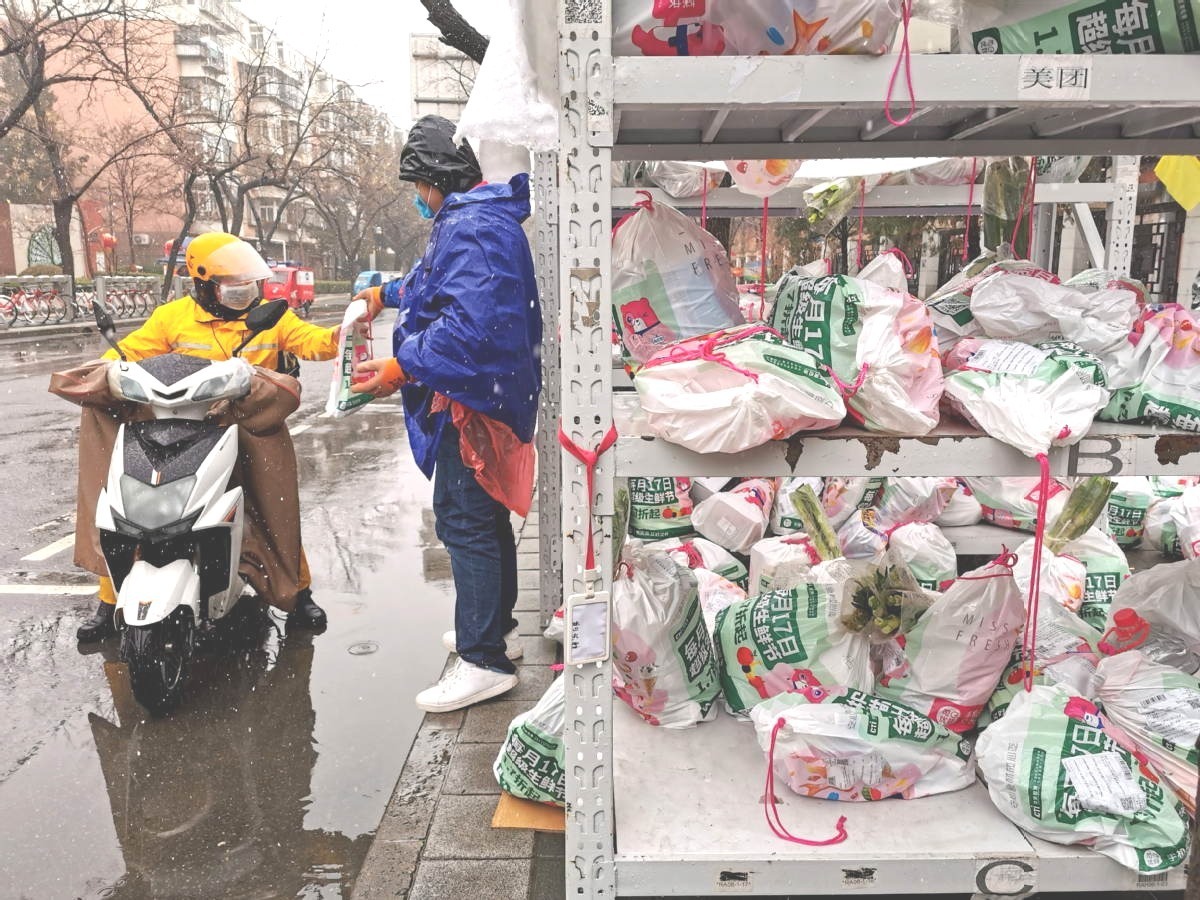
Deliverymen stand among plastic packages and boxes sealed with tape on sidewalks as they call residents to fetch their goods. Parcels and takeout food in plastic bags and containers pile up on shelves outside residential blocks.
As people stay at home more because of the novel coronavirus pandemic, the express delivery industry seems to be one of the least affected in China, as can be seen in many urban areas.
What people buy online varies, but most of the disposable plastic tape, bags and containers used to facilitate deliveries-billions of items a year-end up being dumped.
Last month, the National Development and Reform Commission began rolling out an ambitious plan to curb plastic pollution in major cities by 2025.
As a first step toward implementing the plan, which was released in a guideline issued by the commission and the Ministry of Ecology and Environment in January, the NDRC sought public feedback on April 10 on a list of disposable nondegradable plastic products that it plans to ban or restrict.
Seven of the 13 products on the list are related to the country's still booming express delivery and restaurant takeout sectors, including tape and packaging.
The country will also explore the use of degradable plastic products, a move experts have welcomed.
They say it will boost the development of the degradable plastic industry, but noted that some challenges will be faced in carrying out the plan.
Aside from the need for more research and development to make degradable plastic products suitable substitutes, they said the introduction of degradable plastic into a market where nondegradable products are still in use will make recycling difficult.
Wang Wenguang, secretary-general of Shenzhen Polymer Industry Association, said "the conditions are not yet mature for large-scale use of degradable plastic", but he was confident that, with government support, the country would succeed in promoting it.
China is able to manufacture all five major types of degradable plastic available globally, Wang said.
But he said output is insufficient to meet demand in the event of a sudden ban on nondegradable plastic, and the price of degradable plastic remained high in China.
The price of biodegradable plastic, for example, is three to five times that of the nondegradable plastic commonly used in China, according to a report released last year by Forward (Qianzhan) Intelligence, a market research firm.
"The country should gradually shift from nondegradable to degradable plastic," Wang said.
According to the January guideline, nondegradable single-use plastic products will gradually be banned in the restaurant industry in urban areas and scenic spots across the country by the end of 2022, and then in the express delivery sector three years later.
Meanwhile, nondegradable plastic bags are expected to disappear from some major consumption sectors, including shopping malls, supermarkets and restaurant takeout services, in metropolises by the end of this year and then in all major Chinese cities and urban areas in coastal regions by the end of 2022.
Wang said a viable solution to addressing low production and high prices was to mix cheaper substances such as starch and crop straw into degradable plastic.
A lot more work is needed to improve the heat resistance of degradable plastics to make them adequate substitutes, he said, adding that degradable plastic bags were fragile.
Considering the high cost of producing degradable plastic, Wang said it is best to recycle it. However, recycling could be difficult if it is mixed with common plastic, which is bound to happen before nondegradable plastic was completely banned.
Mao Da, director-general of Toxics Free China, an NGO, also warned the recycling system faced challenges in the shift to degradable plastic.
"Products of the two types will coexist for an extended period of time, but they cannot be processed for recycling together," he said. "Special facilities are needed to deal with degradable plastic. There will be a lot of pressure on the recycling system then."
Mao added that degradable plastic only degrades under certain conditions and it could still pose an environmental hazard as the process could take decades in nature.
While the authorities have yet to draft the standard for degradable plastic required in the January guideline, some types currently available can only degrade in about three months under controlled conditions-temperatures of 50 C to 70 C and relative humidity of 50 to 60 percent.
Instead of completely turning to disposal degradable plastic, the country should also set limits on its production and consumption in advance so that the use of disposal products can be reduced, Mao said.
"As long as they are disposable, they pose environmental hazards," he said.
Without such curbs, the guideline might send out the wrong message that degradable plastic was green.
In 2016, China's express delivery industry used about 17.9 billion plastic bags and 330 million rolls of adhesive tape in 31.35 billion deliveries. The State Post Bureau predicted that 74 billion deliveries would be made in 2020.




- Guangdong urged to drive high-quality development
- Shanghai hosts 6th intl 3E talent fair
- Xi's special envoy attends inauguration of Bolivian president
- Countdown to 15th National Games: On-site warm-up entertains audience
- Eight missing after cargo ship collides with fishing vessel near Shandong
- Investing in people: a worthwhile investment