Xi says protecting heritage crucial









Visit to Yungang Grottoes highlights his focus on cultural understanding as a unifying force
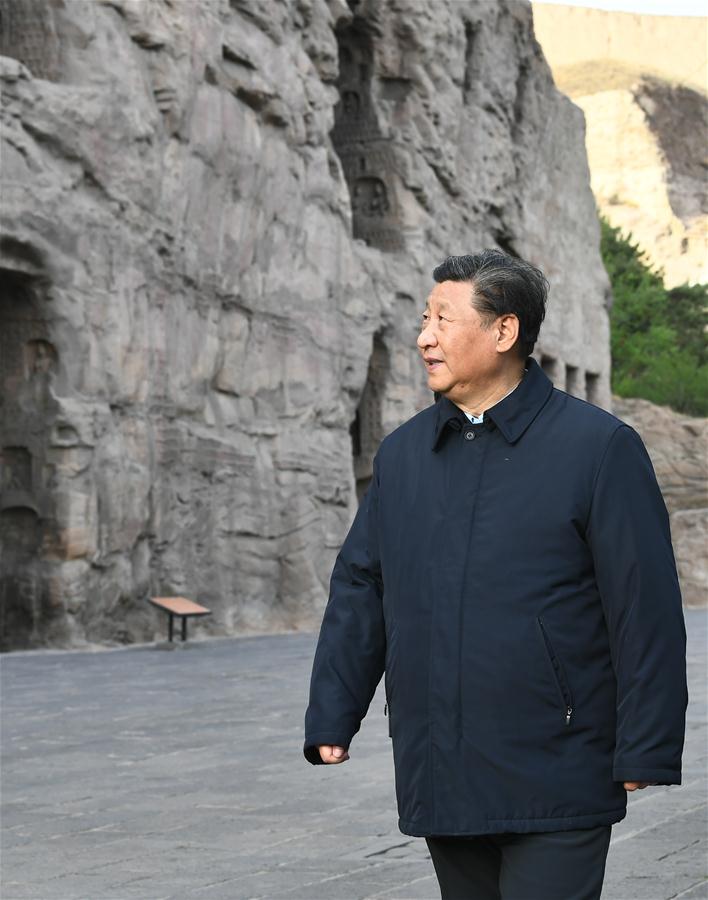
President Xi Jinping's visit to the Yungang Grottoes in Datong, Shanxi province, showed his persistent focus on protecting and exploring the value of cultural heritage to foster a stronger sense of cultural identity and enable further exchanges between civilizations, experts said.
At the Buddhist grottoes, Xi carefully reviewed the statues and wall paintings in the caves and niches and asked staff workers about the protection of the cultural heritage. It was part of his two-day inspection trip to Shanxi province, which concluded on Tuesday.
The protection of the Yungang Grottoes, listed as a UNESCO World Heritage Site in 2001, is of major significance both for China and the world, he said.
The Yungang Grottoes represent the characteristics of Chinese culture and the history of cultural exchanges between China and other countries, Xi said.
The fact that historical cultural heritage assets are nonrenewable and irreplaceable resources means that protection should be a top priority, he said, adding that the development of tourism should avoid excessive commercialization.
It is important to make tourism a process in which people understand Chinese culture and their cultural confidence is bolstered, he said.
He also underlined the importance of conducting more in-depth exploration of the historical contents from the Yungang Grottoes in which different ethnic groups exchange and blend with each other, in order to enrich the sense of a shared community of the Chinese nation.
UNESCO said on its website that the Yungang Grottoes, which comprise 252 caves and 51,000 statues, represent the outstanding achievement of Buddhist cave art in China more than 1,500 years ago.
While influenced by Buddhist cave art from South and Central Asia, the Yungang Grottoes interpreted the Buddhist cave art with distinctive Chinese characteristics and local spirit, and they had a farreaching impact on Buddhist cave art in China and East Asia, the organization said.
Liu Qingzhu, a researcher with the Institute of Archaeology at the Chinese Academy of Social Sciences, said the reason Xi has placed much emphasis on the protection and exploration of cultural heritage is because of its central role in uniting the people.
"China has an uninterrupted, time-tested civilization of 5,000 years, and it is imperative that we further explore it beyond any doubt," he said.
He added that quite different from collectors who use cultural relics for purposes of display, the protection and exploration of cultural heritage assets must serve a country's development.
"Cultural heritage (resources) are reminders that people should not forget their cultural genes, and history can bind a nation's hearts together," he said.
He noted that the Yungang Grottoes, built with imperial instructions during the Northern Wei Dynasty (386-534), show a high level of inclusiveness of foreign culture and recognition of Chinese culture.
Xi has always maintained that culture should serve as a bond to promote dialogue between different civilizations.
During his trip in August to Gansu province, where he visited the Mogao Grottoes and held a symposium with scholars from the Dunhuang Academy, Xi lauded Dunhuang culture as an outcome of the long-term integration of the Chinese and various other civilizations.
As the country works toward the renewed glory of the Chinese culture, it is important to conduct more extensive cultural exchanges with a more open mind and to more proactively learn from all outstanding civilizations, he said.
Xi underscored that parallel efforts must be made to explore the aspects of philosophy, humanity, values and morality from Dunhuang culture and its historical heritage, and to reveal the cultural spirit and mindset of the Chinese nation to foster firmer cultural confidence.
He also urged stronger support for and protection of the quintessence of Chinese culture and intangible cultural heritage, including better research of the history and culture of ethnic groups, to consolidate the sense of unity of the Chinese nation.
Xi also visited the Jiayu Pass, a famed part of the Great Wall built in the Ming Dynasty (1368-1644) during the Gansu trip, and highlighted the significance of keeping China's history and culture alive and strong to preserve the roots for the survival and thriving of the Chinese ethos.
While visiting the Hepu Han Dynasty Museum in the Guangxi Zhuang autonomous region in April 2017, Xi stressed that efforts must be made to let cultural relics, history and culture speak, and to reinforce the research and inheritance of history.




- Xi attends carrier's commissioning
- Senior Xi'an official facing probe by China's anti-corruption watchdogs
- Philippines risks creating trouble for itself: China's defense ministry
- Newborn with congenital heart disease receives life-saving surgery in Yunnan
- Hong Kong charity signs diplomatic talent deal with Beijing university
- Aircraft carrier Fujian, commissioned