Competitive edge will be key to HK's prosperity









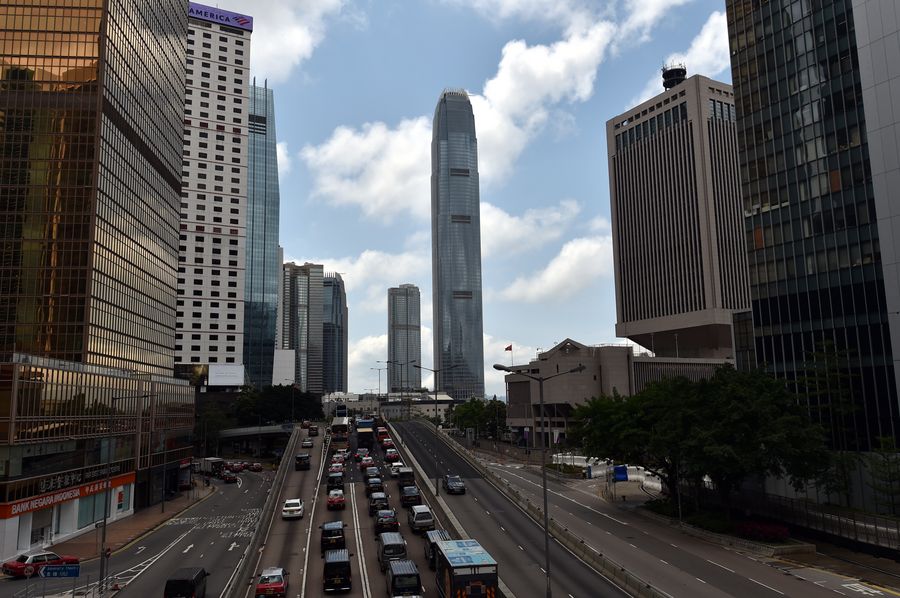
The violent social unrest last year dealt a severe blow to Hong Kong's economy and society.
Its real GDP contracted 1.2 percent in 2019, representing the first annual decline since 2009. Tourism, transportation and commerce were heavily disrupted, casting a shadow over consumer and business sentiment.
Hong Kong's private consumption expenditure registered the first annual contraction since 2003, while the overall investment expenditure recorded the deepest drop in two decades. The exports of goods to major markets shrunk, while its exports of services witnessed the worst decline.
According to the Hong Kong Police Force, the total number of crimes reported in 2019 increased more than 9 percent compared with 2018, reversing the downward trend of the past 12 years.
Rioters used bricks, corrosive liquids and gasoline bombs. The separatist tendencies among radical protesters have endangered Hong Kong's stability and security.
Most countries have laws to safeguard national security against threats such as state rivalries, armed insurgency and terrorism. As new threats arise, societies need to upgrade their enforcement mechanisms.
When China's National People's Congress enacted the Basic Law in 1990, it required the future Hong Kong Special Administrative Region to enact laws to prohibit treason, secession, sedition and subversion against the central government.
For more than 20 years, Hong Kong has been unable to enact its own security legislation. Tung Chee-hwa, former chief executive of Hong Kong, said the city has become "an easy target for hostile foreign opportunists to disrupt public order".
The NPC recently introduced legislation at the national level to improve the enforcement mechanisms for Hong Kong. By June 1, more than 2.9 million of Hong Kong's more than 7.5 million residents had signed a petition to support the legislation.
Henry Litton, a retired judge of Hong Kong's Court of Final Appeal, said the need to upgrade and improve upon national security laws "seems common sense".
Unfortunately, the United States administration has decided to disregard such common sense and attacked China's national security legislation for Hong Kong. The double standards of the US are ironic.
The US has used national security legislation to recalibrate the balance between security and civil liberties. After World War II, the US introduced the National Security Act of 1947, which established the National Security Council and the Central Intelligence Agency.
In response to the Sept 11, 2001, terrorist attacks, the US Congress further enacted the USA Patriot Act to provide law enforcement officials with the tools to prevent and combat terrorism.
Recently, to quell protests against police brutality, the US administration even threatened to invoke the Insurrection Act of 1807 to deploy the military.
In its attacks on China's national security legislation for Hong Kong, the US has threatened to impose sanctions and planned to "revoke preferential treatment for Hong Kong as a special customs and travel territory from the rest of China".
Such decisions are not consistent with the commercial interests of the US. According to the US Department of State and Department of Commerce, as of 2018, the US had its largest worldwide bilateral trade-in-goods surplus (around $31.1 billion) with Hong Kong. The stock of the US foreign direct investment in Hong Kong stood at around $82.5 billion.
Hong Kong has been a major market for US legal and accounting services as well as consumer-oriented agricultural products. Suspending Hong Kong's special trade status will create problems for more than 1,300 US companies operating in Hong Kong, including nearly all major US financial institutions.
The threat of sanctions from the US is not helpful for the market stability of the Asia-Pacific region at a time when international cooperation is needed to cope with the current global challenges.
The status of Hong Kong, the only common law jurisdiction within China, as an international financial center and business hub is a path-dependent, long-term evolutionary outcome based on its unique advantages in bridging China's growing markets with the rest of the global economy.
Regardless of the trade policies that the US administration adopts, Hong Kong's core competitiveness remains irreplaceable for Asia in the foreseeable future.
The bedrock of Hong Kong's prosperity lies not in the "preferential treatment" of other countries, but in its own competitiveness and institutional strengths built on a secure social order and an effective legal system.
The author is an assistant professor at the Centre for China Studies and Lau Chor Tak Institute of Global Economics and Finance at The Chinese University of Hong Kong. The views do not necessarily reflect those of China Daily.






- New plan to boost fight against hepatitis
- Ancient find reveals secrets of lamp fuels
- China sees return travel rush as National Day holiday comes to end
- China to see rainfall, temperature drop
- Ancient grottoes in Southwest China survive, thrive via innovative measures
- Macao sees tourism boom during National Day, Mid-Autumn Festival holidays