How China's GDP can grow by 3% or more this year









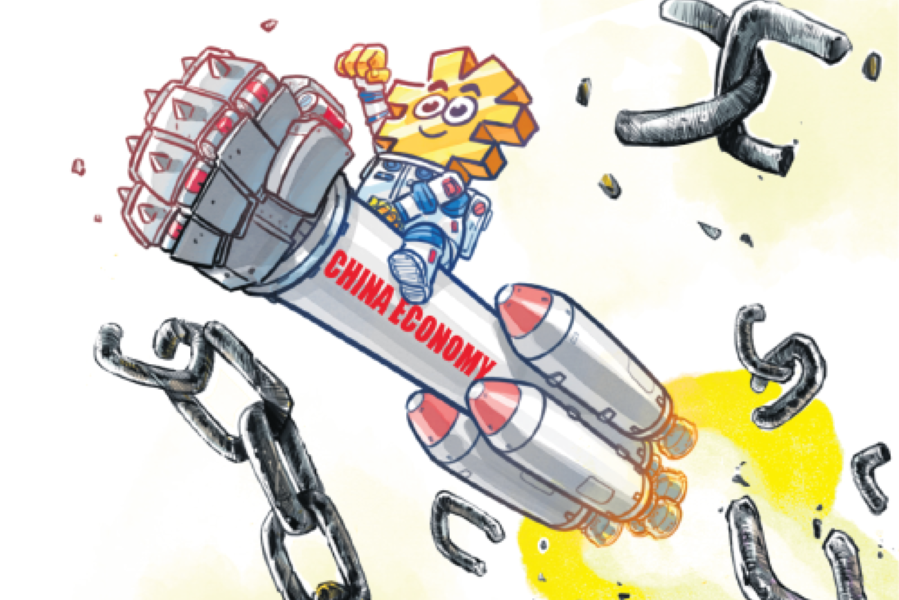
How to make economic policies without a headline growth target? The Chinese government did not set any specific goal of GDP rate this year. However, there is an "implicit "target to guide the growth.
According to this year's Government Work Report, there are some key economic indicators, including that the Consumer Price Index, a gauge of inflation, should be no higher than 3.5 percent, the total deficit is 3.76 trillion yuan ($536 billion) and the fiscal deficit was set at above 3.6 percent of GDP.
The report also listed some employment targets, such as that the registered unemployment rate should not exceed 5.5 percent and to create over 9 million new urban jobs.
China has always attached great importance to the speed of economic growth in the past decades. In the absence of the economic growth target, many other important economic indicators are difficult to determine and various policies are difficult to coordinate.
For example, without the nominal GDP target, it may be difficult to make the annual fiscal budget. Therefore, it is inaccurate to say that China has no economic growth target in 2020.
In fact, China has an "implicit" economic growth rate target, but the government has not publicly stated the specific figure. He Lifeng, head of the National Development and Reform Commission, once mentioned that the key elements of growth targets have been integrated into relevant indicators and policies, including fiscal, monetary and other policies.
To be specific, we can calculate China's 2020 nominal GDP target through two indicators: the deficit amount of 3.76 trillion yuan and the deficit rate of 3.6 percent, which I think is about 5.4 percent and the scale is 104.4 trillion yuan. If we assume that the inflation rate is 2 percent, the real GDP target in 2020 is 3.4 percent.
If we assume that China's economic growth rate can return to the 6-percent potential economic growth rate from the second quarter this year, it is relatively easy to calculate that the actual growth rate of China's GDP in 2020 will be about 3.2 percent. So, whether China will achieve a real growth of 3.2 percent or 3.4 percent depends mainly on effective demand.
Consumption, investment and net exports are the three major driving forces of the GDP, if we analyze the growth from the demand side. As consumption may contribute about 1.76 percentage points to the GDP growth, and the net exports may drive down the growth rate by 0.7 percentage point, it requires an investment growth of 5.7 percent this year.
The most important variable that the government can control is infrastructure investment. Infrastructure investment should increase significantly compared with last year. Only in this way can we achieve 5.7 percent growth in fixed-asset investment to ensure that China's GDP growth can be higher than 3 percent in 2020.
Therefore, promoting economic growth will depend mainly on infrastructure investment, and government policy should enable private enterprises to find investment opportunities.
Effective use of the fiscal expenditure is required. As the fiscal revenue at the end of the year may be less than expected, China's actual fiscal deficit in 2020 is likely to be much larger than originally expected, which is a problem worthy of attention.
This year, the central government will issue 1 trillion yuan special treasuries and local governments plan to issue 3.75 trillion yuan special bonds, which are not included in the calculation of fiscal deficits. If we take the calculation method of the World Bank Group, China's deficit rate will be 11 percent. So, the actual intensity of fiscal stimulus will be much higher than 3.5 percent.
In the large-scale fiscal stimulus policy, a lot of money is likely to be used to contain the COVID-19 epidemic and help people solve living difficulties. The government should also consider the multiplier effect of fiscal expenditure, which means a certain amount of funds should be used to increase investment and spur growth.
In terms of monetary policy, the central bank took very active measures in the first half of this year, doing everything it can to support firms and households.
At present, the recovery of economic growth mainly depends on fiscal policy. If the fiscal policy cannot play a leading role in promoting growth, the role of monetary policy will be very limited.
The major measure of the central bank is to conduct reverse repurchase operations in the open market and maintain low interest rates in the interbank money market.
Another way is to reduce the rates of medium-term lending facility to guide down the benchmark lending rate (loan prime rate or LPR). These tools aim to support flow of credit, at lower financing costs, to spur economic growth.
If economic growth cannot be accelerated, the central bank may have to further ease its monetary policy. And if the issuance of treasury bonds is constrained, the central bank may have an option to conduct quantitative easing measures, just as what has been done by Japanese and US central banks. I don't think we can rule out the possibility.
Considering the growth potential of China's economy, a coordination of fiscal and monetary policies will support the economy to achieve a positive growth, and the real growth is possible to be 2 percent to 3 percent this year.
The writer is an academic council member of the Chinese Academy of Social Sciences in Beijing. He also served on the Monetary Policy Committee of the People's Bank of China from 2004 to 2006.
The views don't necessarily reflect those of China Daily.