



Economic rebound augurs well for future









China stood out among major economies to register a 3.2 percent year-on-year growth in the second quarter, versus a 6.8 percent contraction in the first quarter, bringing hopes that the world's second-largest economy-if it continues to fare well-will help boost the global economy.
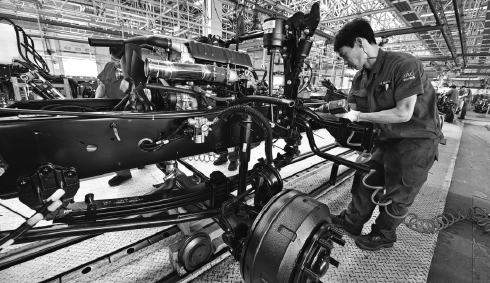
The improvement in major economic indicators-such as industrial output, retail sales, fixed-asset investment and exports-in the second quarter indicates the economy remains highly resilient and has a solid foundation for further expansion in the second half.
The indicators had either registered positive year-on-year growth or seen their negative growth narrow in the second quarter. Year-on-year industrial output growth, for example, was 4.4 percent compared with a negative 8.4 percent growth in the first quarter while retail sales registered a negative 3.9 percent growth, an improvement of 15.1 percentage points.
In the first half, China's GDP growth contracted by 1.6 percent on a yearly basis, 5.2 percentage points higher than in the first quarter, the National Bureau of Statistics announced on July 16.
The data beat general market expectations and showed that the Chinese economy has been on a steady track of recovery as the country has largely contained the COVID-19 outbreak and generally resumed work and production.
Considering that the COVID-19 pandemic in other parts of the world had greatly reduced economic and trade activity in the second quarter-which affected Chinese exports and foreign investment in the country-China's hard-won 3.2 percent GDP growth in the April-June period is quite impressive.
Such an outcome would not have been possible without timely and accommodative monetary and fiscal policies as well as elevated economic opening-up measures adopted by the central authorities.
China has taken a series of financial measures to reduce taxes and fees for enterprises, earmark fiscal funding to combat the pandemic and support infrastructure investment, and lower the cost of borrowing to bolster the corporate sector.
Infrastructure investment has also increased, which has become a major growth engine for the economy going forward.
The authorities have been making investment in public facilities and environmental protection, such as underground pipe networks, sewage and refuse disposal, public transport and water conservation. The rising waters in some regions of South China have damaged flood control facilities and the country is set to increase flood prevention infrastructure investment, which will boost and diversify fixed-asset investment.
Meanwhile, China has continued to open up its economy, exemplified by its decision to further lower the threshold for foreign investment in the financial sector and its launch of the Hainan free trade port initiative, which is conducive to global trade and investment flows-key for the early recovery of the battered global economy.
In the latest sign of China's opening-up resolve, President Xi Jinping said on Tuesday that China will not close its doors and instead will enable better connectivity between domestic and international markets and better employ the two markets and resources to achieve vigorous and sustainable development.
As the effect of these policies gradually unfolds, it is quite possible for China's economic growth to continue to strengthen in the second half of the year, which will benefit the global economic recovery from the COVID-19 pandemic.
Internationally, although uncertainties remain, the good news is that there have been signs of some developed economies, such as the United States, gradually recovering, which will increase demand for Chinese exports.
As the Chinese economy is expected to continue to recover in the second half, it faces multiple challenges on both domestic and international fronts.
Domestically, unlike in other countries, in China the possibility of a massive recurrence of COVID-19 is slim, but it remains unclear to what extent the domestic economy will recover in the coming months.
While economic indicators improved in the second quarter, some remain in negative territory. Policymakers must closely monitor their movements in the coming months to ensure they continue to pick up to bolster the job market and overall economic expansion. If they became weak in the third quarter, policy support will still be needed to ensure they can continue to improve.
Globally, there is still the risk of a second wave of the COVID-19 pandemic. This would dampen global demand and in turn affect demand for Chinese products and services.
As the International Monetary Fund warned in a June report, the COVID-19 pandemic has had a more serious impact on global economic activity in the first half than previously anticipated, and the global economic recovery may turn out to be more gradual than previously forecast.
In its latest 2020 World Economic Outlook forecast, the IMF said that global growth is projected to be a negative 4.9 percent this year, 1.9 percentage points below the April forecast.
Observers also expect that trade protectionism and geopolitical tensions may jeopardize global activity and disrupt economic recovery.
Such an unstable outlook may affect China's exports, which are an important pillar of the country's growth.
As the US presidential election draws near, Sino-US economic and trade relations may face more uncertainties, which will also dampen China's exports.
Facing such a complicated and precarious international environment, China must be forward-looking and make thorough preparations for the worst scenario that may come.
While continuing to implement policies to promote employment, production and consumption, policymakers should avoid overusing monetary and fiscal policies so that they leave themselves some policy room to cope with any unexpected eventualities.
With this in mind, some financial officials have hinted that authorities could pull back from the unusual monetary stimulus measures adopted in the first half to combat COVID-19, as the novel coronavirus is increasingly contained.
Such a flexible policy stance would put China in a better position to handle any contingencies in the coming months regardless of how the domestic and international economic situation plays out.
The author is a senior staff commentator at China Daily.





Today's Top News
- China reports 20% rise in inter-regional trips on first day of holiday
- China rebuffs criticism over drills around Taiwan
- Mainland pledges deeper cross-Strait integration in 2026
- Lai's 'separatist fallacy' speech rightly slammed
- Xi's message for New Year widely lauded
- Swiss bar fire kills around 40, injures more than 110








