Robotaxis to rev up after successful trials









New age technologies of autonomous driving companies gaining traction, investment from leading global giants
Without anyone behind the wheel, a taxi automatically started and made its way down the road, only to slowly come to a full stop at the first red light. Hu Wanqing, a sales manager from Guangzhou, Guangdong province, was fascinated by the self-driving taxi.
It was the first time the 32-year-old Hu hailed such a vehicle. Hu said she did feel nervous at first, but her worries were soon dispelled when the taxi gradually braked to allow a pedestrian to cross its path.
"The car is no different than an ordinary taxi. It just runs smooth and steadily, like a taxi driver with over 20 years' experience," she said.
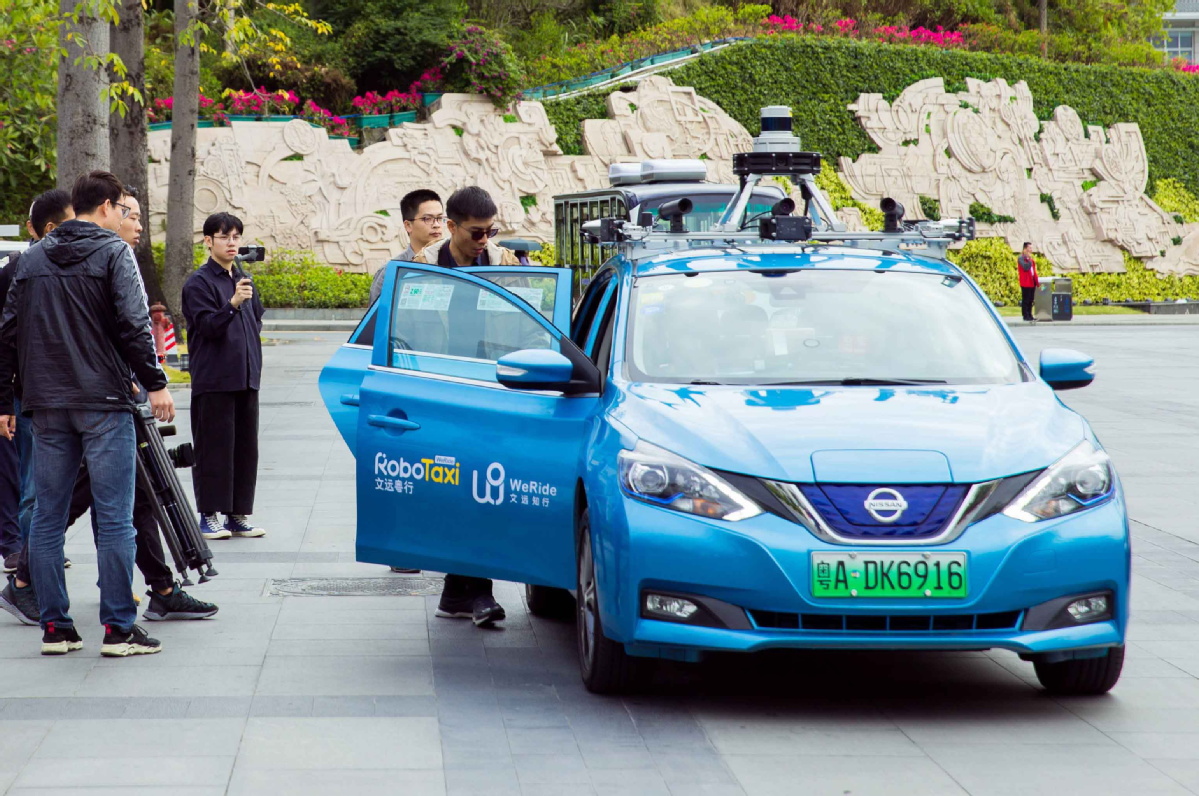
Like Hu, many in Guangzhou have begun to be able to hail self-driving taxis, or robotaxis, since late June after the country's autonomous driving start-up WeRide announced that its self-driving taxi service will be available on Alibaba's navigation platform Amap.
Autonomous driving is revving up its commercialization in China, especially as the COVID-19 outbreak has sped up related applications. Among them, robotaxis have come to the forefront of self-driving commercialization with several tech giants and self-driving companies recently launching unmanned taxi services.
Leading ride-hailing start-up Didi Chuxing opened its on-demand robotaxi services in Shanghai in June. It followed tech giant Baidu Inc, known for its Apollo self-driving platform, announcing the opening of its self-driving taxi service in Changsha, Hunan province, in April.
Momenta, a Daimler-backed Chinese autonomous driving start-up, said that some of its vehicles will be driverless by 2022 in Suzhou, Jiangsu province, where it received a test license, and its entire robotaxi fleet will operate without backup drivers in 2024.
"The autonomous driving sector is speeding up commercialization in China. It is expected that large-scale application of such cars will be a reality over the next two or three years, which is earlier than expected," said Zhang Li, chief operating officer of WeRide.
"The nation's efforts in new infrastructure are also accelerating the commercialization of self-driving vehicles and bringing a unique open market environment for local tech start-ups," Zhang said.
Currently, the nation's robotaxis are based on Level 4 autonomous driving, where a vehicle can run autonomously without human intervention in most cases. Autonomous driving is divided into six levels from Level 0 to Level 5.
Level 3 refers to "eyes off" in which the vehicle will handle situations requiring an immediate response, but the driver must still be prepared to intervene within a limited time. Level 5 is the highest standard, which means no human intervention is required at all.
For the time being, the country's robotaxis are all equipped with a backup driver in the car to ensure safety in case of emergencies. Companies also rely on safety control centers to monitor self-driving vehicles and road conditions in real time and give timely assistance and instructions to vehicles in need.
"Robotaxis can generate huge economic benefits in terms of profitability of labor cost savings. Replacing drivers with driverless technology will save 60 percent of total costs," said Yang Zeyuan, an analyst from CITIC Securities.
For most robotaxi services, passengers pay the same fee as for regular taxis. In Guangzhou, for instance, passengers pay a flagfall fee of 12 yuan ($1.7) and another 2.6 yuan every kilometer.
"The advanced technology requires many inputs, which may lead to difficulties in the short-term profitability of operating robotaxis. But we are bullish on long-term profit prospects," Yang said.
The commercialization of robotaxis is nearing with the decline in the cost of self-driving car components, Yang said.
"With people's increasing demand for ride-hailing services, robotaxis will usher in broader development prospects in the country. It is also expected that the global market will reach hundreds of billion dollars in the near future," Yang added.
- Shanghai designates downtown open road for self-driving vehicles testing
- New AI underwater vehicles could hold key to final frontier
- Leaps and bounds in charging tech expected as corporations compete
- Nissan unveils all-electric crossover Ariya
- Chinese self-driving startup approved for open-road tests