New study may provide key to controlling locust swarms









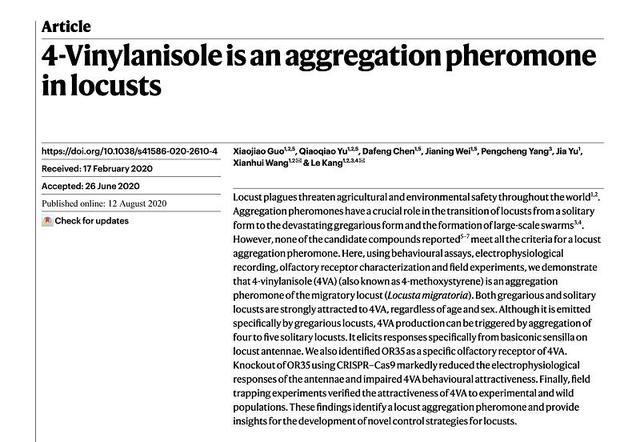
Chinese scientists have discovered a chemical compound called 4-vinylanisole (4VA) that prompts solitary locusts to form massive swarms, a breakthrough that could lead to more effective and environmentally friendly strategies to stop the spread of these voracious insects, according to a study published in the journal Nature on Wednesday.
A single locust is slightly bigger than a paper clip and is typically harmless since it prefers to live a solitary life. However, sometimes they can undergo a physical change and become gregarious, forming a moving blanket of billions of locusts that can block out the sun and devour the landscape of plants and crops.
From January to July, desert locust swarms have devastated crops from the Horn of Africa to India. Around 11.9 million people in Ethiopia, Kenya and Somalia are already experiencing severe acute food insecurity, and the swarms are threatening the food security of another 20.1 million people, according to the Food and Agriculture Organization of the United Nations.
Until now, scientists didn't know what caused locusts to abandon their solitary lifestyle and congregate. For decades, most control methods rely on spraying the swarms with massive amount of insecticide, which could harm other organisms and pollute the environment.
"China has been battling locust swarms for nearly 2,000 years, recording over 800 major plagues of locusts throughout history," said Kang Le, a professor of entomology and ecology at the Institute of Zoology of the Chinese Academy of Sciences.
Kang said his team has identified the 4VA pheromone, a chemical that can attract others of its own species, in migratory locusts, or Locusta migratoria, the most widespread locust species in the world.
The 4VA compound is primarily released from the hind legs and is detectable by the antennae and odorant receptors of other locusts. "4VA is like an irresistible rallying call for locusts, just a tiny amount can attract massive swarms, regardless of age or sex," Kang said.
"One of our most important discoveries is that it only takes a small handful of locusts to congregate, and they will release the 4VA pheromone to draw in a bigger swarm," he said. "This may be the secret why locust swarms can expand at such incredible speed."
As a result, Kang said scientists can use the 4VA compound against the locusts."We can synthesize the pheromone to lure and trap locusts to a designated area, and spray the targeted area with insecticide, therefore greatly reducing the need to mass spray the chemical," he said, adding that this will reduce the costs of swarm control and protect the environment.
However, although the 4VA compound is found to affect migratory locusts, more research is needed to see if it is effective for other subfamilies of locusts, like the desert locusts that are currently affecting Africa and South Asia, Kang said.
"Our preliminary research suggests locust species in the Inner Mongolia autonomous region and Yunnan province can also produce the 4VA compound, but more research is needed to examine whether locust species outside of China can release or respond to the chemical," he added.
Leslie Vosshall, head of Rockefeller University's Laboratory of Neurogenetics and Behavior, said it might be possible to create a chemical that blocks the 4VA receptors, in order to prevent locusts from swarming in the first place.
"The discovery of such a molecule might provide a chemical antidote to insect aggregation and cause locusts to 'stand down' and return to their peaceful, solitary way of life," she wrote in a review commissioned by Nature.
Bill Hansson, a noted Swedish chemical ecologist and vice-president of the Max Planck Society, said the discovery represents the first time scientists really understand what causes the locusts to congregate, which has huge implications for basic research and controlling locust swarms in the wild.
Fang Rongxiang, a researcher at the Institute of Microbiology of the Chinese Academy of Sciences, said the research is a "milestone achievement" that ushered in the "age of understanding the biological mechanism of locust swarms at a molecular level".
"The compound's structure is relatively simple and is cheap and easy to synthesize," he said, adding that the application of the 4VA compound may lead to more environmentally friendly ways to tackle locust swarms.
"There may also be other compounds like 4VA that can cause locusts to gather. This will be an interesting research direction for future projects," he said.




- Shanxi ends province-wide blanket fireworks ban
- Audit: China fixes bulk of fiscal problems tied to 2024 budget
- China reports major gains in circular economy
- Chinese lawmakers review draft revision to banking supervision and regulation law
- Top legislature to study draft laws on environment, ethnic unity, national development planning
- Administrative organs must secure people's interests: senior judge