Mongolian yurts making a comeback









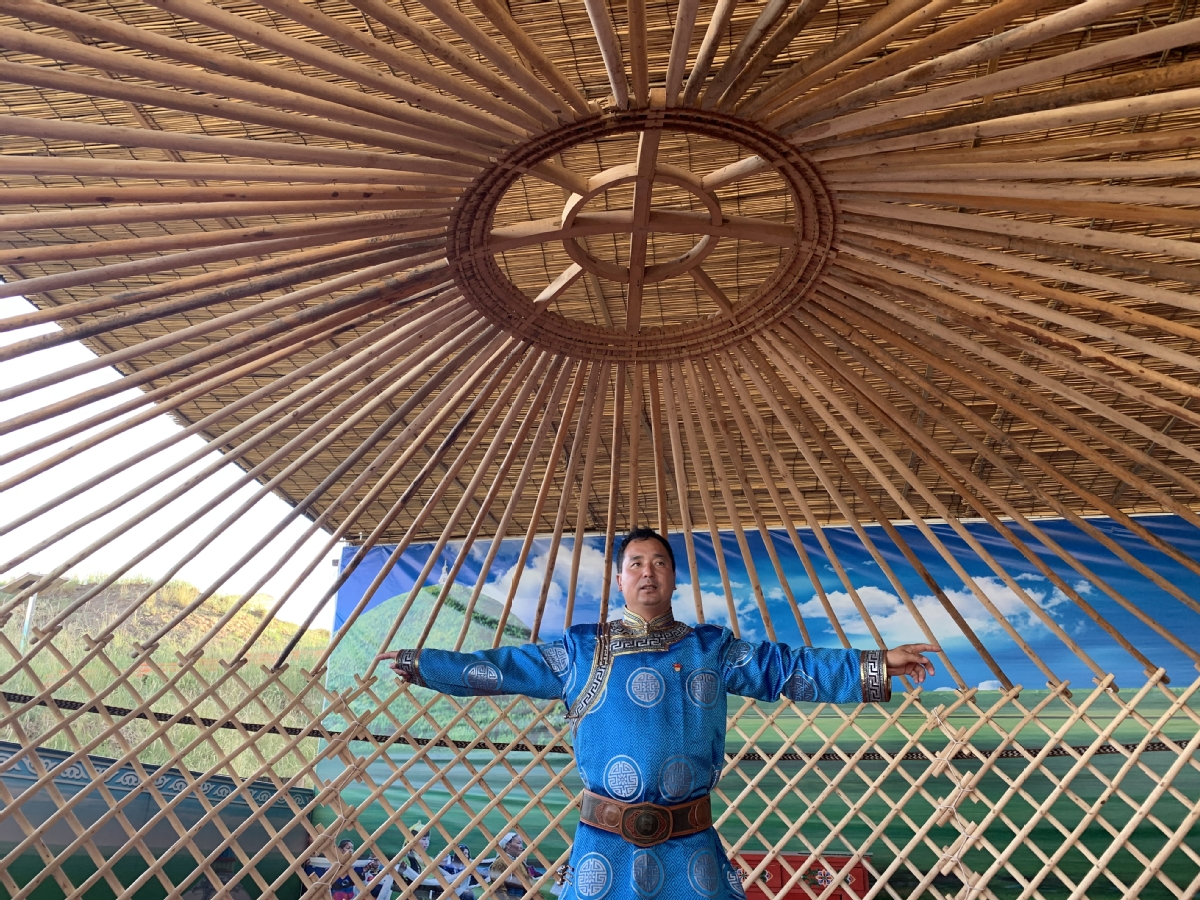
HOHHOT - Yurts have been transformed with modern encasements and glass domes in Burenbayar's "experimental yurt field "on the vast grasslands of the Inner Mongolia autonomous region's Hulunbuir.
The 39-year-old operates a yurt company in Chen Barga Banner. Over the past 20 years, he has manufactured over 3,000 kinds of yurts.
A traditional yurt, or ger, is a portable, round tent covered with animal skin or felt and used as a dwelling by ethnic Mongolians and other nomadic groups. As nomadic life has gradually faded into history, people rarely use yurts as dwellings, aside from tourists who hope to catch a glimpse of past lifestyles.
With Burenbayar's innovative ideas injected into the manufacturing technique, traditional yurts have taken on a new look, attracting orders from across the country and raking in profits.
Born into a herders' family, Burenbayar has been a fan of yurts since he was a child.
"Although I was raised in a brick house, I loved staying at my relatives' yurt on the grassland," he says, adding that his parents always had to drag him home as he was reluctant to leave the yurt.
He was thrilled to hear that one of his relatives opened a Mongolian yurt workshop and offered to work there in 2000. In the plant, he learned how to erect a pole in the center, assemble windows and the door and cover the main structure with felt.
Despite the meager income of 1,000 yuan ($140) per month at the workshop, Burenbayar was delighted as he had acquired all the skills of manufacturing yurts in three years.
He decided to leave the workshop in 2003 because his relatives rejected his proposed innovations.
"Times have changed. And yurts should be adapted to modern needs," he says.
In 2006, he set up his own workshop. He has explored different ways to make the yurts larger and more comfortable for tourists.
The largest one he made was 30 meters in diameter and can hold more than 100 people. It is meant for performances.
"I have replaced the central wooden pole with a steel one to make the large yurt stable and wind-resistant," he says, adding that he has filed patents for several of his innovative ideas.
He has designed yurts to resemble hotel rooms, equipped with card-activated door locks, a shower section and a flush toilet.
"Staying in an ethnic Mongolian yurt has become a must for grassland tours, and a hotel room-like yurt makes tourists feel safe and comfortable," he says.
Based on tourists' preferences, Burenbayar has also designed yurts with glass domes so that people can enjoy starry night skies. A trinity yurt has been created to house family members and friends in three interconnected rooms.
Despite innovations, he continues to incorporate some traditional elements, such as the central pole and leather ropes used to hold up the walls.
"I was told by the older generations that the dome of a Mongolian yurt is a symbol of ethnic unity on the grassland. It is impossible to support any dome if the central pole is missing," he says, adding that traditional culture has to be preserved no matter what innovations are made.
His company has generated an annual revenue of 4.6 million yuan, with a profit of roughly 1 million yuan. The company also brings income to some 80 herders, including five from households previously living below the poverty line.
His company has produced about 70 percent of the yurts in Hulunbuir's resorts. His yurts have even been sold in Beijing, and the provinces of Sichuan and Liaoning.
"I hope more people will fall in love with Mongolian yurts like me, as well as traditional Mongolian culture and the beautiful grasslands of the region."