Cooperatives and incubators lift living standards










Thanks to the cooperative, government subsidies and other small sources of income, all the impoverished families had been lifted out of poverty by the end of 2018.
"The village has reaped economic, environmental and social benefits simultaneously with the cooperative," said Jamyang Samdrub, director of the county's agricultural and animal husbandry bureau.
"People and animals are two essential elements of grassland ecology. Proper animal husbandry helps maintain the ecological balance on the grassland, as the yaks tread grass seeds into the soil and their feces is a natural fertilizer. The yaks, horses and Tibetan sheep eat different kinds of grasses, so they prevent excessive growth and maintain a good diversity of grasses."
This method is preferable to a ban on grazing, he said, adding that, contrary to received wisdom, a ban would be bad for the land.
"In some areas, a complete ban on grazing animals would lead to greater grassland degeneration. Rational grazing and supplementary feeding are better choices to protect the grassland," he said.
The expansion of animal husbandry has had other positive effects, creating a sort of ripple around the bedrock industry.
"Due to the rapid growth in demand for fodder, areas around Shiyi which used to grow crops have started growing fodder grass, which sells at a higher price than crops. It supports the development of animal husbandry in Shiyi while also raising the grass growers' incomes," Jamyang Samdrub said.
The improvements aren't limited to economics, either, as community relations have also seen positive developments.
"Neighborhood relations and people's spiritual outlooks have greatly improved," Jamyang Samdrub said.
"Herders no longer come into conflict with each other over boundary issues on the grassland. In the past, the exchange of information was rare among herders, but now over 390 villagers work together in the cooperative and frequently learn from each other."
In all, 961 animal husbandry cooperatives have been set up in Qinghai, benefiting 650,000 people who previously lived in poverty.
Traditional crafts
Ninety-eight percent of Yushu's residents are members of the Tibetan ethnic group.
In addition to conventional animal husbandry, the area supports a range of cooperatives that use traditional Tibetan crafts and culture to boost poverty relief.
A business incubator park dedicated to poverty alleviation is bearing fruit in Yushu's Nangqen county.
Since its launch in November 2017, the park has attracted and supported 15 rural cooperatives from across the county and benefited 320 impoverished households, or 1,122 people, directly and indirectly.
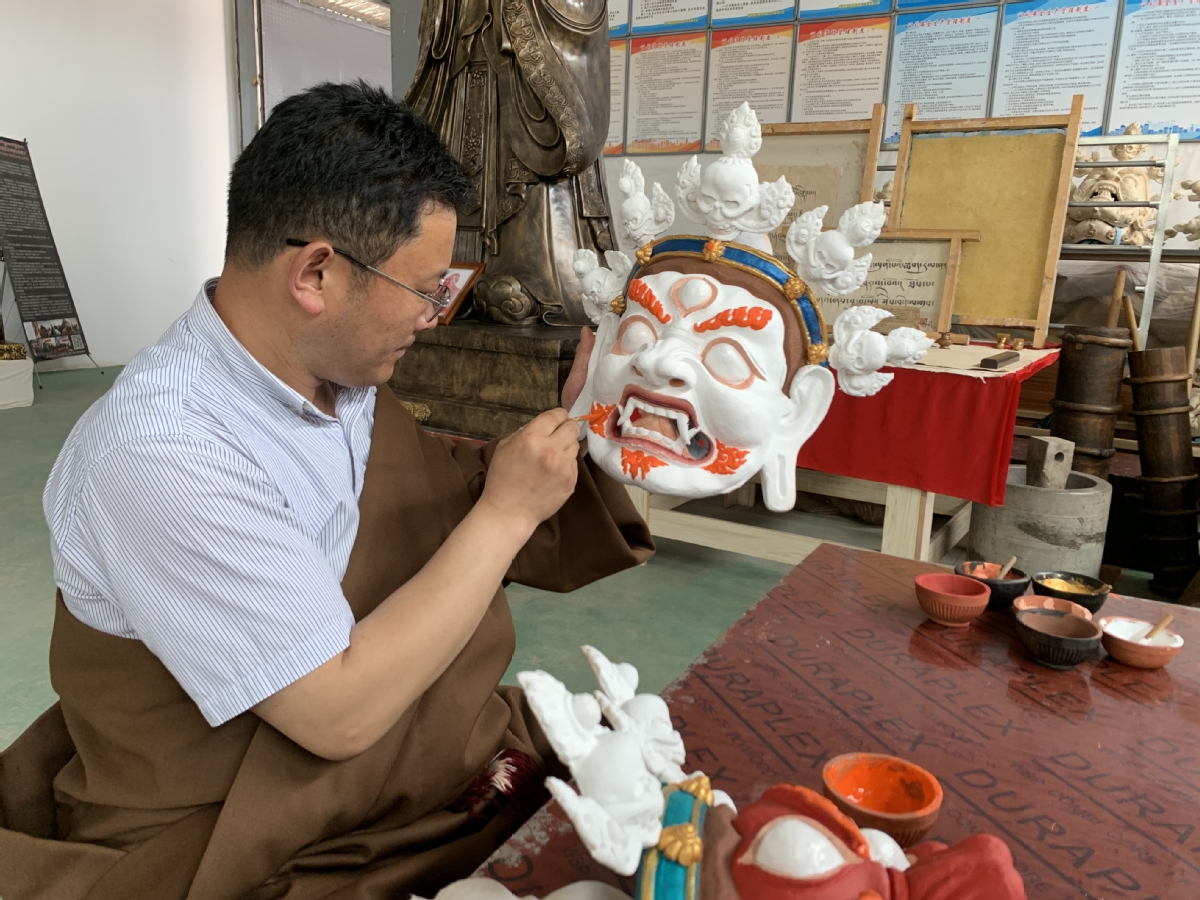
The businesses in the park display strong local features as they produce unique artifacts such as Tibetan black pottery, incense, carvings, highland barley wine, traditional clothing, felt products and thangka paintings.
Prominent among these is Tibetan black pottery, the manufacture of which has a history of more than 4,000 years and has been officially recognized as a national intangible cultural heritage.
Ogyan Tsetan, a young master of the craft, has started a business in the park. He has 13 employees, with 11 coming from poverty-stricken families. A skillful potter can earn about 4,000 yuan ($577) a month.
Cooperatives in the park enjoy large working spaces and pay monthly rent of just 5 yuan per square meter. In addition, joining together has raised their profile in the county and beyond, helping to attract more business opportunities.
The 170-plus employees each earn around 1,800 yuan a month. They had all been lifted out of poverty by the start of last year.
By the end of 2018, similar industrial parks had been established in 39 poverty-stricken counties in Qinghai, creating more than 8,000 jobs.