Does China make unlawful claims in the South China Sea?
Mike Pompeo: China makes unlawful claims in the South China Sea, trampling on international law.









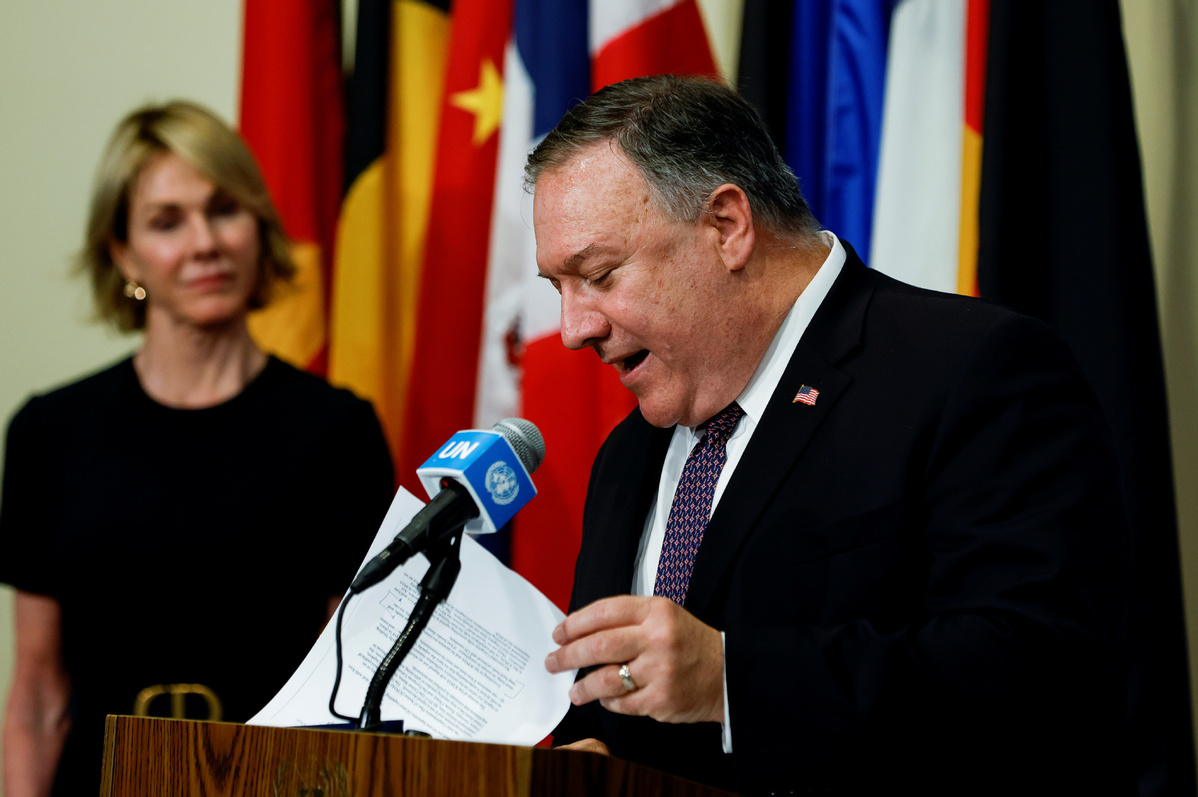
US Secretary of State Mike Pompeo, in his recent speech at the Richard Nixon Presidential Library, negated every aspect of China-US relations, maliciously attacked the leadership of the Communist Party of China (CPC) and China's political system, and attempted to drive a wedge between the CPC and the Chinese people. He also wantonly criticized China's domestic and foreign policies, spread the so-called "China threat", and called for an anti-China alliance to contain China's development.
Pompeo's baseless, fact-distorting speech misrepresents history and the reality. It is full of ideological prejudice and driven by a Cold-War mentality. His remarks have not only been condemned by the Chinese people, but also criticized and opposed by sensible people in the United States as well as the international community.
To debunk the lies fabricated by Pompeo, let the facts speak for themselves.
Rumor:
Mike Pompeo: China makes unlawful claims in the South China Sea, trampling on international law.
Fact:
China has exercised effective jurisdiction over relevant islands, reefs and waters in the South China Sea for over a thousand years. China's sovereignty and relevant rights and interests in the South China Sea have been established in the long course of history, and are solidly grounded in history and law, conforming to international law and practice. As early as the 2nd century BC in the Western Han Dynasty, the Chinese people sailed in the South China Sea and discovered the South China Sea islands in the long course of activities. China is the first to have discovered, named, and explored and developed the South China Sea islands and relevant waters, and the first to have continuously, peacefully and effectively exercised sovereignty and jurisdiction over them, thus establishing sovereignty over the South China Sea islands and the relevant rights and interests in the South China Sea.
-- Many foreign documents also recorded the fact that during a long period of time only Chinese lived or made a living on the Nansha Islands. The records of the Chinese fishermen living and working on the Nansha Islands were kept in documents including The China Sea Directory published in 1868 by order of the Lords Commissioners of the Admiralty of the United Kingdom, The Asiatic Pilot, Vol. IV, published by the United States Hydrographic Office in 1925, the French magazine Le Monde Colonial Illustré published in September 1933 as well as Japanese literature Boufuu No Shima (Stormy Island) published in 1940.
-- China's longstanding exploration, development and sovereign jurisdiction over the South China Sea islands have long been acknowledged by its neighboring countries, which conforms to the principles of customary international law. China has resumed the exercise of sovereignty and other lawful rights and interests over the relevant islands, reefs and waters in the South China Sea in accordance with the post-World War II (WWII) international order and relevant territorial arrangements established in the Cairo Declaration and Potsdam Proclamation, and has maintained and consolidated international law in the South China Sea since WWII, which has been recognized by many countries in the world, including the United States. After WWII, China recovered the Nansha Islands and resumed exercising continuous and effective jurisdiction over them.
-- In 1948, the Chinese government officially published the dotted line in the South China Sea, reaffirming its territorial sovereignty and relevant rights in the South China Sea. For a long time until the late 1960s, no country, including those littoral countries around the South China Sea, had ever questioned China's sovereignty over the Nansha Islands. Later, due to the discovery of petroleum in the South China Sea, some countries began to raise territorial claims to all or part of China's Nansha Islands.
-- Since the 1970s, some countries began to send troops to occupy certain islands and reefs of China's Nansha Islands. So far, a total of 42 islands and reefs in China's Nansha Islands have been illegally occupied by other countries.
-- None of the working oil drilling rigs in disputed waters in the South China Sea is China's. China's oil and gas exploration, fishing and other activities in the South China Sea are carried out in waters under China's jurisdiction. China is committed to working with littoral countries concerned to shelve maritime disputes and promote joint development of oil and gas resources for mutual benefit and win-win results.
-- With the joint efforts of China and ASEAN countries, the situation in the South China Sea remains stable in general. The consultations on the Code of Conduct (COC) in the South China Sea have made steady progress. China and ASEAN countries are willing to conclude the consultations on the COC at an early date, showing their firm conviction to formulate regional rules and safeguard peace and stability in the South China Sea.
-- With regard to the award rendered on July 12, 2016 by the Arbitral Tribunal in the South China Sea arbitration, China has solemnly declared that the award is null and void and has no binding force. China neither accepts nor recognizes it. China's above position has sufficient legal basis. Territorial issues are not subject to the United Nations Convention on the Law of the Sea (UNCLOS). In 2006, China made a declaration under Article 298 of the UNCLOS that maritime delimitation disputes are excluded from the compulsory dispute settlement procedures. By virtue of the principle of sovereignty, the jurisdiction of any international judicial or arbitral body over an inter-State dispute depends on the prior consent of the parties to the dispute. Despite China's opposition, the Arbitral Tribunal in the South China Sea arbitration imposed jurisdiction over matters without China's prior consent, seriously violating the principles of sovereignty and consent of the States concerned. The Arbitral Tribunal lacked legitimacy, impartiality and jurisdiction. The process was a political farce and the award was on flimsy legal grounds, challenging the norms of international law and impairing the solemnity and authority of UNCLOS. Tom Zwart, a well-known professor of law from the Netherlands, said the award by the Arbitral Tribunal will be regarded as the fruit of a poisonous tree in East Asia, and it will fail to garner recognition and support.
-- China's position and proposition on the South China Sea arbitration has won widespread understanding in the international community, and nearly 120 countries expressed their support.
-- The United States refuses to join the UNCLOS in order to uphold its maritime hegemony and maintain its hegemonic status to the greatest extent.
-- The South China Morning Post published an article titled "It's the US stirring the pot in South China Sea" on July 28. The article pointed out that the US has no standing with the UNCLOS because it has never ratified it. Don't people find it bizarre that the US thinks it can sit in judgment over other countries' disputes? It seems a rather transparent attempt to hijack those disputes to further Pompeo's own not-so-hidden agenda, the article said.


- Exhibition highlighting the 'Two Airlines Incident' opens in Tianjin
- Average life expectancy in Beijing rises to 83.93 years
- Energy drink overdose sends delivery worker to hospital
- GBA and Hainan deepening cooperation to boost innovation and sustainable growth
- Beijing mulls including the costs of embryo freezing and preservation in medical insurance
- Rocket developed by private Chinese firm fails, loses three satellites