Investing in growth now a piece of cake
Overseas-listed Chinese firms' IPOs in China promise to open wealth floodgates









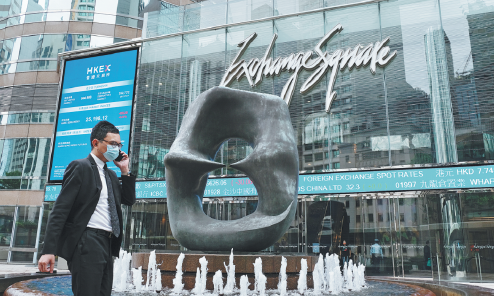
September has been extraordinarily rewarding for equity investors in Hong Kong. For several months, they had been eagerly waiting for new stocks of industry-leading companies based on the Chinese mainland. Several such companies finally made their floats on the Hong Kong stock exchange.
Local investors' targets included stocks of Huazhu Group Ltd, a hotel chain, Yum China Holdings Inc, which operates KFC-branded quick service restaurants, and ZTO Express (Cayman) Inc, one of China's biggest courier or delivery companies that will make its debut on Tuesday.
With such listings, this September will go down in the history of the Hong Kong bourse as the month that saw a record number of secondary listings by hitherto US-listed Chinese companies.
Huazhu, Yum and ZTO chose Hong Kong for their secondary listings as the bourse enabled similar listings of China's internet giants such as JD and NetEase in June. In November, NYSE-listed Alibaba made a high-profile secondary offering.
In recent months, a steady stream of unconfirmed media reports originating outside of China speculated that US-listed Chinese companies such as online travel agency Trip.com Group Ltd and e-marketplace 58.com Inc may go private first, before re-listing in Hong Kong or on mainland bourses in Shanghai and Shenzhen.
The narrative has been that Chinese companies want to stay closer to their home market, in order to hedge against regulatory uncertainty overseas.
The reference, of course, was to the ongoing Sino-US dispute over corporate auditing practices, which finds echo in the broader economic and technology tensions between the world's two biggest economies.
"2020 probably marks the start of the era of US-listed Chinese firms seeking secondary listings or re-listings on home exchanges," said Dong Dengxin, director of the Finance and Securities Institute, which is part of the Wuhan University of Science and Technology in Hubei province.
Since the Luckin Coffee Inc's accounting scandal erupted in April, the US administration has increasingly tightened regulation of Chinese listings. It also threatened to delist Chinese companies that fail to open their books to US authorities. The earliest deadline for complying with US audit requirements could be in the January of 2022.
This landed 260 Chinese issuers, accounting for about 5 percent of the US-listed firms, in a harsh dilemma. The proposed US inspections could be in violation of Chinese laws that stipulate that inspections overseas need to be carried out only under a bilateral regulatory cooperation mechanism. The current cooperation framework set up in 2013 has failed to meet US officials' expectation.
Market insiders said the two sides have yet to sit and agree a new cooperation channel.
But, experts also cited capital market reforms in Hong Kong and the mainland as a big reason why US-listed Chinese companies are returning to home exchanges.
To make public offerings easier for new-economy businesses, the Hong Kong bourse had allowed companies with dual-class shares, a special equity structure preferred by many technology firms, to get listed in 2018. This paved the way for secondary listings from Alibaba and JD.
Meanwhile, Chinese authorities also stepped up efforts to enable technology firms to return home for financing. Landmark progress last year in the form of the debut of Shanghai's STAR Market, which is dubbed the sci-tech innovation board, is a shining example of capital market reforms.
President Xi Jinping announced in November 2018 that China would launch the STAR Market and pilot the registration-based system for IPOs to give full play to market forces and to ensure more inclusiveness, in order to benefit technology firms.
Semiconductor Manufacturing International Corp, a Chinese chipmaker, has since re-listed on the STAR Market in July, after delisting from New York last year.
The registration-based reform has been replicated on Shenzhen's ChiNext board, while the country eased the requirements for secondary listings on mainland bourses in April.
"Recent reforms have made both Hong Kong and Shanghai more friendly to fast-growing technology companies," said Stephanie Tang, China head of private equity with Hogan Lovells, a global law firm.
"High-quality Chinese companies now have multiple alternatives (to US exchanges) available to raise capital and carefully weigh each listing venue's trade-offs."
As the US-listed Chinese firms return home to raise fresh funds, Hong Kong and mainland exchanges sense a strategic opportunity to improve the quality of companies listed on them, making it easier for local investors to invest in the country's best growth companies, experts said.
"The return of overseas listed Chinese stocks to home exchanges means that Chinese investors have the opportunity to invest directly in those high-quality targets, which will cement the attractiveness of renminbi-denominated assets," said Cheng Shi, chief economist at corporate financing platform ICBC International.
Thanks to the easy and clear market access as well as an international investor base, the Hong Kong exchange should remain the major destination for large-cap US-listed Chinese firms' secondary listings, helping boost trading volume of the exchange and cement its position as an international financial center, experts said.
"The rules are clear and the execution process is efficient. The ecosystem of investors, research analysts and professional parties is well established," said David Chin, head of investment bank in Asia Pacific for UBS, the Swiss bank. Chin is also UBS China country head.
Mainland listing is also "an attractive option" partly as it would help raise Chinese companies' profile among their customers, Chin said.
For small-cap US-listed Chinese firms, a re-listing on the STAR Market or ChiNext board may be ideal, given the potential for higher valuation and better liquidity than in Hong Kong, said an Everbright Securities report.
The Singapore Exchange, or SGX, another international financial hub in Asia, is also trying to have returning Chinese companies list on it.
SGX features a deep base of global institutional investors, which makes it one of the wealth management centers in Asia, facilitating secondary listing and providing convenient refinancing channels. This makes it attractive for Chinese businesses seeking to expand their business into Southeast Asia, said Karen Chen, vice-chairman of SGX China, the bourse's local branch.
The exchange is confident of "achieving breakthroughs" in attracting Chinese listings in the new fiscal year starting July, Chen said.
Amid all these developments, experts still call for a proper resolution of the US-China auditing dispute. This, they said, will dispel uncertainty and costs facing both the Chinese firms concerned and their investors.
Some of them expect the auditing dispute to be resolved next year, provided the two countries demonstrate a willingness to solve the dispute proactively.
Last month, the China Securities Regulatory Commission, the country's top securities regulator, made a fresh proposal to resolve the dispute. The proposal would allow the US side to pick any of China's State-owned enterprises for a trial joint inspection, according to a Bloomberg report. The proposal has yet to receive positive replies from the US administration.
While many obstacles remain on the path to peaceful resolution, certain aspects like working papers and auditor responsibilities need to be sorted out quickly. However, the willingness to engage in creative thinking and discuss potential cooperation is encouraging, said Tang from Hogan Lovells.
"I am still hopeful that the two sides will reach a sensible and mutually acceptable arrangement next year," said Chin with UBS, adding he understands the CSRC had collaborated with its US counterpart on a number of cases in the transfer of relevant audit documents in the past.





Today's Top News
- Tesla overtaken by BYD in global EV sales in 2025
- Trade-in subsidy aims to drive more consumption
- Cooperation can boost cross-Strait integration
- State-owned firms register stable performance
- Global experts hail Xi's people-centered message
- Trips promote equality and coexistence