Homegrown nuclear tech gets impetus
China expects to be leader of the sector by 2026 as more projects go on stream









China is more committed to moving away from reliance on imported nuclear power technology and building up its own homegrown systems, said insiders.
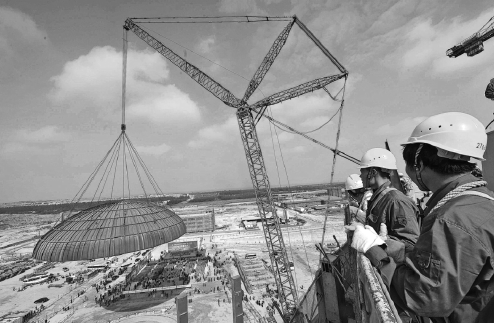
Construction of two nuclear power projects at a cost of 70 billion yuan ($10.24 billion), including the Hainan Changjiang phase 2 and Zhejiang San'ao phase 1 projects were approved recently, both of which will be adopting domestically developed third-generation Hualong One reactors.
The units will begin operations over the next five to six years.
Wei Hanyang, a power market analyst at Bloomberg New Energy Finance, said the government prefers to utilize its self-developed third-generation technology-Hualong One.
"It indicates a clear trend for China to move away from imports of nuclear power technology and marks a likely acceleration of local adoption, as successful local applications will help export Hualong One to more countries in the world," he said.
China had 49 gigawatts of installed nuclear power capacity last year, the third largest globally. The sector continues to develop even though it makes up just around 5 percent of the country's total generation, compared with 70 percent in France, 19 percent in the United States and 12 percent in Germany, said Bloomberg New Energy Finance.
The agency predicted that China will pass France as the world's second biggest nuclear power generator in 2022 and overtake the United States four years after that.
Nuclear power plant construction has been suspended in China over the past few years.
"China has not approved new nuclear power sites for two consecutive years, since Guangdong's Huizhou and Fujian's Zhangzhou in 2019. Nuclear power will help decarbonize China's power and heating sector, replace some of the existing coal powered-consumption and meet increasing energy demand, which is embedded in China's economic shift to services-led industries," said Wei.
It is believed China will see more than 17 nuclear units under construction by the end of this year and at least four units will begin construction by 2020 alone. The approval and commencement of new nuclear power units is also expected to gradually become the norm.
The China Nuclear Energy Association estimated that nuclear power will play a more significant role in China's energy mix going forward, and the country is expected to construct six to eight reactors each year to gradually push forward its nuclear development between 2020 and 2025.
He Yu, former chairman of China General Nuclear Power Corp, had also been actively calling for the mass production of Hualong One reactors due to their safe, technically mature and economically competitive technology, so as to ensure installed capacity of nuclear power in China reaches at least 150 GW by 2030.
While China is expected to fall short of its planned total installed nuclear capacity of 58 GW by the end of this year, capacity is still likely to increase exponentially in the coming decade, and China is still on track to become the top global nuclear energy player over the next decade, said the association.
According to the nuclear association, China is expected to have 51 nuclear facilities in operation by the end of this year, with an installed capacity of 52 GW. More than 17 nuclear units will be under construction with installed capacity reaching 19 GW.
Nuclear projects in the country will focus on the large-scale and mass production of domestically developed third-generation reactors including Hualong One, which is already officially in mass production, it said.
Wang Yingsu, secretary-general of the nuclear power branch of the China Electric Power Promotion Council, was quoted by Bloomberg as saying that technology localization, development of homegrown nuclear power technology and the capability of constructing and operating nuclear power plants independently have always been China's goals since it began its nuclear power program more than 50 years ago.
Wang said more power plants will choose Hualong One in the future because it's China's independently developed technology and is equal to foreign technology.
According to Wei, renewable energy is also rising up as a challenge to further nuclear development because wind and solar are demonstrating declining costs that undercut nuclear, and they can serve an increasingly decentralized power system without dependence on a single large unit.
Nuclear reactors may also be restricted by availability of coastlines, while non-nuclear renewables can be located literally anywhere, he added.
However, Zheng Mingguang, chief engineer at China's State Power Investment Corporation, said that the nuclear power generation price in China is not as high as the cost of renewable energy sources and increasing demand for power will provide big opportunities for nuclear power.
Zheng expects that the country will develop nuclear power more actively in the future as both the use of large and small-scale reactors will find applications in China beyond just electricity generation.
As China is readying for nuclear power expansion, big reactors will be used to supply electricity and smaller facilities will provide multiple applications. It can also be used for non-power applications such as heat, steam supply, hydrogen production and desalination, he said.
Zheng added that establishing a complete supply chain has also helped the nuclear power industry in China.
The country is expected to have total installed capacity of 70 GW of nuclear facilities under operation by the end of 2025, and 30 GW under construction. The combined figure of installed capacity both under construction and in operation will reach 200 GW by 2035.
According to Joseph Jacobelli, an independent energy analyst and executive vice-president for Asia business at Cenfura Ltd, a global renewable energy company, as nuclear reactors will be potentially operational for as long as 50 years, careful planning and checks are imperative for China.
He said China's nuclear sector has risen from novice to expert as Chinese nuclear experts have mastered the core technologies of third-generation nuclear reactors, and are able to provide strong technical support.
China topped the world in terms of installed capacity of nuclear power units under construction in 2019.By the end of last year, China had 13 nuclear power units under construction, with the country's independent research and manufacturing continuing to increase, according to the association.
In 2019, 39 units of main nuclear power facilities were independently designed and successfully handed over to clients.
Nuclear power accounted for about 5 percent of total power generated in China in 2019.
Qiu Jiangang, deputy head of the experts committee with the China Nuclear Energy Association, said the focus of nuclear construction around the world is expected to shift from developed to developing countries, and the focus over the next five years should be on coastal regions as major locations for nuclear project construction, while inland provinces including Hunan, Hubei and Jiangxi should also plan in advance to ensure nuclear power generation.



Today's Top News
- Tesla overtaken by BYD in global EV sales in 2025
- Trade-in subsidy aims to drive more consumption
- Cooperation can boost cross-Strait integration
- State-owned firms register stable performance
- Global experts hail Xi's people-centered message
- Trips promote equality and coexistence