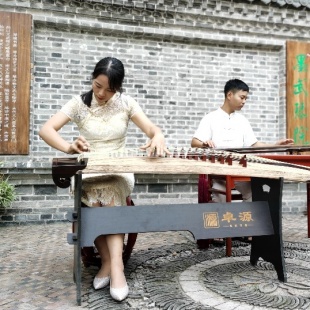



Trees provide sweet guqin music-and sometimes love comes along, too










Half a century ago, people in Lankao county, Henan province, planted paulownia-fast-growing trees that can get 30 meters tall-to counter desertification. Today, with their large, heart-shaped leaves, the trees have become a source of wealth by turning into musical instruments.
In recent decades in Xuchang village in Lankao, Guyang township, many farmers whose ancestors made a living from crops have become adept at making traditional Chinese musical instruments.
And every so often, romance comes along for the ride.
Paulownia trees 10 years old are an ideal material for the soundboards of traditional Chinese musical instruments such as the guqin, a zither-like seven-stringed plucked instrument. The wood has good air permeability and resonance.
Soundboards from Lankao have captured more than 95 percent of the traditional Chinese musical instrument market nationwide, allowing the county to become a major center for traditional musical instrument manufacturing in central and western China.
Xu Yachong from Xuchang village founded his own workshop in 2017 with his elder brother after they learned the skills of guqin-making in many places across the country. Their company produces more than 200 instruments a year, with annual revenues of about 1 million yuan ($147,000).
But for Xu, 26, the instruments made from local paulownia trees are much more than a business: They have brought him love.
In the summer of 2017, college graduate in music, Wei Chenxin, was invited to Xuchang village to tune the instruments. As she walked past Xu's rural home, Xu was playing the guqin outside, and the sound struck her heart. She knew the village's reputation for musical instrument manufacturing, but she didn't expect a young man to be playing the instrument so well in a farmyard.
Love began to grow as the instrument maker and tuner-both skilled performers-discussed folk music at length. And then again and again. The next year Xu changed the subject and asked Wei: "Will you marry me?" And she said yes.
Wei said she would have rejected the offer if made years earlier, when Lankao was a national level impoverished county. But now it finds itself among the first counties in China to rise out of poverty. The musical instrument manufacturing business has contributed greatly to its economic growth.
In Xuchang village alone, there are more than 70 musical instrument manufacturers that employ more than 1,200 local residents. An industrial chain has formed, with nearly every household in the village taking part in the business.
The business started in 1985, but since 2000 things have accelerated. Hundreds of Xuchang residents have left home to study instrument making techniques and then returned to start businesses. They produce around 52,000 instruments annually and generate revenues of nearly 100 million yuan.
But the development of the industry has not alway been always smooth. Xu Shunhai, the village's Party chief, said people went through a period of unhealthy competition, refusing to move to a standardized industrial park outside the village because they could sell their products online.
"Now we have realized that without necessary regulations and standards, we will forever be cheap factories rather than becoming a true industry," he said. "Today's consumers pay more attention to product quality, which requires us to innovate. The essential goal of the guqin is to achieve inner peace, and making a quality one requires inner peace, too."
In the workshop of resident Kong Haiguang, the focus is on high-end products. He spends two or three years making a single guqin by hand, while an industrial production line could make 1,000 a month, he said.
"The difference lies in the materials and procedures," Kong said. "Industrial manufacturing usually omits certain procedures to reduce costs, but only traditional techniques make a real guqin that gives full play to its unique charm."
The instruments made in Kong's workshop have served a number of high-end events such as the G20 Hangzhou Summit in 2016.
"Local governments are helping us develop the business with measures such as giving loans and building roads," he said.
Junyi Musical Instrument Co of Guyang town produces about 1,500 instruments every month, making it a major musical instrument producer in Lankao, said the company's Zhao Shanggong.
Junyi now has more than 80 employees who earn about 5,000 yuan each month, Zhao said.
A worker surnamed Huang spoke highly of the situation. "Although the salary I earn from making the instruments is a little bit less than that of working in the city, it's convenient for me to take care of my kids because the factory is close to where I live."
In 2017, Guyang township was honored with the title Characteristic Town of Henan. Thanks to preferential policies and a complete industrial chain of musical instrument manufacturing, Xuchang village is planning to develop music-themed tourism, said Xu Shunhai, the Party chief.
He plans to build a concert hall in the village to attract artists from outside to perform and exchange ideas with residents. He also wants to encourage local children to learn about traditional Chinese instruments and music culture.