Poverty fight extends to all corners









Small, remote ethnic group becomes model of country's comprehensive, wide-reaching resolve to improve people's lives
Editor's note: With China set to meet its goal this year of eliminating extreme poverty before next year's 100th anniversary of the founding of the Communist Party of China, this series looks at the efforts of different areas of the country to erase poverty and improve livelihoods.
Li Wenshi pulls the bar of the loom, her hands moving deftly over the smooth stretch of fabric.
Slowly but surely, the singular strands of twine come together to form a dazzling tapestry of rainbow-like colors under her watch.
The weaver, in her late 70s, looks over her work and smiles, her joy and contentment shining through the tattoos on her face.
Li is a member of the country's Derung ethnic group, which mainly resides amid remote mountain valleys carved out in part by their namesake Dulong River of Southwest China's Yunnan province.
Since major anti-poverty measures were rolled out a decade ago in Dulongjiang township, Li has been living a life of increasing ease and comfort as a resident of its Xiongdang community in Dizhengdang village.
She is one of the few elderly Derung women in the area who still have the face tattoos that were etched in her early teens, in line with the ethnic group's customs, to help ward off any outsiders trying to take its women away. Like the impoverished lives the villagers led, that traditional practice no longer exists for the group. And like the blankets, clothes and carpets Li weaves for leisure and spare cash, the future of Derung villagers seems to be getting brighter and better by the day.
"We had no real roads, we lived in straw huts and when it rained the roofs leaked. There was no electricity. Those days are behind us now. The roads connect the village. We live in concrete houses with running water and electricity. We can buy whatever we like," Li said.
"We are leading better lives. I hope our next generation can build on that and live even better. There are more good days ahead of us."
In early 2015, Li said she had the chance of a lifetime to express her gratitude for the improvements she experienced-she came face-to-face with President Xi Jinping in Kunming when he visited the provincial capital as part of an inspection tour. Li was a member of the Dulongjiang delegation to the city and it was her first time out of the village.
"When I met President Xi, I could feel the care and concern he had for us, I could feel the help and support from the country and the Party," Li said. The group photo she took with the president now takes pride of place in the patio of her home, her beaming smile marking copies of the image on walls, restaurants and other public places throughout the township.
Like Li, Dulongjiang and its Derung residents have become a model of China's comprehensive and wide-reaching poverty alleviation drive, beneficiaries of the unprecedented national aim to eliminate extreme poverty-defined as living with less than 2,300 yuan ($345) in annual income-by the end of this year.
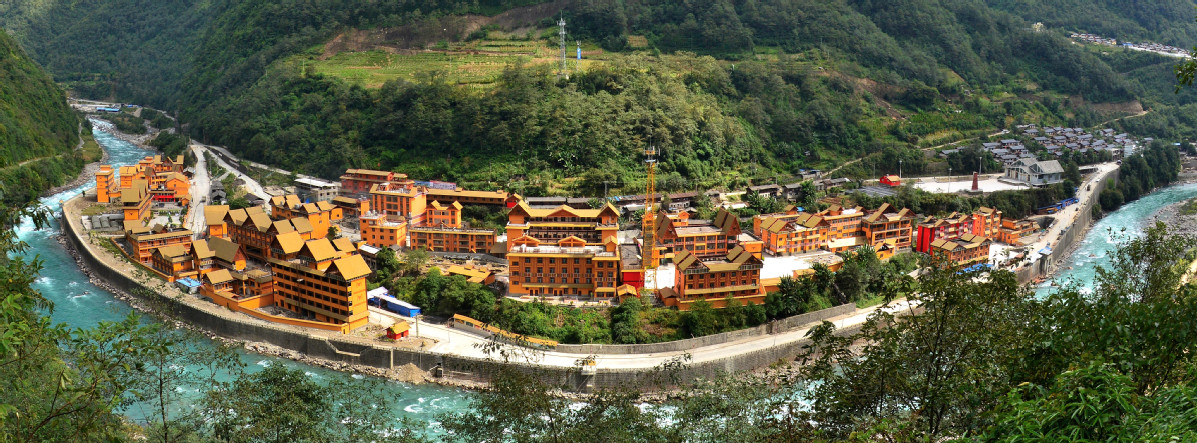
Dulongjiang township is tucked in the northwest corner of Yunnan, under its Gongshan Derung and Nu autonomous county in Nujiang Lisu autonomous prefecture.
Dulongjiang villagers number about 4,200, making the Derung one of the smallest of China's 56 ethnic groups.
Until 2009, the annual per capita net income of farmers in the township was recorded at less than 908 yuan and many Derung members were still living in thatched huts, subsisting on surrounding resources.
In 2010, a major assistance program was launched to spur the development of the township and lift its residents from poverty. The measures ranged from agriculture, education and housing, to transportation, tourism and healthcare.
To that effect, six years ago, a 6.7 km-long highway tunnel became a lifeline to the township by ending six months of annual winter isolation, when heavy snowfall cut off access to villagers. It now takes a day and half to reach Dulongjiang from the city, often via precariously winding mountain roads.
Continued poverty alleviation and development efforts helped the Derung villagers to finally shed the poverty label. By the end of 2018, all impoverished Derung communities in the township were successfully elevated from poverty. Per capita income reached 7,637 yuan, according to local government figures. Dulongjiang also won a national award for its innovative approach and exemplary achievements in poverty alleviation.
On April 10 last year, the Derung ethnic group received a message from President Xi-he congratulated the community for their achievements in alleviating poverty and encouraged the villagers to continue striving for improved lives.
Poverty alleviation is "just the first step", with "better days still ahead", said Xi, who is also general secretary of the Communist Party of China Central Committee.
"Dulongjiang is a reflection of the Party's resolve to eradicate poverty, an example of how no efforts will be spared and no stone left unturned to achieve that mission. We Derung are such a small community in such a remote part of the country, but look around you here, look at the support we get," said Mu Wenjun, 29, deputy director of the township's Kongdang village.
Mu completed his tertiary studies in 2017 and decided to return to his village instead of staying on in the city. He received administrative training for a year and a half before taking up his post. His work goes beyond administrative duties to include helping and educating fellow Derung villagers to be part of the economic and social initiatives of the anti-poverty drive.
For the past decade, his parents themselves have been harvesting black cardamom covering more than 1.33 hectares in the area, reaping up to 1.5 metric tons of the popular Asian herb, whose aromatic seed pods are used as a medicine and spice, to generate more than 10,000 yuan annually in additional income for the family.
"Like most other households, before the poverty alleviation measures, we subsisted on simple crops such as corn," Mu said.
"Other than harvesting cardamom, we also teach villagers about healthcare and hygiene. Those standards have been raised significantly."



- Countdown to 15th National Games: On-site warm-up entertains audience
- Eight missing after cargo ship collides with fishing vessel near Shandong
- Investing in people: a worthwhile investment
- Exhibition commemorating the epic relocation of universities opens in Fujian
- Twelve punished for scaffold collapse that killed 7 in Shandong
- Slovenian official visits whole-process people's democracy practice site of CPPCC committees