


Age of restoration
The ruins at Yuanmingyuan stand testament to its destruction by foreign forces in the 19th century but universities are determined to recapture the site's former glory, Wang Kaihao reports.









 A demo of a digitally restored model of Ruyuan Garden, based on archaeological studies, made by Tianjin University. WANG KAIHAO/CHINA DAILY
Various expertise
After Yuanmingyuan Ruins Park was opened in 1988, a passionate debate in academic circles was ignited, discussing whether the destroyed palaces and gardens should be rebuilt.
Though a consensus has been generally reached in recent years that the underground architectural foundation of the ruins should be kept intact as a witness to history, people probably still have a nostalgic, emotional desire to experience what Yuanmingyuan looked like in its heyday.
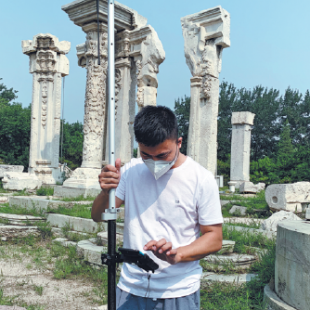
Fortunately, with their varied expertise, researchers from each university in the alliance have partially uncovered the original appearance.
For instance, in the last decade, archaeologists unearthed the Ruyuan ruins, once an exquisite garden resembling typical Jiangnan style (a cultural term describing the areas on the southern bank of Yangtze River's lower reaches), and figured out what the architecture really looked like.
Based on studies of the excavated foundations and referring to ancient documents, a team of students from Tianjin University that is strong in architectural studies "reconstructed" the main buildings of Ruyuan as 3D virtual models.
The achievement also opens up the possibility of designing a new exhibition hall on the ruins and thus enabling tourists to better imagine its past glory.
In Zhengjue Temple, one of the best reserved architectural complexes in Yuanmingyuan that survived the inferno, teachers and students from the Central Academy of Fine Arts used old photos and virtual restorations to make replicas of a group of destroyed Buddha statues. Other researchers from Peking University redesigned the time-telling bell and drum in the temple based on their studies.
When Qing Dynasty emperors had the resort built, the basic layout of the lake, rockery, and other scenic spots in the compound were roughly designed as scaled-down replicas of China's geographic features-the high and long mountains on the northwest and oceans on the east. Many current projects of the universities, thus, have focused on restoring the original landscape there.
According to Xi Xuesong, deputy director of the Yuanmingyuan research center at the China Agricultural University, scholars with his center are conducting comprehensive studies of the ancient waterways in Yuanmingyuan.
"Through our studies, we also want to improve the general water environment in the park and increase the efficiency of irrigation of the green lands," he says.
It is estimated that over 40 percent of Yuanmingyuan's area was originally covered by water. Some man-made lakes have been rebuilt based on written references.
And Luo Juchun, a professor from Beijing Forestry University, is leading research on tree varieties in Yuanmingyuan and the original vegetation during the imperial years, aided by ancient paintings and documents.
"Some plants are detrimental to the underground cultural relics, and we have to move or cut them step by step," he says.
Wider benefits
In January, Yuanmingyuan Ruins Park was listed as a top-rated scenic spot in China. About 340,000 people poured into the park during the National Day holiday earlier this month, a slight increase from the figure in 2019 despite disruption caused by COVID-19.
The team from the Beijing Jiaotong University has leveraged its strengths in transportation and traffic management to help the park to design a set of signboards for tourists, while the creative faculty from the Central Academy of Fine Arts has designed food and a series of souvenirs featuring the artistic elements from Yuanmingyuan, which proved to be popular among visitors.
Beijing Foreign Studies University focused on the history of Sino-foreign cultural communications reflected through Yuanmingyuan. The research center there has also widely surveyed related files, old photos and documents in the United Kingdom and Japan and translated relevant domestic publishing into foreign languages.
Xia Haishan, president of the newly founded alliance, also a professor with Beijing Jiaotong University, says that closer cooperation of the research centers will enable universities to launch more related research.
"Many research projects and graduation designs about Yuanmingyuan can be undertaken on the platform, and the results can be practical, meeting the actual needs concerning everyday operation of the park," Xia says.
"It's a long-term task. As our work progresses, we're getting a stronger feeling that the cultural meaning of Yuanmingyuan is uniquely marvelous."
Contact the writer at wangkaihao@chinadaily.com.cn
- Universities join hands to study Old Summer Palace
- Old Summer Palace restored by tech in 90 seconds
- Old Summer Palace offers free entry to mark 160th anniv. of massive loot
- National Museum initiates launchesa global relay of 'treasure hunt'
- Old Summer Palace digitalized in Beijing's industrial remains