


Book on vaccines provides injection of hope amid pandemic









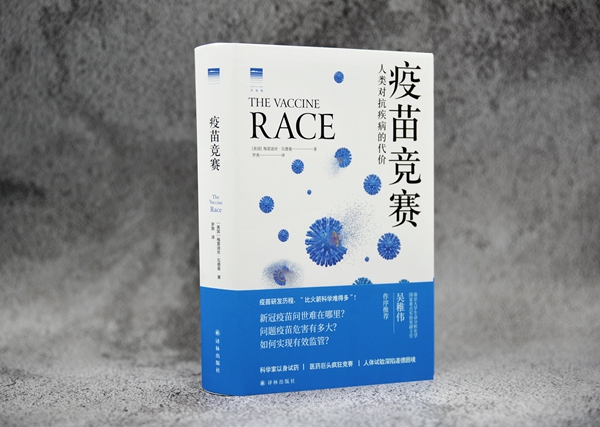
At the precise moment when scientists are seeking the so far elusive COVID-19 vaccine, a Chinese translation of The Vaccine Race is released. The work by US writer Meredith Wadman offers a historical and tantalizing view of the complex process, and unexpected difficulties, in the development of vaccines against polio, rubella and rabies in the 1960s and '70s.
The book describes, in absorbing but understandable detail, the path of a vaccine, from its research and development, to its use in the market and the necessary supervision of related public organizations that lead to it becoming an effective and reliable product. The fascinating story is easy to follow, says Wu Zhiwei, deputy director of State Key Laboratory of Analytical Chemistry for Life Science at Nanjing University.
Wadman started writing the book in 2016, determined to tell the stories of obscure scientists Leonard Hayflick and Stanley Plotkin. The former used cells from an aborted fetus to develop a new technology that "would sustain much of the world's vaccine-making for 60 years"; the latter adopted Hayflick's technology to make a reliable vaccine against rubella.
Rubella can cause severe damage to fetuses during the first trimester. But the vaccine developed by Plotkin has been used worldwide and "eliminated rubella in the Western Hemisphere", Wadman says in an email interview with China Daily.
She spent three years preparing and writing the book because she had to "wrestle a very complicated, sprawling tale with many characters into a readable form"-essentially, explaining science so that readers can easily follow and organizing the intricate scientific history into a compelling story.
Another difficulty was to decide whether and how she should approach Mrs X. In 1962, Swedish woman, who was given the pseudonym Mrs X, had a legal abortion and without her knowledge, the fetus was sent to Hayflick at the Wistar Institute in Philadelphia, the United States, who used it to develop a new technology to nurture human cells for vaccine production.
Vaccines developed using tissues from the aborted fetus have made a lot of money for big companies, which raises the question of whether or not Mrs X should be paid.
In 2013, Wadman managed to reach Mrs X, but "she did not want to tell me what happened to her in that long-ago, painful time", Wadman writes. "But she did say: 'They were doing this without my knowledge. That cannot be allowed today'."
Ethical as well as legal issues regarding the research and development of vaccines are, therefore, two major topics in the book.
"It's important to tackle the legal and moral problems that are every bit as much a part of any medical development as the science," she says.
"These are still live questions today: Who owns a medicine or a vaccine developed with cells, proteins or tissues taken from a single person, like Mrs X? Who deserves a share of the profits? Should people always have to give informed consent for the use of their tissue? Even if it is, say, a remnant after surgery from which their name and identifying information has been removed. Why, or why not?"
In the book, Wadman talks about how researchers carried out trials on human bodies in the US in the 1950s and '60s, especially from disadvantaged groups, such as orphans, babies born by female prisoners, and mental patients.
"It's important to document and talk about the past abuse of human beings in medical research because there is always a danger, despite new laws and regulations forbidding such abuses, that they will happen again," she says.