Life-saving devices come to the rescue









Subway deployment
On Oct 27, work started on installing AEDs at subway stations in Beijing.
According to local authorities, the devices are now available at 22 stations on Line 1 and five on Line 4. Each station is equipped with one AED.
The machines are placed in prominent locations in stations, with clear signage and detailed instructions on how to use them.
By the end of 2022, the devices will be available at all subway stations in the capital, and more than 80 percent of the network's employees will be trained to use them.
They will also be placed in more areas across the city, including railway stations and parks, and the public will be told where the devices are located.
Wan Junfeng, instructor and doctor for the Lvye Rescue Team, which was founded in 2003 and is one of the first civil organizations in China to perform outdoor public rescue work, said, "It's exciting to see that the government is investing more in providing AEDs and that more people are willing to donate the devices."
As a medical professional, Wan understands the important role AEDs play in cases of emergency.
"We have to have a sufficient number of AEDs, but people also have to be able to locate them," he said.
However, many of the devices are situated in obscure areas, as they are relatively expensive to supply (costing 30,000 yuan, or $4,540, each), which means it will take longer to locate them, Wan said.
As a result, in 2018, he and his team from the rescue service launched a campaign calling for people to collate the locations of AEDs in public places.
Before the onset of the COVID-19 pandemic early this year, the locations of hundreds of AEDs had been collected nationwide, but Wan said, "It's still far from enough."
He is also worried that most people do not know how to operate the devices.
Wan recalled an incident last year when a classmate at his son's junior high school experienced a fatal cardiac arrest as he played basketball.
"No one around him knew how to conduct first aid treatment, including the use of an AED," Wan said. "My son felt deep regret, as the victim had asked him to play basketball with him. However, my son, who has the first aid knowledge required to handle such a situation, had homework to do.
"Not only must an AED be in place, but everyone must also have the knowledge required to enable people to cooperate with each other to make the best use of these devices.
"It is even more important to popularize first aid knowledge-not merely to have an understanding of AEDs."
Training sessions
Chen Zhi, director of the training center at Beijing Emergency Medical Center, said the level of awareness of AEDs in China is not as high as it could be.
"Users don't need to have a professional medical background. As long as they have first aid knowledge and can operate an AED, they can take part in emergency rescue work," he said.
Although survival in cases of cardiac arrest depends on many factors, Chen said the prompt and correct use of an AED will greatly improve a patient's chances.
"We must vigorously promote first aid training and conduct a range of courses so that everyone can master first aid skills. The public must actively take part," Chen said.
"I think everyone should spend at least one day learning these first aid skills."
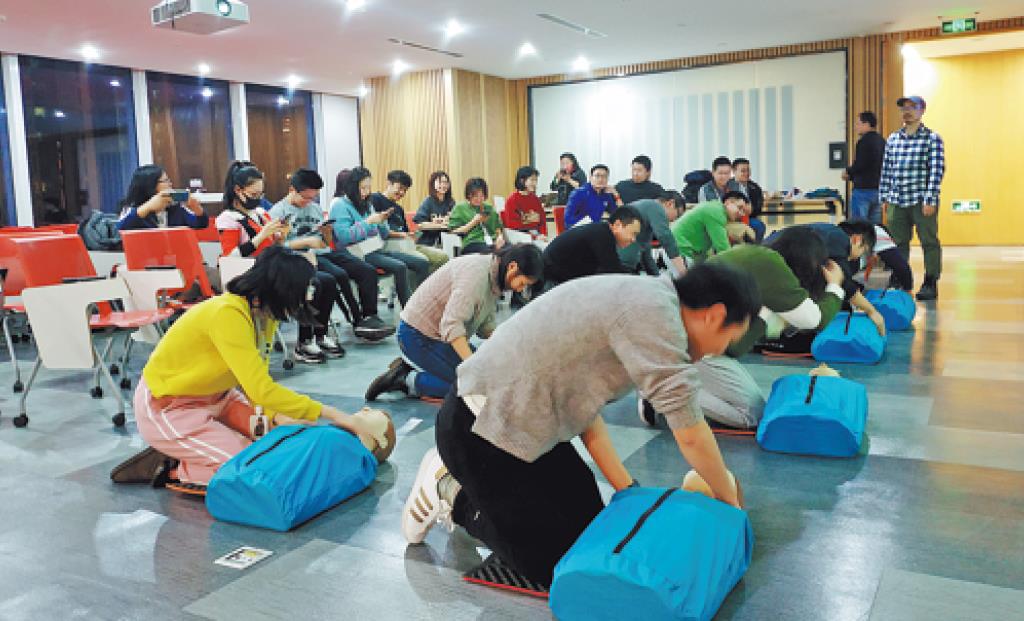
In March last year, Tsinghua University launched three training courses, including lectures on theory and practical exercises on AED use and CPR skills.
Professional trainers taught students basic first aid knowledge, such as how to dress a wound, along with disaster prevention and mitigation techniques.
Under the guidance of professionals, students operated an AED on a training machine and applied CPR on a simulator.
However, the number of such learning channels available to the public is limited.
Liu Yushu, a researcher from the Chongyang Institute for Financial Studies at Renmin University of China, has constantly encouraged people to learn how to use an AED.
"We often joke in the office that whenever someone falls down, colleagues close to that person should be responsible for administering an electric shock," Liu said.
He added that researchers are among those at high risk of experiencing cardiac arrest or a heart attack, especially when they suddenly stand after staying up late for a long period.
However, apart from educating himself by reading articles and watching videos, Liu has not attended any training sessions, because they have not been available.
Civil servant Chen Liyuan, 27, said the best way for her to learn how to use AED is through online platforms such as Bilibili, a leading site in China.
"But I'm still confused even after I've watched the video clips many times," she said. "Also, I don't have anywhere to perform such a task."
She said she would consider signing up for training courses if she could afford them and they were available near her home. Wan and his colleagues from the rescue team have offered first aid training courses to the public for many years.
"We usually have two sessions a week, with around 20 people taking part each time. However, due to the pandemic, we have had to suspend training," he said.
The rescue team has also designed three retraining sessions, focusing on first aid, AED use and CPR, in line with popular courses at the American Heart Association.
Such sessions are for those who have had full training but have forgotten certain skills.
Wan said, "Small social organizations like ours have very limited capabilities, especially in terms of funding and manpower, and there are too many people who need training, such as subway employees and teachers."
He added that he hoped training would be promoted at a higher level to benefit more people.
Chen Zhi, from the emergency center, said society should be aware of the importance of first aid and promote such training systematically, suggesting that it be included in the national education system.
"When kids go to kindergarten, they receive basic first aid training designed for their age. In elementary school, first aid knowledge should be expanded (to more categories). As for middle schools, high schools and universities, they must provide first aid courses and training," he said.
Pei, from Tsinghua University, said she was unable to attend the latest training session, but wants to sign up as soon as another is available.
Regulation enforced
The issue of whether rescuers should bear legal responsibility for any negative consequences resulting from their actions has triggered hot debate.
Article 184 of the general principles of the Civil Law, approved by the National People's Congress, China's top legislature, on March 15, 2017, stipulates that rescuers bear no civil liability if they cause harm to those being rescued.
On Nov 9, Hangzhou, capital of Zhejiang province, became the first city in the country to regulate the configuration and use of AEDs in public places.
The regulation exempts rescuers' from civil liability if they cause harm to a person being helped in an emergency through use of an AED.
Wan said: "More cities throughout the country are being equipped with AEDs. We may encounter more problems in the future, but I believe we can figure them out."






- Tianjin University unveils initiative aimed at developing innovative leaders
- Nanjing Massacre survivors decreases to 23
- China rebuffs criticism over drills around Taiwan
- Mainland pledges deeper cross-Strait integration in 2026 message
- Wuxi marks New Year with cross-cultural symphonic celebration
- Smart trip aid goes live