Offshore wind power efforts gain ground









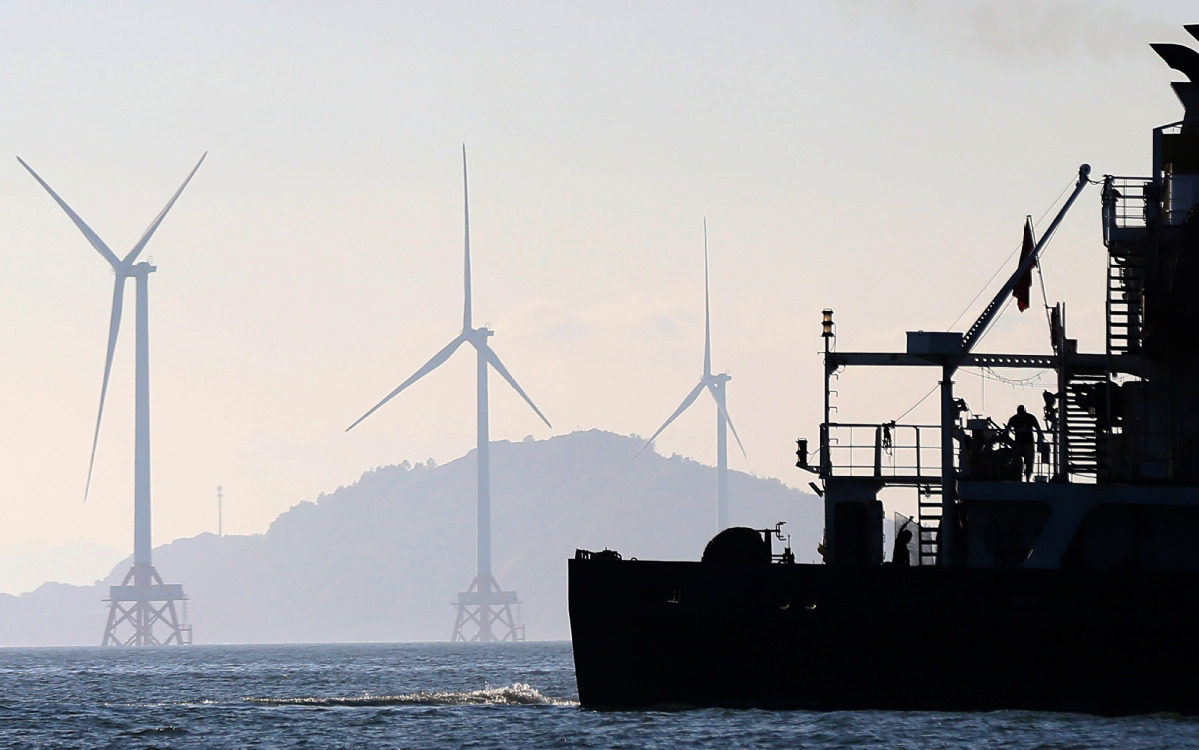
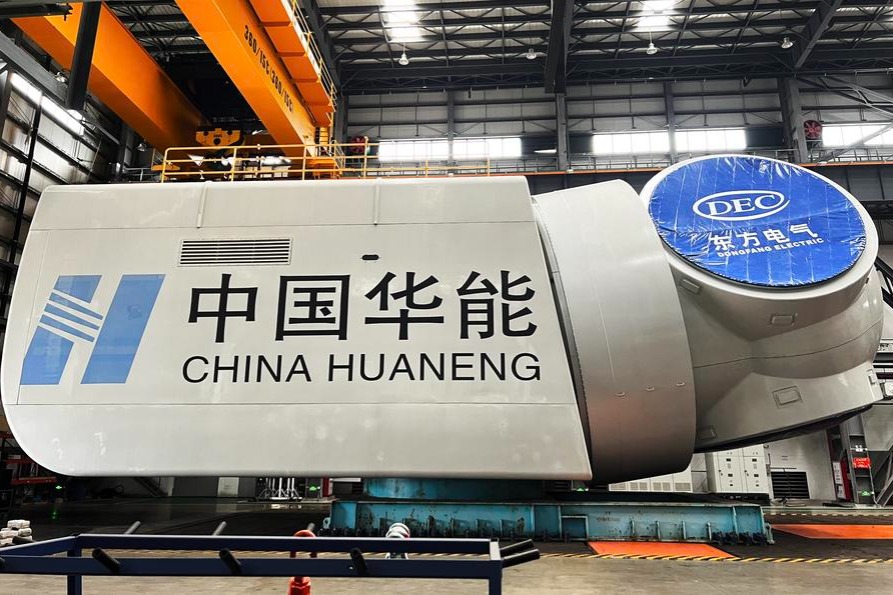
China's offshore wind power, boosted by policy support and improved technology, has been a fast-growing segment over the past few years, and is expected to continue to do so in the next decade, insiders said.
By the end of 2019, the country's accumulated grid-connected installed capacity reached 5.93 million kilowatts, reaching its target a year ahead of schedule. The figure jumped to 7.5 million kW by September, and is set to continue growing in the coming three decades, said the China Association of Oceanic Engineering.
It has also become the third largest offshore wind power country, behind the United Kingdom and Germany. The average cost for offshore wind power projects fell by around 17.5 percent over the past five years, reaching 14,000 yuan ($2,144) to 18,000 yuan per kW, said Zhao Shengxiao, deputy chief engineer with PowerChina Huadong Engineering Corp Ltd.
On the fifth anniversary of the landmark Paris agreement, China is committed to increase its installed capacity of wind and solar power to more than 1,200 gigawatts by 2030 and boost its ratio of non-fossil fuels in primary energy consumption to around 25 percent over the same period. It also pledged to lower carbon dioxide emissions per unit of gross domestic product by over 65 percent from 2005 levels.
While China's first international pledge specifically on renewables capacity is encouraging, to meet its carbon neutrality goals, the sector still needs the right incentives and market-oriented reforms.
Luan Dong, China renewables analyst at Bloomberg New Energy Finance, said that while the country should be able to surpass its 1,200-GW target, without addressing renewable integration bottlenecks, further acceleration will be challenging.
"Bottlenecks mainly surround system flexibility-inflexible coal power supply and interregional transfers," Luan said.
"The other side of this is finding ways to incentivize renewables to firm up output. Apart from mandates to pair renewables with storage at a cost in some provinces, we should come up with more effective mechanisms to attract developers to combine clean energy technologies to proactively reduce fluctuations."
He added that without additional subsidies from the central government for newly installed offshore wind projects from the beginning of 2022, it will be difficult for some operators to make a reasonable profit.
The government is very ambitious regarding its green development plan.
Li Gao, director-general of the Department of Climate Change with the Ministry of Ecology and Environment, said China will give priority to the development of wind and solar power during the next 10 years and encourage regions with geological advantages to develop offshore wind projects.
The government will also enhance policy coordination and reduce nontechnical costs for renewable energy to ensure the grid parity of solar and wind power, Li said.
Even if China faces a series of challenges in realizing established goals, it will still proceed with confidence in the implementation of new measures, he added.
According to a report by the Global Wind Energy Council, China's offshore wind capacity saw the most development last year, and is set to drive global growth in the sector in the coming decade.
China accounted for 40 percent of new global offshore wind capacity in 2019-a record 2.5 GW-51 percent more than the previous year. The country is now home to 23 percent of the world's offshore wind capacity.
Guangdong, one of the provinces in China that had the most newly added offshore wind capacity in the past few years-along with Jiangsu and Fujian provinces-is expected to increase its capacity more than any other region in the coming five years.
Wind power generated off China's coastlines can meet demand from the populated eastern regions, as these areas not only rely on the west-to-east power transmission project, but also are able to provide themselves with sufficient energy, said Liu Jizhen, an academician at the Chinese Academy of Engineering.
The west-to-east power transmission project is an important part of China's resources strategy to transmit power from western areas to power-hungry regions in the east, Liu said.
The rapid development of offshore wind projects off China's eastern shores will further satisfy energy needs in the populous eastern regions, he said.
Liu added that existing offshore wind power projects require further systematic scientific surveys and evaluations as well as top-level designs, equipment research and technological breakthroughs.