New heating project to cut fossil fuel use









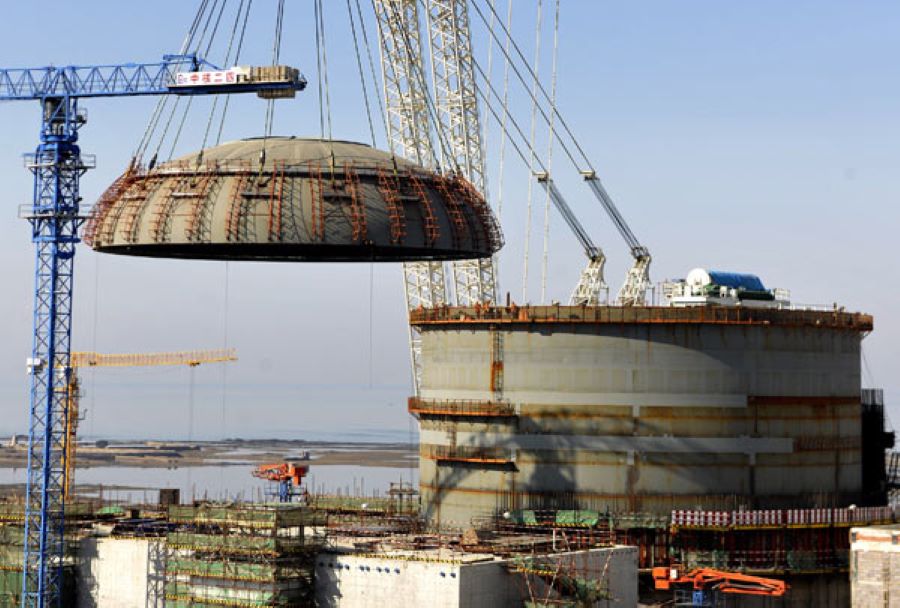
With China's first commercial nuclear heating project expected to provide heat to the entire city of Haiyang, Shandong province, by the end of 2021, the scenario of nuclear powered-heat during winters in northern parts of China along with a reduced reliance on fossil fuels are both likely going forward, insiders said.
Consisting of two AP1000 units capable of heating a total of 700,000 square meters, the pilot project began operating at Haiyang nuclear power plant recently and is expected to eventually provide heating for more than 200 million sq m of housing, said Shandong Nuclear Power Co, a subsidiary of State Power Investment Corp.
The system extracts nonradioactive steam from the secondary circuit of two Haiyang AP1000 units, which is then fed to an offsite heat exchange station to heat water that flows through the municipal heating pipes to residences.
This use of nuclear energy for heating is expected to reduce the burning of 23,200 metric tons of coal annually, cut soot emissions by 222 tons, sulfur dioxide by 382 tons, nitric oxide by 362 tons and of carbon dioxide by 60,000 tons, said the company.
Analysts said compared to traditional thermal sources, nuclear reactors generate heat without carbon emissions and are considered a green replacement for coal-based heat, especially during winter heating seasons.
Wang Shoujun, council president of the Chinese Nuclear Society, said the country's nuclear sector is entering a new period of development, which has laid a solid foundation for the sector's secure and efficient development.
The Haiyang plant has a heating system connected to two traditional nuclear power units, making it the first commercial attempt in China to supply heat from traditional nuclear power, said Wei Hanyang, a power market analyst at Bloomberg New Energy.
But it is only the beginning, Wei said. China is undergoing an approval process for a nuclear-based heating plant in Heilongjiang province, which will be the first inland reactor not connected to a power generator.
Both efforts in Shandong and Heilongjiang underscore China's resolve to decarbonize its energy-intensive heating sector, Wei added.
In addition to SPIC, many other companies are also laying out blueprints for nuclear heating to further replace coal-fired boilers in the country. They are also carrying out a large amount of research and development work on nuclear heating in the country.
China National Nuclear Corp, one of the country's largest nuclear power companies, has already introduced its low-temperature heating reactor DHR-400 to serve residential customers, and the project has been successfully supplying heat to clients for years.
China General Nuclear Power Corp, the country's largest nuclear power operator, has also jointly conducted preliminary work on the construction of a nuclear energy heating demonstration project in China with Tsinghua University.
Russia, Switzerland, Sweden and other European nations have all had nuclear-fueled district heating schemes, and heat from nuclear power plants has also been sent to industrial sites in several countries.
However, planning and site selection, land and water use, emergency plans for crisis management as well as public safety concerns all make nuclear heating a lengthy process, and before the technology is implemented on a large scale, mounting public concerns over nuclear safety following the 2011 Fukushima nuclear disaster in Japan must be addressed.
China's nuclear power plant construction in the coming years is expected to advance steadily and the government is aiming to reduce coal consumption to curb pollution. Therefore, nuclear-based heating alternatives are also likely to be more widely embraced, Wei said.
China has emerged as a top player on the global nuclear power generation stage. It has an advanced nuclear power industry chain including uranium resources exploration, nuclear fuel supply, engineering design and development, engineering supervision, equipment manufacturing, operational maintenance and disposal of radioactive waste.
"More public consultation is needed if nuclear heat is going to be implemented in inland provinces or other ecologically sensitive areas in China," he said.