Companies play major role in boosting sustainable development in Belt, Road









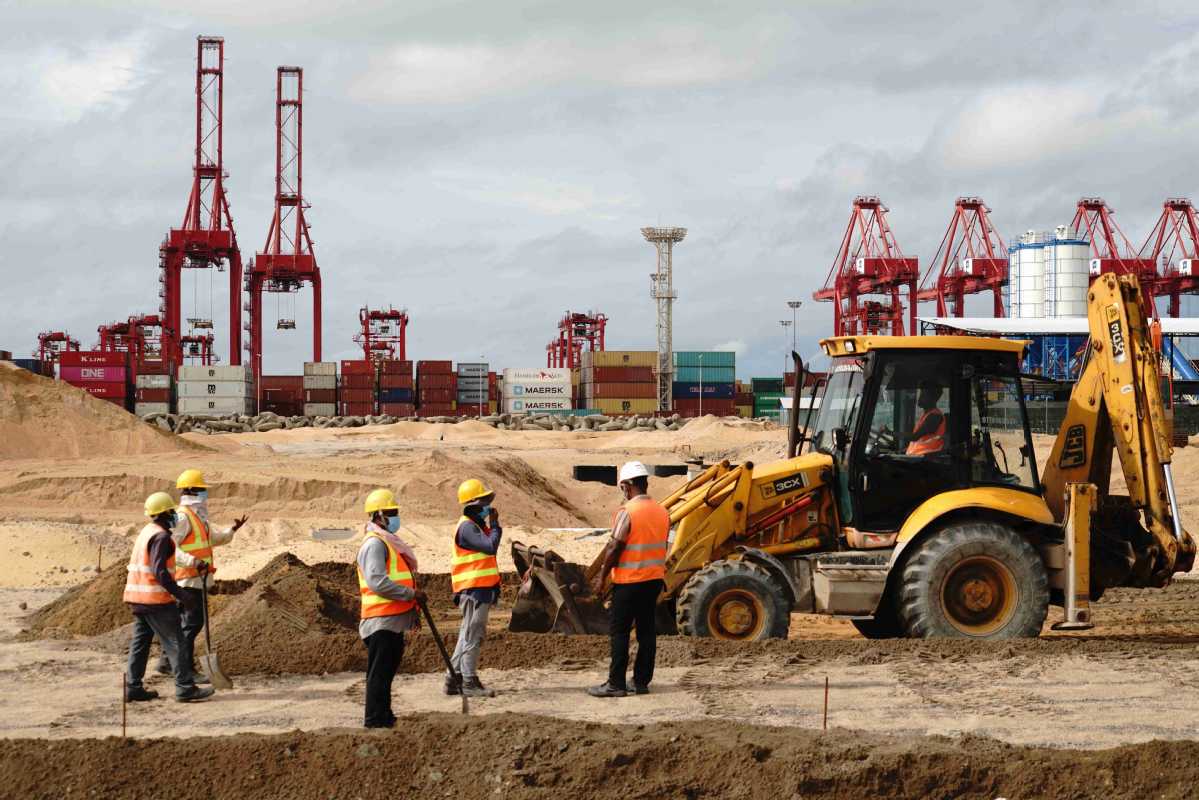
HONG KONG-Some 20 kilometers north of Sri Lanka's Hambantota Port, an extension to the country's Southern Expressway is raised high off the ground for a special purpose-to let wild elephants cross the thoroughfare safely.
The "elephant passage", an eco-friendly design recommended by a Chinese contractor, is one of the many examples that show how Chinese companies work hard to protect the environment and preserve local ecology when constructing projects under the Belt and Road Initiative.
The expressway extension, which began service in February, is significant for Sri Lanka as it connects the established port and airport in Colombo with the new port and airport of Hambantota.
The original plan for the extension project did not include a bridge. However, the realization that the area was frequented by herds of elephants led the Chinese contractor to discuss eco-friendly alternatives with the South Asian nation's Road Development Authority.
The two sides decided to design an elevated bridge which would allow traveling elephants to safely pass underneath the structure.
"In order to reduce the impact of the project on local wildlife, we created the elephant passage," Yang Senyan, a representative from the project's contractor China Harbour Engineering Co, told Xinhua.
Raising the road with viaducts inevitably increased costs, but the efforts paid off. It is now safer for wild elephants to move about in their habitat.
People traveling along the roadway are, if lucky, able to see some of Sri Lanka's 7,500 wild elephants using this corridor to safely cross under the expressway.
As China has made an ambitious aim to have CO2 emissions peak before 2030 and achieve carbon neutrality before 2060, through the framework of the BRI, it is also cooperating with many countries to jointly tackle climate change via green development.
In that sense, while BRI cooperation brings vast development benefits to participating countries, Chinese companies constructing BRI projects also prioritize environmental protection.
In Cambodia, the 400-megawatt Lower Sesan 2 hydropower station is the largest and the seventh one built by China in the Southeast Asian country.
When constructing the hydropower station, the Chinese contractor built a fishway in the dam to facilitate aquatic life to migrate in both directions.
According to the environmental impact assessment of the project, there are 34 kinds of long-distance migratory fish in the area. In order to meet the needs of these fish, the Chinese contractor initiated a proposal to the Cambodian government to build the fishway.
Along the 2.9-kilometer-long fishway, the maximum water level difference between upstream and downstream portions is 26.5 meters. While the bottom width of the fishway is 4-5 meters, rest pools are set every 800 meters to better facilitate the fish along their journey.
On the bank of the dam, a clear stream flows through the woods. The station's fishway significantly minimizes the impact of the energy project on the local ecology.
The fishway is just like a natural river. "This is the way the fish came home," the engineering manager of the project, Nong Zuguan, told Xinhua.
"Cambodia could be an example of how human development can go hand in hand with environmental sustainability," Nick Beresford, the United Nations Development Programme's resident representative in Cambodia, said in a statement last week.
In 2015, China made it clear that when investing in infrastructure, efforts would be made to promote green and low-carbon infrastructure construction and operations.
In Pakistan, energy projects built hand-in-hand with China have involved meticulous considerations regarding emission controls and lowering the impact on the surrounding environment.
As a major investment under the China-Pakistan Economic Corridor, the 1,320-MW coal-fired Sahiwal power plant provides around 6 percent of the total electricity supply in the country.
One important feature about the Sahiwal facility is that it uses advanced technologies to control emissions.
"We were the first company to introduce supercritical technology in Pakistan. It is one of the top coal-fired technologies in the world to generate clean electricity," said Zohaib Hassan, an environmental engineer at plant.
The technology enables the operator to produce more electricity with less coal consumption, and less coal means less emissions. Furthermore, coal used at the plant contains very low mercury and sulfur content.
"We have a system to control various kinds of emissions from the plant. For nitrogen oxide emissions control, we have low NOx burners, whereas sulfur dioxide emissions are controlled by a flue-gas desulfurization system," Hassan said.
Applications of such technologies have enabled the plant to keep emissions well below not only national standards in Pakistan, but also below those in Europe and Japan, Hassan added.
Apart from cutting emissions at coal-fired power plants, China is also helping Pakistan to develop more renewable energy resources.
"China has in recent years been investing in Pakistan under the CPEC in the energy sector with a special focus on producing nonpolluting energy by utilizing clean resources including solar, wind and hydro," said Muzaffar Ali, chairman of the Energy Engineering Department of the University of Engineering and Technology, Taxila.
The CPEC is paving the way for Pakistan to achieve its ambitious target of increasing the share of renewable energy in power generation to 30 percent by 2030 from the current 4 percent, Ali said.