Ancient murals restored in labor of love










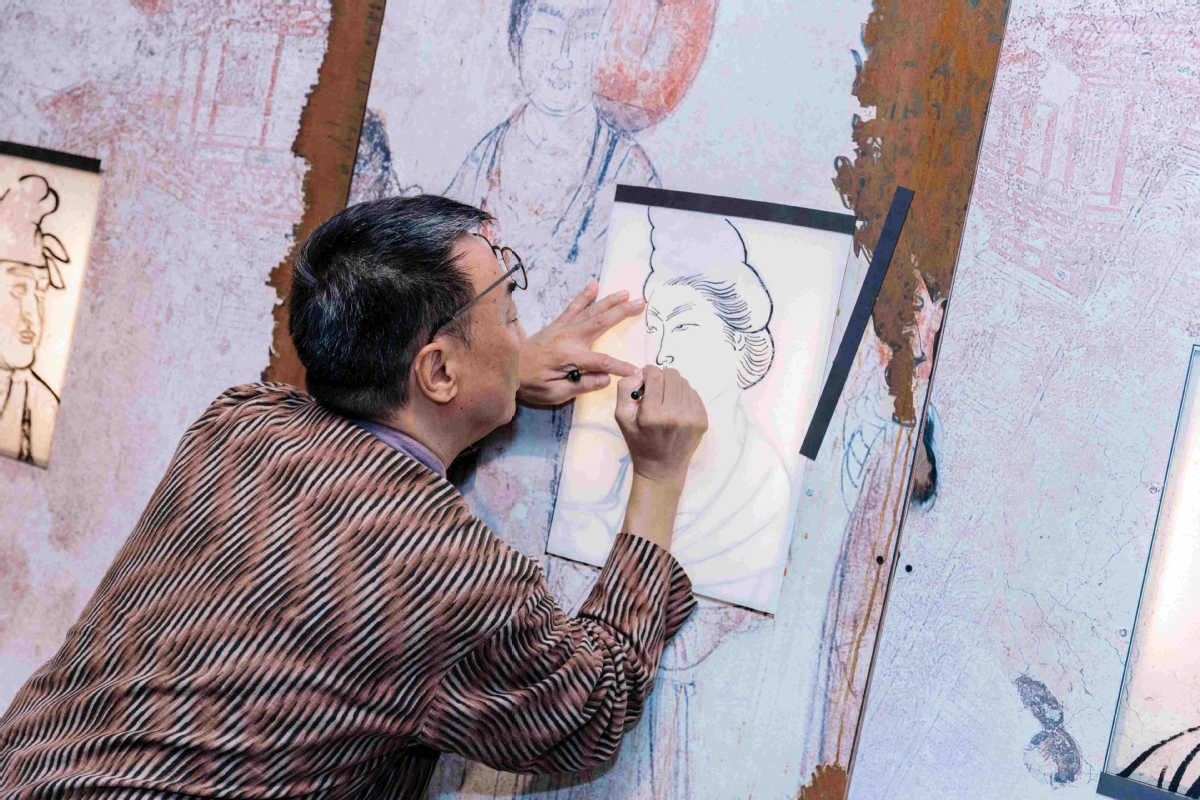
Delicate work requires keen eye for detail
Cloud and mist shroud the magnificent ancient buildings of an imperial palace, with incense permeating the corridors before wafting beyond the city walls.
This magnificently detailed scene forms part of a mural discovered at the Tomb of Prince Yide, the grandson of Emperor Li Zhi and Empress Wu Zetian during the Tang Dynasty (618-907).
The tomb, located in Xianyang, Shaanxi province, is more than 85 kilometers from downtown Xi'an, the provincial capital.
The mural is in a collection that has been housed at Shaanxi History Museum in Xi'an for more than two decades. The museum, situated near Big Wild Goose Pagoda, is one of the best-known in China.
In September, replicas of this mural and more than 40 others from the museum were featured in an exhibition that toured universities in Taipei, Taichung and Taoyuan in Taiwan.
When the display arrived in Taipei, one visitor wrote in the guestbook, "I want to fly to Chang'an (modern-day Xi'an) immediately and enjoy the murals in person."
Liu Jia, a project manager for the Shaanxi Provincial Cultural Relics Exchange Association and a curator for the exhibition, describes the murals as "time capsules".
"They reveal the prosperity during the Tang Dynasty, enabling us to explore, research and verify how politics, society, art and culture developed at the time," Liu said.
The murals are exceptionally popular, she said, adding, "A mural has a trace of mystery due to its fragility, and they are difficult to restore if damaged."
The collection at Shaanxi History Museum, housed in an area of more than 1,000 square meters in the Treasure Hall of the Tang Dynasty Mural Paintings, features more than 600 artworks.
It is China's first collection of Tang Dynasty tomb murals, and the exhibition hall is the country's largest for such artworks. Both the collection and the hall are the result of Sino-Italian efforts to preserve murals.
Before entering the hall, which officially opened to the public on June 20, 2011, visitors must wear shoe covers.
The underground hall is luxuriously decorated and features high-tech equipment such as temperature and humidity controls.
Of the 97 wall paintings on display, 18 murals in five sets have been listed as national treasures by the National Cultural Heritage Administration.
Most of the murals exhibited are from three tombs in the Tang Dynasty, which were owned by relatives of Empress Wu Zetian (690-705), the sole female ruler in ancient China.
Murals found in the tombs were first relocated for restoration work in the 1960s and 1970s.
Yang Wenzong, deputy director of the museum's mural collection base, who has worked at the institution for more than 30 years, witnessed the murals being removed from the tombs. He has also seen the rapid advances made in restoration techniques over the years.
"When we speak about murals from graves, we often refer to them as Tang tomb murals," Yang said. "We've excavated many tomb murals dating to the Han Dynasty (206 BC-AD 220) and such artworks reached their peak in the Tang Dynasty."
The three tombs were owned by princes and princesses from the imperial family during the Tang Dynasty, Yang added. Murals from these graves are rich in color, showcasing the skills of artisans at that time.
"Interestingly, the owners of the three tombs were either killed or committed suicide by imperial order from Empress Wu Zetian, and their mausoleums were later rebuilt by the emperors who succeeded her," Yang said.
There are numerous Tang tomb murals in Xi'an and central Shaanxi.
Yang said there were three types of mural at the time-two of them found above ground and one below. The former was found mainly at grottoes, temples, churches and palaces, and the latter at graves.