


As storied as it is luxurious









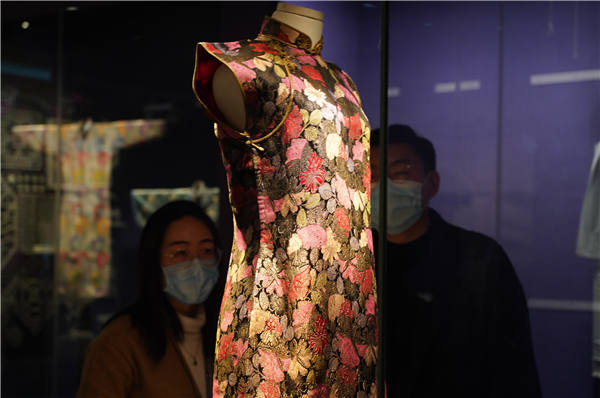
A new exhibition in Shanghai tells of the history of silk and its journey through the world, Zhang Kun reports.
A new exhibition at the Shanghai History Museum tells of the storied past of silk, a fabric which first emerged in China 5,000 years ago, and how this coveted material made its journey to the West along the Silk Road.
The exhibition, which opened on Dec 25, features 139 objects from four museums-the Shanghai History Museum and the Nanjing Museum Administration in Jiangsu province, the China National Silk Museum in Hangzhou, Zhejiang province, and Suzhou Silk Museum of Jiangsu province.
Major cities such as Nanjing, Hangzhou and Suzhou in the Yangtze River Delta were for centuries important silk-making hubs in China, says Zhang Xia, a researcher at the Shanghai History Museum and the curator of the exhibition. Since the 16th century, this region was reputed to be where silk craftsmanship was at its finest.
According to Zhang, the exhibition is divided into three chapters, with the first focusing on traditional Chinese silk art. The oldest exhibit displayed is a piece of brocade with dragon and phoenix patterns from the Warring States Period (475-221 BC). Similar patterns are also found on the bronze and jade objects from the same period, Zhang told the media in a preview of the show.
Aside from examples of ancient Chinese silk art, the exhibition also features representations of sericulture and silk making in painting, literature and historical documents.
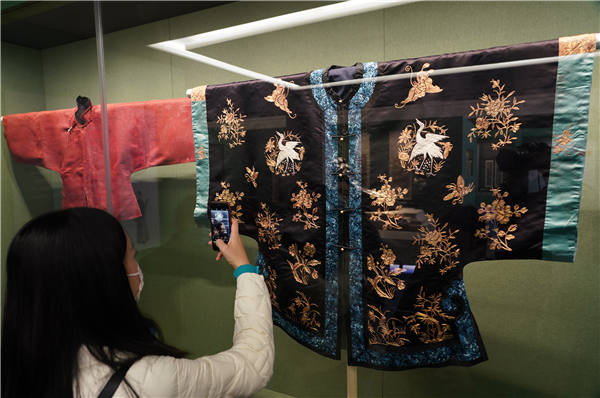
Traditional silk-weaving techniques reached maturity in the Ming (1368-1644) and Qing (1644-1911) dynasties and were primarily found in five silk hubs, all of which are in the Yangtze River Delta region: Suzhou in Jiangsu, Songjiang (today's suburban Shanghai),Hangzhou, and Jiaxing and Huzhou of today's Zhejiang province.
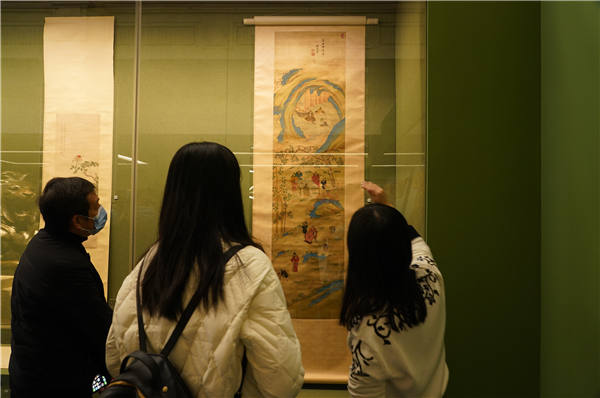
Another exhibit is a Gu embroidery from the collection of the Shanghai History Museum. Donated by Wang Shuizhong from Taiwan, the piece was created using a combination of painting and embroidery on satin. Measuring 1.87 meters long and 45 centimeters wide, this exhibit is a classic example of Luxiangyuan, a celebrated embroidery house of Shanghai in the Qing Dynasty.
Chinese silk was later introduced through central and western Asia into Europe along the Silk Road and became one of the most important commodities traded between China and the West, says Hu Jiang, director of Shanghai History Museum.
After the 12th century, sericulture, silk reeling and weaving were introduced to Europe, Hu says. There, silk developed to maturity in Italy first before France started producing its own silk in the 14th century. Later, the French city of Lyon rose to become the center of the silk industry in Europe. France eventually became the trendsetter of European fashion with its unique style of silk art.
The second chapter of the exhibition features silk art in the West, from the early fabrics found along the Silk Road to the unique styles of France. The design and presentation of this part were made possible with the support of the Musee des Tissus et des Arts Decoratifs in Lyon, France, although the pandemic made it impossible for the French museum to bring its most prized artifacts to Shanghai, Zhang says.
Following the advancement of textile machinery, the outlook of silk art completely changed. Three-dimensional patterns began to appear and the selection of colors became more varied. Photographic tapestries gained great popularity with the invention of the jacquard machine in the 19th century.
The third chapter takes visitors back to China in the late 19th century, when China's pioneering intellectuals shared their perceptions of modern Western civilization and gradually introduced Western industrial systems to China, first in the Yangtze River Delta region.
Shanghai has since become an important textile hub in China, constantly developing new techniques, machines and fabrics that have been influential in the fashion and public spheres in China.
If you go
Weaving in East and West
9 am-5 pm (last entry before 4 pm),Tuesday-Sunday, through March 21. Shanghai History Museum, 325 Nanjing Road West, Huangpu district. 021-6323-2504.