State Grid unit forms JV with CSCEC









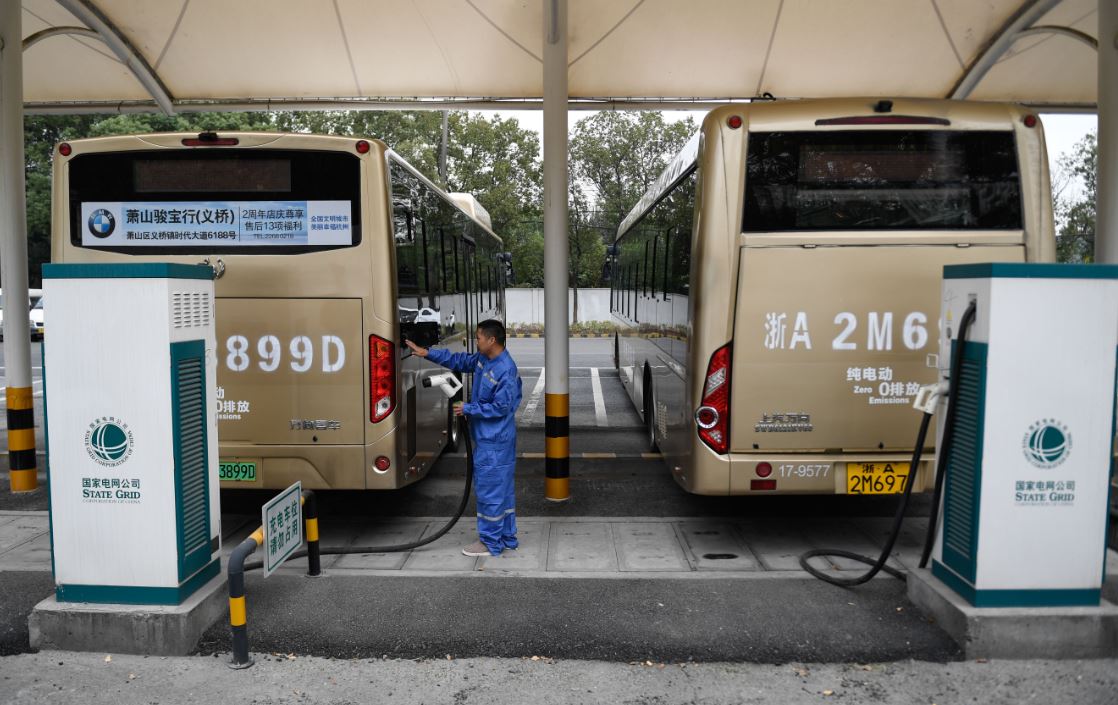
State Grid Electric Vehicle Service Co, a unit of State Grid, set up a joint venture with China State Construction Engineering Corp on Friday to further tap the potential of China's smart charging network for new energy vehicles.
The 50-50 joint venture, Guojian Smart Energy Technology Co Ltd, will take advantage of State Grid's technological advantages of electric vehicle charging and battery swap services and property resources of China State Construction Engineering Corp, to further push forward the country's new energy vehicle supply-side structural reform, said the subsidiary.
Pang Xiaogang, executive vice-president of State Grid, said the company, which offers services to over 1.1 billion people across 26 regions, built 172,000 charging piles by the end of 2020. It has come up with a fast charging network that covers 176 cities and 50,000 kilometers of highways nationwide. State-owned enterprises play an important role in boosting the modernization and stability of industrial and supply chains in the country, he said.
The smart charging network, which aims to promote data-sharing between various charging companies, currently has 1.03 million charging piles, and has effectively functioned as a green transportation platform for more than 5 million electric car users.
State Grid said earlier that the company will continuously focus on core and key technologies and invest more than 80 billion yuan ($12.4 billion) by 2025 on technology research and development to promote the safe and steady operation of the country's power industry and supply chain. Investments in the power grid and related industries during the next five years will exceed 6 trillion yuan, it said.
It will also further its innovation efforts and continue to invest in the country's high voltage, charging pile and new digital infrastructure sectors, unlocking growth opportunities from China's technology upgrade and industrial reforms.
China has the largest electric vehicle fleet globally, which also represents more than 40 percent of global EV sales. According to figures released by the China Electric Vehicle Charging Infrastructure Promotion Alliance, 462,000 new charging facilities were built in 2020, while the public charging infrastructure saw a year-on-year growth of 12.4 percent. The year-on-year growth for public charging infrastructure growth in December was 56.3 percent, it said.
Beijing, Guangdong, Shanghai, and the provinces of Jiangsu, Zhejiang, Shandong, Anhui, Hubei, Henan and Hebei saw the most public charging infrastructures, and accounted for 72.3 percent of the nation's total. Most of charging services are used by buses, it said.
There are nine charging operation enterprises that had more than 10,000 charging piles, including charging network operator TELD, Starcharge and State Grid.
Kou Nannan, head of China research with BloombergNEF's advanced transport sector, said China's EV strategy requires a new business model for EV charging in resident districts. The new joint venture may create the synergy to solve both the grid issue and the construction issue.
"The early EV owners usually have a convenient home charging environment, but as EV penetration rises, it is getting more difficult to install chargers at home. The problem, if not handled well, could hamper EV adoption in the future," he said.
According to Kou, one of the critical reasons that prevents home EV charger installation is that there is not enough grid capacity.
"Most of China's residential building were designed and built without considering EV charging demand, and it is very expensive to upgrade the distribution network as the construction cost is huge in densely populated urban areas. Smart charging is necessary to ease grid constraints," he said.
The Chinese government has stepped up its commitment to actively developing industries including new energy vehicles, along with new infrastructure projects and construction, including 5G and electric vehicle charging stations.
Kou said that he is optimistic about the future charging market in the country as China has included charging networks as one of the seven new infrastructure packages to simulate the post-COVID-19 economy.