Xinjiang's Tacheng touting cleaner heating systems









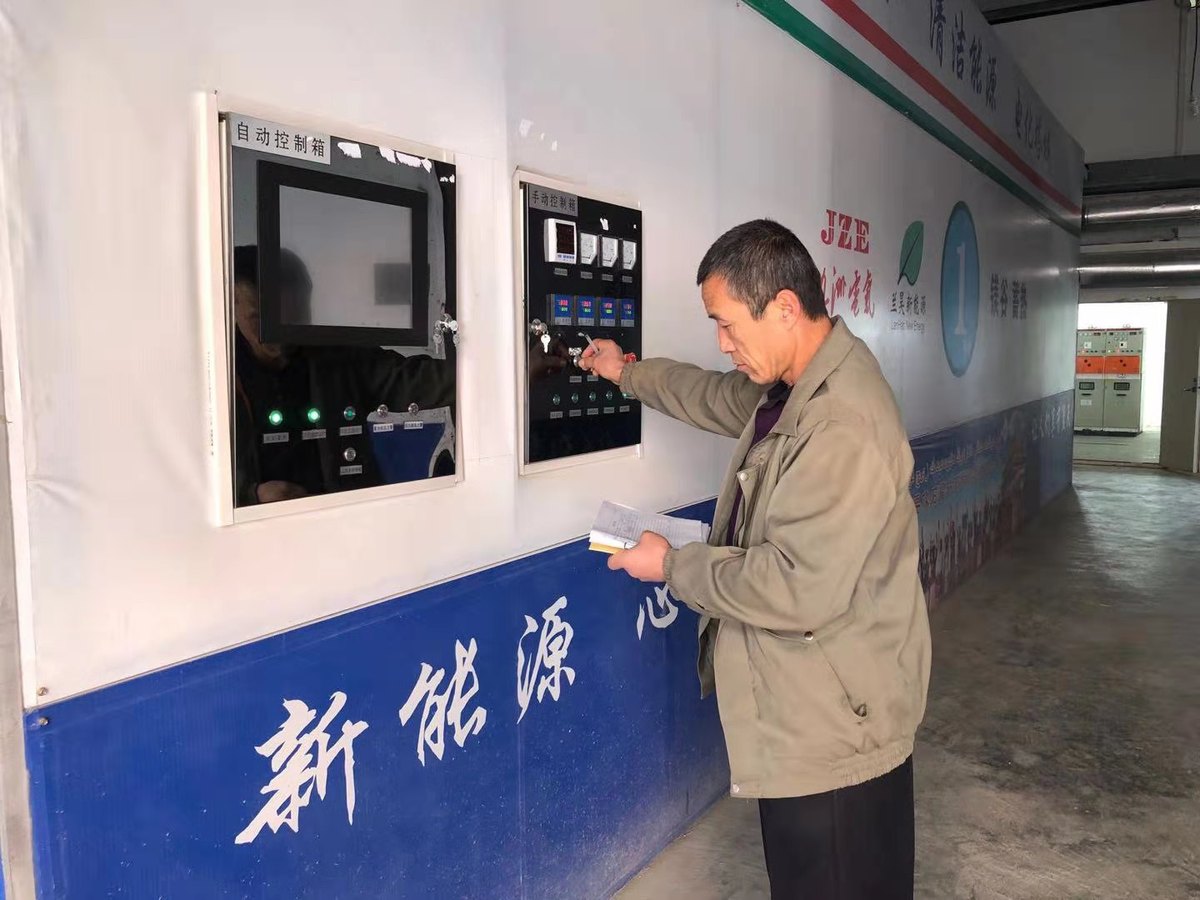
Elshinebal, a 50-year-old farmer in Tacheng, a city in the Xinjiang Uygur autonomous region, used to burn coal for heating and cooking in his suburban bungalow and describes his coal-laden life back then as "dusty".
In August 2019, he moved to a downtown apartment that uses a central heating system supported by an electric thermal storage device. The device collects electricity generated by a combination of wind, solar power and coal for heating, which he said has made his living environment cleaner.
"In the past, I had to mop the floor, covered by coal dust, every day in my kitchen, where I had installed my personal coal boiler," he said. "It was inevitable that sometimes dishes would get a little contaminated by the black dust.
"Not far from my house, I could also see gray smoke from the chimneys of two public coal boilers that supported a neighborhood. Transforming a coal-heating system into an electric one can create a dust-free house and a clean surrounding environment for us."
Wang Yongming, a China General Nuclear Power Corporation engineer, was responsible for a heating project powered by electricity, mainly generated from wind, in Altay prefecture. It was the first of its kind in Xinjiang, and Wang told media outlet Tianshan.com in 2018 that for buildings heated by electricity in a 50,000-square-meter area during the cold season, the project can reduce the use of coal by 1,200 metric tons and cut carbon dioxide emissions by 3,100 tons, effectively lowering air pollution.
Recent data from Tacheng city government showed that structures in Tacheng prefecture heated by electricity cover 1.21 million sq m, and no gas, water or solid waste pollutants are being discharged.
The community where Elshinebal-his full name in the Mongolian language-purchased his new apartment started to adopt the electric thermal storage devices in 2018.
Through a mobile phone application, electricity company workers can adjust the temperature of heating boilers in buildings remotely. Different from traditional coal boilers, the device doesn't need people on duty, the company said.
Elshinebal said he is no longer concerned about inconsistent temperatures because the heat in his apartment is always stable.
"Now, my room temperature remains at 20 C. When I lived in the bungalow, winter nights were a little colder than days because the fire would go out in the coal boiler while I was sleeping," he said.
Moreover, he doesn't have to pay more for the heating system because the electric thermal storage device collects power at night, when electricity is cheaper, over a 10-hour period, and the amount it collects is enough to provide heat for 24 hours.
During the city's cold season, from October to April, Elshinebal pays about 2,200 yuan ($339) to heat his 100-sq-m apartment. At his former house, he used to pay more than 3,000 yuan to buy coal for heating during the period.
A private electricity company headquartered in Harbin, Heilongjiang province, set up and operates the project amid a campaign to promote electrical heating in Tacheng city. Heilongjiang is one of several provinces assigned by the central government to assist Xinjiang's development by providing the region with necessary resources.
The company, which did not want to be named, said that it is expanding its adoption of wind energy in Tacheng city to better power the electric thermal storage devices together with coal.
The campaign aims to reduce pollutants from various sources, including heating devices and vehicles, by improving electricity consumption in the city's energy consumption structure and enlarging the proportion of renewable energy in electricity generation.
China will strive to hit peak carbon dioxide emissions before 2030 and achieve carbon neutrality before 2060, President Xi Jinping announced at the United Nations Summit on Biodiversity in September.
At the Climate Ambition Summit, which concluded in December, Xi said, "Guided by our new development philosophy, we will promote greener economic and social development in all respects while pursuing high-quality development."
Hao Haohong, a senior Tacheng prefecture government official in charge of energy and industry development, said that the quality of wind energy resources in the prefecture is good, but consumption is a problem.
"Electricity volume that depends on wind speed is unreliable," he explained. "The inconsistent power cannot support agricultural or industrial production well, but it can be transformed and stored as heat energy and provide heating service.
Likening the heat storage device to a reservoir, he added that the device can also solve the wind energy waste problem because people use little electricity for production at night and most wind energy generated at night is not used.
By December, Tacheng prefecture had generated 2.5 billion kilowatt-hours from renewable energy, accounting for more than 30 percent of power generation in the area, the prefecture government said.
Tacheng prefecture's development and reform commission plans to reduce the use of as many coal-fired boilers as possible in the area and switch to electric ones.
The commission said it will be harder to promote electric heating systems in old neighborhoods and in suburbs due to renovation difficulties.
However, it added that electric heating and renewable energy will be a future trend and a major government task, and that it will create more models for surrounding counties and cities to follow.



- China launches Lijian 1 Y9 carrier rocket
- First cross-border event debuts at the National Games
- China Focus: National Games enhances coordination under 'one country, two systems'
- China's Fujian aircraft carrier to make regular appearances on high seas: spokesperson
- A decade of dialogues
- HK: a stage for art and cultural dialogue