


Flowing through time









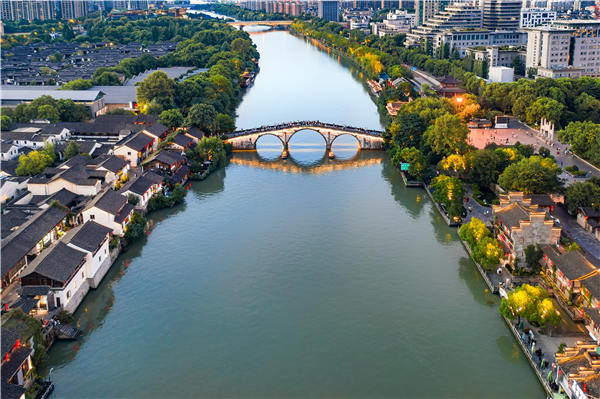
An exhibition reveals how history has navigated the course of the Grand Canal network over the ages, Lin Qi reports.
Editor's note: President Xi Jinping, who is also general secretary of the Communist Party Of China Central Committee, said in 2017 that the Grand Canal is a precious legacy passed down by our ancestors. Culture flows along the waterway, he said, and the watercourse should be protected, inherited and used. In 2019 and 2020, the State Council and various ministries released a series of guidelines to protect and rejuvenate the 2,500-year-old world wonder. China Daily journalists explore the waterway's glorious past, rich legacy and future prospects.
Esteemed 11th-century writer and poet Qin Guan described a serene night in his poem, Han Gou: "Frost brings a chill to Han Gou, and the water looks quite clear; on such a freezing night, a myriad stars light up boats. Deep from the dense water plants come, surprisingly, the sounds of words and the laughter of people."
Han Gou, a canal in today's Jiangsu province, ran across Qin's native city of Gaoyou. It was dredged in the late fifth century BC around a walled city in the state of Wu during the tumultuous Spring and Autumn Period (770-476 BC).
Fuchai, who was then the king of Wu, ordered the construction of Han Gou to connect the Yangtze and Huaihe rivers to the north to facilitate the transportation of soldiers and military supplies.
Han Gou was one of China's earliest known canals and was the precursor to the Grand Canal network.
By the time Qin, who lived in the Northern Song Dynasty (960-1127), wrote the poem, the Grand Canal, which included several artificial waterways that were extensions of Han Gou, had played a strategic role in connecting the country's north and south to ensure political stability, economic prosperity and cultural infusion throughout several dynasties.
The weight of history Qin felt that night at Han Gou continues to touch people today. They appreciate his poem, which is printed on a wall at the National Museum of China in Beijing, which also displays a bronze sword believed to have been used by Fuchai that was unearthed in Anhui province in 1976.
These are being shown at the exhibition, Paddling for A Thousand Miles, until March 1, to hail the storied history of the 3,200-kilometer-long Grand Canal.
The vast conglomeration of artificial waterways-about half of it still functioning today-running through the extensive central-eastern and northern-eastern plains of China was inscribed as a UNESCO World Heritage site in 2014.
Chief curator Zhao Yong says it wasn't easy to organize the show to trace the monumental project's history.
The exhibition presents over 170 artifacts from the collections of the National Museum, the Capital Museum in Beijing, Tianjin Museum, Hebei Museum in Shijiazhuang and several other cultural institutions.
It employs digital technology, such as an animation that simulates the bustling transportation and social life along the waterways.
The displayed objects show how various sections were excavated, what roles these different channels played, how cargo, especially of national importance, such as grain, was guarded and how the construction advanced engineering, shipping management and cultural diversity.
The animation, which is based on a picture book titled China Through Time: A 2,500-Year Journey Along the World's Greatest Canal, published by Encyclopedia of China Publishing House and DK Publishing, is displayed on a three-meter-high and 25-meter-long screen.
Shangguan Tianmeng, the exhibition's chief visual designer, says: "The display tables and platforms are curved to resemble waves. This, along with lighting, creates an atmosphere as if viewers are walking along a waterway as they navigate the Grand Canal's past."